
You've just retiled your kitchen floor, and now the old corded vacuum barely reaches the far end of the room without you shuffling furniture out of the way first. The cord catches on chair legs, the suction seems inconsistent on smooth tile, and you're already wondering whether a cordless upgrade would make the whole process faster and considerably less frustrating. Shopping for a cordless vacuum for tile floors in 2026 means navigating dozens of options at every price point — so this guide reviews seven of the strongest contenders and tells you exactly what each one does well and where it falls short.
Tile floors are one of the trickier surfaces to vacuum effectively, because fine dust and pet hair tend to scatter when a stiff bristle roll passes over them, pushing debris forward rather than pulling it into the bin. Grout lines compound the problem, trapping grit and hair in recessed channels that require focused, consistent suction to clear properly. A quality cordless vacuum for tile needs a purpose-built soft roller head, enough airwatts to handle heavier debris without losing grip, and a runtime long enough to cover your full floor plan on a single charge. If your home includes a mix of tile and laminate, our guide to the best vacuum for laminate floors covers many of the same models from a different angle and is worth reading alongside this review. You'll find all of these picks and more in our cleaning category, where we update reviews regularly as new models hit the market.
The seven vacuums reviewed here range from Dyson's flagship V15 Detect Plus to the budget-friendlier Dyson V8, the innovative LG Cordzero Q3, the vacuum-mop hybrid Bissell CrossWave Cordless Max, the ultra-maneuverable Dyson Omni-Glide, and the precision-engineered Miele Triflex HX1. Each has been assessed on suction performance on hard floors, head design suitability for tile, battery life, filtration quality, and overall value for the price in 2026. Read through the full breakdowns below, use the buying guide to zero in on the specs that matter most for your situation, and check the FAQ section for answers to the questions we hear most often from tile-floor owners.
Contents


The Dyson V15 Detect Plus is the most technologically advanced cordless vacuum Dyson currently makes, and on tile floors it earns that status convincingly. The Fluffy Optic cleaner head uses a precisely angled green laser to illuminate microscopic dust particles that are completely invisible under normal lighting conditions — fine debris you'd otherwise pass over without knowing it was there. That real-time visibility changes how thoroughly you clean, because you can actually confirm coverage rather than guessing. The piezo sensor system counts and classifies particles by size, displaying results live on the LCD screen, so you get objective feedback on how much your floor actually needed vacuuming and whether you've cleared it adequately. The Digital Motorbar head is included as a second cleaner head for carpets and mixed-floor transitions, which makes the V15 a genuine whole-home machine rather than a specialist tile tool.
Suction is rated at 240 AW — the highest in Dyson's current cordless range — and the motor spins at up to 125,000 rpm. On tile, that translates to confident pickup of everything from fine flour dust in the kitchen to coarser debris tracked in from outside, even in grout-line channels that shallower suction struggles to clear. Up to 60 minutes of runtime is available in Eco mode, which handles light tile maintenance efficiently. Boost mode, at the other extreme, depletes the battery in approximately 5 minutes, so you'll use it selectively on stubborn spots rather than for full-room passes. The wall dock keeps the vacuum and its two cleaner heads and four attachments organized and charged between uses, which is a small but genuinely practical quality-of-life feature.
The V15 Detect Plus has two real drawbacks worth naming plainly. First, the price is at the absolute top of the cordless vacuum market — if budget is a meaningful constraint, the performance gap between the V15 and a V8 or V12 won't justify the price difference for most tile-only households. Second, the dust bin is relatively compact compared to full-size upright machines, so on large tiled floor areas with heavy soiling, you may be emptying it mid-session. That said, if you want the most capable hard-floor cordless vacuum available in 2026 and you're willing to invest accordingly, the V15 Detect Plus is the benchmark against which everything else in this category is measured.
Pros:
Cons:
The Dyson V12 Detect Slim Absolute takes the laser dust-detection technology from the V15 and puts it into a noticeably lighter, slimmer form factor that's built for homes where maneuverability matters as much as raw suction power. In kitchens, bathrooms, and tiled hallways where you're constantly navigating chair legs, cabinet bases, toilet bases, and doorframes, that reduced bulk translates directly into a more comfortable daily cleaning experience. The precisely angled laser makes invisible dust visible on hard floors, illuminating fine particles against the tile surface so you can see exactly where you need another pass — the same core technology as the V15, delivered in a machine that's meaningfully easier to handle in tight quarters. The LCD screen displays a live particle count and categorizes debris by size, which is a genuinely useful indicator of how clean your floor actually is after each pass.
Single-button power control is a design choice that sets the V12 apart from most cordless vacuums that require you to hold the trigger throughout the cleaning session. On extended whole-home runs across large tiled areas, that trigger-free operation reduces hand fatigue noticeably, especially if you're switching hands to reach awkward corners. The Slim Absolute includes a full set of attachments for above-floor cleaning — reaching ceiling fans, upholstery, and crevices — so it functions as a complete home cleaning system rather than a floor-only tool. Maximum suction is lower than the V15, rated at approximately 150 AW, but for tile floors in standard household use, that suction ceiling is more than adequate for everyday dust, fine debris, and pet hair pickup.
The trade-off for the slimmer, lighter build is a reduced dust bin capacity and somewhat lower maximum power than the V15. For heavily soiled tile or a kitchen that sees serious cooking debris, you'll notice the suction ceiling faster than you would with the V15's 240 AW motor. But for the large majority of tile floor households doing regular weekly maintenance, the V12 Detect Slim Absolute is one of the most balanced and refined options in Dyson's current range — it pairs laser-guided intelligence with an ergonomic package that makes cleaning feel noticeably less like a chore.
Pros:
Cons:
If the V12 or V15 sits beyond your budget but you still want the engineering reliability that Dyson is known for, the Dyson V8 is the model where that value proposition lands most convincingly. It doesn't offer laser detection or particle counting, but it delivers 115 AW of suction through a Motorbar cleaner head that handles tile, hardwood, and low-pile carpet without requiring you to swap attachments at every surface transition. The Motorbar head actively de-tangles long hair and pet fur as it cleans, pulling wrapped strands free from the brush roll so they're captured rather than redistributed — a practical feature for households with pets or long-haired family members who move through tiled living spaces daily.
Up to 40 minutes of fade-free runtime in standard mode is enough to cover most single-story tiled homes on a single charge, though Max mode reduces that to approximately 5 minutes, so you'll use it selectively on stubborn spots. Three above-floor attachments — an upholstery nozzle, crevice tool, and mini motorized tool — cover the most common cleaning scenarios beyond the floor, and a wall dock and charger are included to keep everything organized between sessions. Converting to handheld configuration takes seconds and makes stair cleaning, furniture, and car interiors genuinely accessible. For buyers who are trying to assess where the V8 sits in the broader budget landscape, our overview of vacuums under $200 gives useful context on competitive options at lower price points.
The V8's honest limitations are its suction ceiling and its lack of laser detection. At 115 AW, it handles tile cleaning confidently in everyday conditions but may fall short on deeply packed grout debris or heavily soiled surfaces after extended neglect. Without the laser head, you're relying entirely on visual inspection to confirm complete coverage — which works fine for experienced cleaners but removes the precision reassurance of the V12 and V15. That said, for a household that wants Dyson's build quality and engineering on a more accessible budget in 2026, the V8 delivers a genuinely solid tile floor cleaning experience without cutting corners on the fundamentals.
Pros:
Cons:
The LG Cordzero Q3 takes a noticeably different approach from the Dyson models in this review by incorporating built-in sensors that automatically detect whether you're cleaning tile or carpet and adjust suction power for each surface without any manual input required. For homes where tile and rugged area rugs share the same open-plan space — a kitchen that flows into a dining room with a large woven rug, for example — that seamless automatic adjustment removes one more decision from an already repetitive task. The Dual Floor Max Lite nozzle combines a soft roller for hard surfaces and a carpet agitator in a single head, so you never need to stop and swap attachments as you move through a mixed-floor space. Up to 150 AW of suction is delivered through a Smart Inverter Motor, and the 15-cyclone separator system helps maintain that suction performance over time by preventing filter clogs — a practical engineering choice that protects long-term performance.
Built-in LED headlights illuminate dark corners and the spaces beneath kitchen cabinets, appliances, and furniture, which is particularly valuable on tile floors where fine dust collects in low-light zones near baseboards and in shadow. A 5-step filtration system captures fine particles before they can be recirculated into the room's air during cleaning, making the Cordzero Q3 a thoughtful choice for households with allergy or asthma concerns. Pet hair management is built into the dual-nozzle design with hair minimization technology that reduces tangles during use, so you're not stopping to manually clear the brush roll mid-session. The beige colorway is a refreshing departure from the typical black-and-silver aesthetic that dominates this product category, and it reads well in modern kitchen and living room environments.
The auto-detect surface sensing is the Cordzero Q3's most compelling differentiator, and in practice it works reliably — transitioning across the tile-to-rug boundary happens without any hesitation or manual mode switching. Specific runtime data in standard cleaning mode should be verified on the current Amazon listing before purchase, as confirmed independent reviews are still accumulating for this model. Overall, the LG Cordzero Q3 is a sophisticated, intelligently designed option for buyers who want automation built into their cleaning tools rather than having to think about surface transitions each time they move between rooms.
Pros:
Cons:
The Bissell CrossWave Cordless Max is categorically different from every other product in this review — it's not just a vacuum but a combined cordless vacuum and wet mop in a single machine, which makes it uniquely compelling for tile-floor owners who want to eliminate the separate mopping step entirely. On tile specifically, vacuuming and mopping simultaneously is a natural workflow match: the machine picks up dry debris with suction while the mop pad cleans the surface with solution in the same pass, and Bissell's Two-Tank Technology keeps fresh and dirty water completely separate throughout the process so you're applying clean water to the floor throughout rather than spreading increasingly grimy liquid as you go. Up to 30 minutes of cordless runtime is available, which covers most kitchens, bathrooms, and tiled hallways in a standard home comfortably.
The Self-Cleaning Mode is one of the CrossWave's most practical features in day-to-day use — after your cleaning session, you run the machine briefly over its docking tray, which flushes out debris and freshens the brush roll without requiring manual disassembly. That simplicity makes post-session cleanup feel far less burdensome than competing wet-dry combo systems that require more hands-on maintenance. Multi-surface versatility extends to sealed hardwood, laminate, and area rug refreshing, though the CrossWave's vacuuming performance on pile is secondary to its hard-floor focus — it isn't a replacement for a dedicated vacuum if carpeting makes up a large portion of your floor plan. Cleaning formulas are included in the box, so you can start using it immediately after unboxing without a separate supply run.
The 30-minute runtime is the CrossWave's most significant practical constraint. For larger homes with extensive open-plan tile coverage across kitchen, dining, and living areas, you may find yourself needing a second charge to complete the full circuit — which interrupts the workflow momentum that makes the combo approach so appealing. If you're coming from a home where vacuuming and mopping tile are currently two completely separate steps in your routine, the CrossWave Cordless Max delivers a genuine and measurable efficiency gain by collapsing those two steps into one, and for tile-primary households that's a compelling argument in 2026.
Pros:
Cons:
Dyson designed the Omni-Glide specifically and exclusively for hard floors, and the difference in approach shows immediately in the way the machine moves. Weighing less than 5 lbs, it features an omnidirectional fluffy cleaner head that pivots in any direction — forward, backward, and sideways — which makes navigating around chair legs, appliance bases, bathroom fixtures, and irregular furniture arrangements dramatically easier than with a conventional vacuum head that only moves in two directions. The fluffy barrel roller captures fine dust and lightweight debris on tile without scattering it across the surface, and the slim profile allows the machine to slide beneath furniture that most cordless vacuums simply cannot reach. For homes where under-cabinet and under-furniture zones accumulate tile dust between deeper cleaning sessions, the Omni-Glide's reach is a meaningful practical advantage.
Dyson positions the Omni-Glide explicitly as a between-clean tool — something you pick up daily or every other day to maintain tile floors between your weekly deep-cleaning session with a more powerful machine, rather than as your primary heavy-duty vacuum. At under 5 lbs, the effort required to use it is genuinely minimal — you can do a quick kitchen sweep in 10 minutes without any meaningful physical commitment, which is exactly the kind of friction reduction that makes daily maintenance habits stick. If you're exploring compact supplementary tools that pair well with a main stick vacuum like the Omni-Glide, the best handheld vacuums guide covers portable add-on options worth considering for furniture, stairs, and car interiors.
The Omni-Glide's limitations are worth stating clearly: it doesn't have the suction muscle for deep cleaning, its dust bin is small, and runtime is shorter than the V8, V12, or V15. If you have pet hair accumulation in tile grout, heavy kitchen debris after cooking, or tile that hasn't been vacuumed in several days, this machine will reach its limits before the floor is fully clean. But for daily light maintenance and quick touch-ups on hard floors — especially in spaces where the combination of low weight and directional freedom matters more than suction power — the Omni-Glide is a uniquely well-suited tool that no other model in this review replicates.
Pros:
Cons:
Miele has spent decades building a reputation for corded vacuum engineering that outlasts and outperforms competitors, and the Triflex HX1 is the company's most ambitious effort to bring that same standard of quality to the cordless market. The patented 3-in-1 design is the machine's structural signature: it switches between Comfort mode as a traditional upright stick vacuum, Reach mode with the motor unit repositioned for extended-pole access to high shelves and beneath furniture, and Compact mode as a handheld for upholstery and stairs. That configuration flexibility means you're genuinely getting three tools in one package rather than the single-mode approach most cordless vacuums offer. Cleaning performance is rated equivalent to Miele's most powerful corded vacuum series, and on tile floors that claim holds up in everyday use — suction is consistent across a full cleaning session without the fade that some competitors show toward the end of a battery cycle.
The replaceable VARTA lithium-ion battery provides up to 60 minutes of runtime, which matches the Dyson V15 at the top of the range, and the replaceable design means you can purchase a spare battery and double your continuous cleaning capacity — a meaningful practical advantage for very large homes with extensive tile coverage across multiple floors. Included accessories cover the core cleaning scenarios: a wall-mount bracket, SPD 20 upholstery nozzle, and crevice nozzle for tight spaces and grout lines. The HEPA-standard filtration that Miele's corded line is known for extends to the HX1, capturing fine particles that cheaper filtration systems allow to pass back into the room — a meaningful benefit on tile floors where fine dust is easily disturbed and recirculated during vacuuming.
The Miele Triflex HX1 occupies a different philosophical space than the Dyson models — it's less focused on technology features and more focused on long-term reliability and engineering precision. There's no laser detection, no particle counter, and no auto-detect surface sensing — what you get instead is a machine built to perform consistently over years of regular use, backed by Miele's service network and their reputation for build durability that often surpasses competitors in longevity testing. If your priority is a cordless vacuum you'll still be using in seven or eight years without a degraded cleaning experience, the Triflex HX1 makes a case that premium brands often overlook: sometimes the most important spec isn't suction or smart features, but how long the machine keeps working as advertised.
Pros:
Cons:
The cleaner head is the single most consequential factor for tile floor performance, and it's worth understanding the differences before you commit to a purchase. Soft roller heads — like Dyson's Fluffy and Fluffy Optic designs — use a barrel-shaped fabric roller that captures both fine dust and larger debris simultaneously without pushing it forward across the tile surface. Standard stiff bristle brush rolls scatter fine particles on smooth hard floors, which is why purpose-built hard-floor heads make such a measurable difference to the actual quality of your cleaning pass. Motorbar-style heads, which Dyson uses on the V8 and V15, are primarily optimized for carpet performance but handle tile well due to their strong suction and hair de-tangling systems — they're more versatile across floor types but less specialized for tile than a dedicated Fluffy-style roller.
If your home is predominantly tile with occasional area rugs, prioritize a vacuum that includes a dedicated soft roller as the primary cleaning head, with a motorized attachment available as a secondary option for deeper carpet passes. If you have a genuinely mixed home with equal proportions of tile and wall-to-wall carpet, a strong motorbar head with high AW suction may serve your total floor coverage better than a tile-optimized soft roller paired with a weaker secondary head.
Airwatts (AW) measures the combination of airflow and suction pressure that translates into real-world cleaning performance — it's the most useful single metric for comparing cordless vacuums honestly. For tile floors, where debris sits on a smooth surface rather than embedded in pile, you don't necessarily need the highest AW rating on the market. Fine kitchen dust, pet hair, and tracked-in grit on tile respond well to 100–150 AW applied through the right head design, and excessive suction can actually make a vacuum harder to push smoothly across tile because the head seals too firmly against the floor. For most tile-primary households, 100–150 AW represents the practical sweet spot — the Dyson V8 at 115 AW and the LG Cordzero Q3 at 150 AW both sit in this range and handle standard tile cleaning tasks effectively. The Dyson V15 at 240 AW is most valuable when you're dealing with heavily soiled grout, high-traffic debris, or frequent transitions between tile and deep carpet pile in the same session.
Quoted battery runtimes on cordless vacuums are almost always measured in Eco or minimum-power mode, which means the real-world figure in a balanced cleaning mode will typically run 20–30% shorter than the headline number. A model claiming 60 minutes of runtime will usually deliver 40–50 minutes of practical use at the moderate suction level most people use for standard tile maintenance. For a single-story home with tile in the kitchen, bathrooms, and hallways, 35–40 minutes of effective runtime is generally enough for a complete circuit. For larger homes with open-plan tiled living areas or multi-floor layouts, look for models with genuine 60-minute claimed runtimes — the Dyson V15, V12, and Miele Triflex HX1 all sit in this range. Replaceable battery designs like the Miele Triflex HX1 allow you to purchase a spare and extend continuous runtime without waiting for a full recharge cycle, which is a practical solution for very large homes.
Tile floors often feel cleaner than carpet to allergy sufferers precisely because they don't trap particles in pile — but vacuuming tile with weak filtration can actually make air quality worse during the cleaning process, recirculating fine dust and allergens through the machine's exhaust while the brush collects them from the floor. Multi-stage filtration that captures particles down to 0.3 microns is the threshold for meaningful allergen capture — that's fine enough to collect pet dander, dust mite fragments, and common pollen. The LG Cordzero Q3's 5-step filtration system with 15-cyclone pre-separation is designed to keep filters cleaner over time by removing most particles before they reach the filter stage, which protects suction performance as well as air quality. The Miele Triflex HX1 carries Miele's filtration standards forward from their corded line. All models in Dyson's V-series use whole-machine sealed filtration that prevents dust from escaping through gaps in the body — worth confirming when evaluating competing brands that may seal the filter stage but not the full machine.
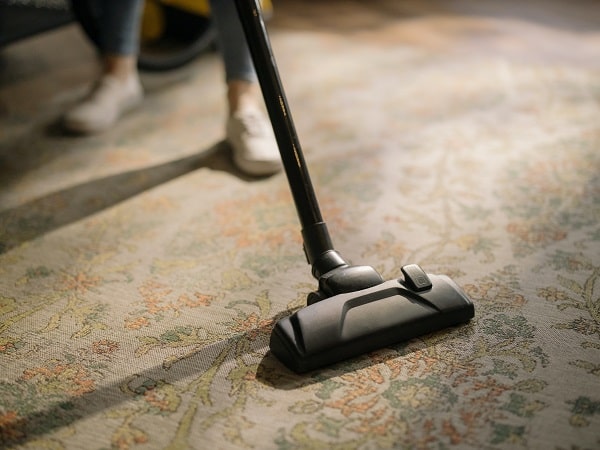
The most important factors are cleaner head design, suction consistency, and filtration quality. Tile floors respond best to soft roller heads — like Dyson's Fluffy and Fluffy Optic designs — that capture fine dust without scattering it forward across the surface. Standard stiff bristle rolls tend to push lightweight particles ahead of the head rather than pulling them into the bin, which is why purpose-built hard-floor designs make a measurable difference. Good filtration matters as well, because fine tile dust that bypasses a weak filter gets recirculated into your room's air during the cleaning process itself.
For a typical single-story home with tile in the kitchen, bathrooms, and hallways, 30–40 minutes of real-world runtime in a balanced cleaning mode is usually enough for a complete session. If you have an open-plan home with large tiled living and dining areas, or a multi-story layout where you're cleaning different floors in a single session, aim for a model with at least 45–60 minutes of quoted runtime — recognizing that the real-world figure at moderate power will be somewhat shorter. The Dyson V15, V12, and Miele Triflex HX1 all offer up to 60 minutes in their most efficient modes, making them suitable for larger tile floor plans.
For buyers who prioritize tile floor performance above all else, Dyson's Fluffy and Fluffy Optic cleaner heads are the most purpose-built hard-floor vacuum tools on the consumer market in 2026 — and those heads are only available on Dyson machines. The laser dust detection on the V12 and V15 adds a layer of cleaning confidence that's difficult to replicate without it. That said, the Dyson V8 at a lower price point handles tile competently without those features, and the LG Cordzero Q3 and Miele Triflex HX1 are strong non-Dyson competitors that justify their own pricing on different merits.
Most of the models in this review handle both surfaces, though some transition between them better than others. Dyson models that include both a Fluffy head and a Digital Motorbar head — like the V15 Detect Plus — cover tile and carpet equally well, and the LG Cordzero Q3's auto-detect sensor transitions between them automatically without any manual mode switching. The Dyson Omni-Glide is the exception in this list: it's designed exclusively for hard floors and performs poorly on carpet pile. If your home has significant wall-to-wall carpet alongside tile, look for models that include both a soft roller head and a motorized brush head as standard inclusions.
Yes, particularly if eliminating the separate mopping step from your cleaning routine is a priority. Tile floors are the surface where the CrossWave's combined vacuum-and-mop functionality is most effective — the suction and mopping work together efficiently on smooth hard surfaces, and the Two-Tank Technology ensures you're applying clean solution throughout the session rather than spreading increasingly dirty water. The 30-minute runtime is the main practical limitation for larger tiled areas, and if your home has substantial carpeted zones as well, a dedicated vacuum will outperform the CrossWave on pile. For tile-primary households, it's the most efficient all-in-one solution in this review.
Grout lines are one of the more challenging features for vacuum heads because the recessed channel can trap debris that a flat roller passes over without fully capturing. For moderately recessed grout, the crevice tool attachment at medium-to-high suction is the most effective vacuum approach — concentrating airflow into the channel rather than spreading it across a wide floor area. Models with high AW suction and tight-seal heads, like the Dyson V15 or LG Cordzero Q3, handle grout debris better than lower-powered models when the vacuum head is pressed directly over the line. For heavily stained or deeply packed grout, vacuuming first to loosen surface debris and then using a dedicated grout brush with cleaning solution gives the best combined result.
 |
 |
 |
 |

About Liz Gonzales
Liz Gonzales grew up surrounded by art and design in a New York suburb, with both parents teaching studio arts at the State University of New York. That environment sharpened her eye for aesthetics and spatial detail — skills she now applies to evaluating home products where form and function both matter. She has spent the past several years writing about lighting, home decor accessories, and outdoor living gear, with a particular focus on how products perform in real residential settings rather than showrooms. At Linea, she covers lighting fixtures and bulb reviews, outdoor and patio gear, and general home product comparisons.
You can Get FREE Gifts. Furthermore, Free Items here. Disable Ad Blocker to receive them all.
Once done, hit anything below
|
|
|
|