
Hardwood floors cover an estimated 5 billion square feet of U.S. residential space, and flooring-industry surveys consistently show that households sweep or dust their hard-surface floors four or more times every week — far more often than they run a full vacuum. That kind of daily routine calls for a tool that is fast, quiet, lightweight, and gentle enough not to scratch a finish you paid good money to protect. A powered sweeper checks every one of those boxes, and in 2026 there are more solid options on the market than ever before, ranging from simple mechanical rollers you grab off the closet hook to 2-in-1 devices that sweep and mop in a single pass.
If you have ever stood in an aisle staring at a wall of sweepers wondering which one is actually worth your money, you are not alone. The category looks simple on the surface — push it across the floor, dirt goes away — but the differences in brush design, dustbin capacity, handle ergonomics, and surface compatibility matter a lot once you are using the thing every single day. Scratching a hardwood floor with the wrong bristle type, or ending up with a sweeper whose bin fills up after three pulls across the kitchen, is a frustrating waste of time and cash. We have done the research so you can skip straight to a pick that fits your home. You can also browse our full cleaning tools and guides section for more recommendations across every floor type.
In this 2026 roundup, we put seven of the most popular and highly rated floor sweepers through their paces, covering everything from a budget-friendly compact that fits in a coat closet to a wide-path commercial unit built for warehouses and garages. We looked at how each one performs on bare hardwood, whether it handles pet hair without clogging, how easy it is to empty, and whether the handle is comfortable enough for extended use. Below you will find honest, balanced reviews so you can weigh the trade-offs yourself and pick the sweeper that makes the most sense for your specific floors and cleaning habits.

Contents


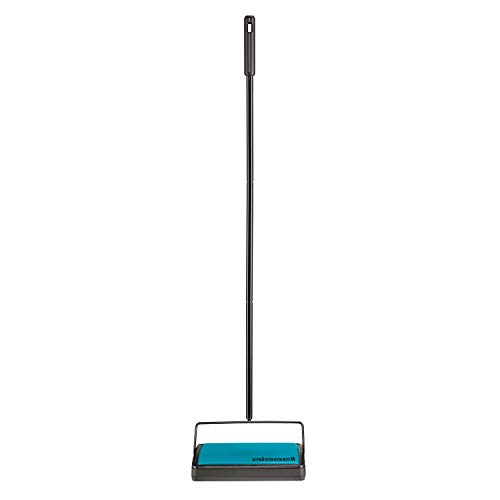

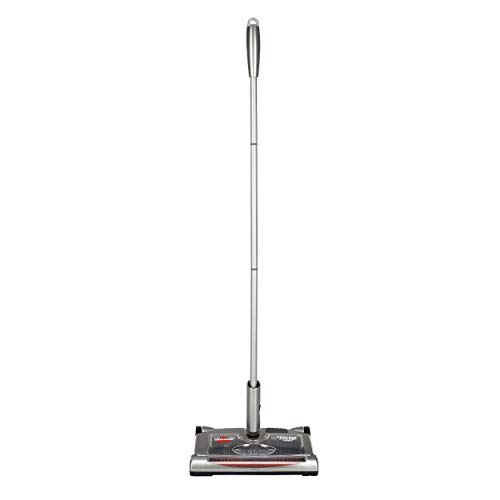
The Bissell Natural Sweep 92N0A has been around long enough to build a loyal following, and for good reason — it is one of the quietest mechanical sweepers you will find, which matters if you have light sleepers in the house or you like to do a quick cleanup while someone is on a call nearby. The dual rotating brush system (meaning two center brushes that spin as you push) picks up crumbs, pet hair, cereal, and loose dirt from both hard floors and low-pile rugs without making the grinding racket that cheaper single-brush designs tend to produce. At just 4.2 pounds, it is genuinely easy to reach under furniture and maneuver around table legs, and the two corner edge brushes are a standout feature that most sweepers at this price point simply do not include — they kick debris toward the center brushes so you are not constantly chasing crumbs along baseboards.
Performance on bare hardwood is where this sweeper earns its reputation. The brushes are gentle enough not to scratch a finished floor, yet firm enough to gather fine dust that a broom tends to scatter rather than collect. If you have dogs or cats, you will appreciate that the brush roll does not jam with hair the way a vacuum roller can — it collects strands into the dustbin rather than wrapping them into an impossible knot. Emptying the bin is straightforward: flip open the bottom door over a trash can and the debris falls out cleanly. The one area where the 92N0A asks for patience is deep-pile carpet — it handles low-pile area rugs reasonably well, but on thick shag it will push debris rather than pick it up, so keep that in mind if your hardwood rooms are bordered by heavy rugs. This sweeper also supports Bissell's partnership with the Bissell Pet Foundation, so a portion of every purchase goes toward helping homeless pets — a small bonus if that kind of thing matters to you when choosing between similar products.
For a cord-free, battery-free sweeper that is always ready to grab and go, the Bissell Natural Sweep sits at the top of the mechanical-roller category in 2026. If you are also dealing with stubborn stuck-on messes alongside daily dust, pairing this sweeper with one of the options from our best steam mop for hardwood floors guide gives you a very complete cleaning setup without ever touching a mop bucket.
Pros:
Cons:
If you have been looking for a single tool that replaces your broom, dustpan, and mop all at once, the Swiffer Sweeper 2-in-1 Starter Kit is the most popular answer to that question and has been for years. This particular bundle gives you one Sweeper unit, 14 dry sweeping cloths, and 5 wet mopping cloths — which is a generous head start before you need to buy refills. The dry cloths work on an electrostatic (static electricity that attracts dust) principle, so instead of pushing dust bunnies across the floor like a broom does, the cloth traps and locks hair, dust, and fine debris to the pad. You then pull off the used cloth and toss it — no shaking, no dustbin to empty, no cloud of dust in your face.
Switching from dry to wet mode takes about five seconds: swap the dry cloth for a wet mopping cloth pre-loaded with cleaning solution, and the same pivoting head that sweeps now mops. The flexible swivel head is genuinely useful for getting around chair legs and under the toe-kicks of cabinets, and the flat profile slides under most beds and sofas with zero effort. The wet cloths dissolve light grime and dried drips from hardwood and tile very effectively, though Swiffer does note you should avoid using the wet cloths on unfinished, oiled, or waxed wood, as well as non-sealed tiles, because those surfaces are water-sensitive. For a sealed hardwood floor in good condition, this is a non-issue. The main ongoing cost to keep in mind is refills — unlike a mechanical sweeper or a machine with a dustbin you empty, the Swiffer is a consumable system, so factor refill packs into your long-term budget.
As a starting kit for someone setting up a new apartment or replacing a worn-out broom-and-mop combo, this 20-piece set delivers strong value in 2026 because you get weeks of supplies included at a price that undercuts buying the hardware and cloths separately. If you find yourself dealing with tile grout in the kitchen or bathroom in addition to your hardwood, our guide to the best grout cleaning machine covers tools that work well alongside a sweeper like this one.
Pros:
Cons:
The Fuller Brush 17052 takes a different approach from the dual-brush Bissell models by leaning into electrostatic technology, meaning the brushes generate a static charge that pulls dirt and dust toward them the moment the sweeper touches the floor. The 9-inch cleaning path is narrower than some competitors, but the payoff is a compact footprint that fits into tight spaces — under low-clearance furniture, between appliances, and into corners that a wider sweeper simply cannot reach. The metal housing (the outer body of the sweeper) is advertised as indestructible, and while that may be marketing enthusiasm, it does feel noticeably more solid than the all-plastic designs you find at this price point. If you have accidentally bashed your sweeper against a doorframe or dropped it down the stairs, you know how quickly cheaper plastics crack and flex.
For quick touch-ups on hardwood, tile, wood laminate, and low-pile carpet, this sweeper works well as a grab-and-go tool that you store in a closet or slide under the bed. The adjustable handle accommodates different heights, which is a small but real ergonomic improvement over fixed-handle designs that leave shorter or taller users hunching over or bending at an awkward angle after a few minutes of use. The electrostatic brush design is particularly effective at pulling fine dust and pet hair off hard floors without requiring you to push hard or make multiple passes over the same area. That said, the 9-inch path does mean cleaning a large open kitchen or living room takes more back-and-forth passes compared to a wider-path sweeper, so this model is better suited to smaller rooms or targeted cleanup rather than whole-floor sessions. Emptying is straightforward — a simple door release drops the collected debris.
If you are comparing this to a handheld vacuum for small messes, the Fuller Brush wins on silence and convenience, though a good handheld vacuum will handle finer particles better. You can compare some top handheld options in our best handheld vacuum consumer reports roundup if you want to see how the two categories stack up side by side.
Pros:
Cons:
Most of the sweepers on this list are built for residential kitchens and living rooms, but the LUSHIJIE 41-inch industrial push sweeper operates on an entirely different scale. Its 41-inch (roughly one-meter) sweeping path means you cover dramatically more floor with each pass — the manufacturer rates it at approximately 45,000 square feet per hour of cleaning capacity, which is the kind of number that only makes sense when you are talking about warehouses, parking lots, factories, large retail spaces, or big garage floors rather than a three-bedroom house. If you manage a commercial space or a very large workshop and you are currently using a standard push broom and a dustpan, this sweeper will feel like a revelation: no electricity, no gas, no charging cables, yet roughly ten times the cleaning speed of a conventional broom according to the manufacturer.
The 55-liter (about 58 quarts) debris hopper is large enough that you are not stopping every few minutes to empty it, which is critical when you are covering thousands of square feet in a single cleaning session. The rust-resistant polypropylene (a type of plastic that resists corrosion) bristles are rated for rough surfaces and can handle gravel, iron filings, leaves, and light construction debris in addition to the typical dust and dirt you would encounter indoors. The reinforced frame is built for sustained daily use in ways that a residential sweeper is not. Where this unit is clearly out of its element is in a typical home — it is heavy, it requires real storage space, and its wide chassis will not fit through a standard interior doorway. For the right use case, however, it is an exceptional tool that eliminates the back-breaking labor of sweeping large concrete or hard-floor spaces by hand. According to Wikipedia's overview of floor sweeping equipment, push sweepers in this class have been a staple of industrial cleaning precisely because they combine speed with zero operating cost.
Pros:
Cons:
The Bissell Easy Sweep 2484A answers a very specific question: what if you want a sweeper that takes up almost no closet space and is light enough for a child or elderly family member to use without effort? This compact model is the most pared-down entry in Bissell's sweeper lineup, and that is precisely its appeal. You do not charge it, you do not load it with pads, and you do not need to find a power outlet — you just grab it, run it over the floor, and put it back. The cordless design with no batteries required means there is literally no maintenance beyond emptying the dustbin and occasionally rinsing the brush compartment.
On hardwood floors, the 2484A picks up hair, dirt, dust, and light debris efficiently in a single forward pass, and it handles low-pile area rugs and carpet edges without scattering material backward. Its compact frame lets it slide under furniture that a full-size sweeper cannot reach, which is a practical advantage in bedrooms with low-profile bed frames or under sofas where dust and pet hair tend to congregate. The dustbin is small by design — that is the trade-off you accept for the compact form factor — so if you are sweeping a large open floor plan you will empty it two or three times during a session. For a kitchen, hallway, or single bedroom, though, this is a non-issue. The teal colorway is pleasant enough to leave out on display without looking out of place. If you are comparing this to a stick vacuum for daily hardwood maintenance, the 2484A wins on simplicity and instant readiness, while a stick vacuum will handle finer particles and rugs more thoroughly. Our guide on the best stick vacuum for hardwood floors covers that comparison in detail if you are still deciding between the two approaches.
Pros:
Cons:
If you liked the idea of the standard Swiffer Sweeper but wanted something more capable of handling tougher messes, the Sweep & Mop Deluxe is the upgraded version worth considering in 2026. The most important structural difference is the reinforced pole and the locking head mechanism — the locking head lets you angle the cleaning pad flat against a baseboard or press it firmly into a corner for scrubbing that the flexible-only head on the standard model cannot deliver. The collapsible pole also makes this easier to store in a closet without fighting with a full-length handle, which sounds like a minor detail but is genuinely useful in smaller homes and apartments.
The Heavy Duty dry cloths included in this kit are thicker than standard Swiffer dry cloths and are designed to trap more debris in a single pass, which means you are swapping cloths less often during a session. The wet mopping cloths are formulated to dissolve dried grime and light grease, not just spread water around — a meaningful difference on kitchen floors where cooking splatter tends to stick. As with the standard Sweeper, the wet cloths should not be used on unfinished or waxed wood floors, but on sealed hardwood, engineered wood, tile, and vinyl they work very well. The black colorway gives it a more premium look than the standard white unit if aesthetics matter to you. The main reason some buyers opt for the standard Swiffer over this Deluxe version comes down to price and simplicity — the Deluxe has more features, but if you mostly do dry sweeping and occasionally need a light mop, the standard kit may be all you need. The Deluxe earns its place when you deal with stickier or heavier messes on a regular basis and want the extra scrubbing leverage the reinforced pole provides.
Pros:
Cons:
The Bissell Perfect Sweep Turbo 28806 occupies an interesting spot in this lineup — it is a mechanical sweeper like the Natural Sweep 92N0A, but the "Turbo" designation refers to a brush roll that spins faster relative to the push speed, which gives it a bit more aggressiveness in picking up debris compared to a standard mechanical design. The 480-milliliter (roughly 16-ounce) dirt cup is a reasonable capacity for a residential sweeper, large enough that you are not stopping every few minutes on a typical floor area. The grey colorway is neutral enough to blend into most homes without looking out of place on a hallway hook or closet shelf.
Where the Perfect Sweep Turbo stands out is in its price-to-performance ratio for straightforward daily hardwood maintenance. If you do not need corner edge brushes and you are mostly sweeping open floor areas rather than chasing crumbs along baseboards, this model gets the job done reliably and quietly. It runs without cords, batteries, or charging — just push and go. The higher-speed brush roll is noticeably more effective on slightly heavier debris like small cereal pieces, dried pasta, or larger crumbs compared to a basic mechanical roller, making it a better choice for households that cook frequently and generate kitchen floor messes throughout the day. The trade-off is that without corner brushes, you will need to do a quick sweep along walls with a separate brush or by angling the sweeper itself, which takes a bit of extra time. Still, at its price point, the Perfect Sweep Turbo is one of the more capable budget options in the mechanical sweeper category and a solid choice if you want a no-fuss, maintenance-free tool for everyday hardwood sweeping.
Pros:
Cons:
The most fundamental decision you will make when choosing a floor sweeper in 2026 is whether you want a mechanical brush roller or a pad-based system like the Swiffer. Mechanical sweepers use spinning or rolling brushes to push and collect debris into an onboard dustbin that you empty and reuse indefinitely. Pad-based systems use disposable cloths — either dry electrostatic pads or pre-moistened wet pads — that you attach, use, and throw away. Mechanical sweepers have lower long-term cost because there are no consumables to buy, but pad-based systems often trap finer particles more effectively and give you the option to mop in the same pass. If you have pets or allergies, a pad-based dry cloth tends to hold fine dander and hair more thoroughly than a brush roller that can sometimes release particles back into the air when you bump the sweeper or empty the bin.
The width of the sweeper's cleaning path determines how many passes you need to cover a given floor area, which directly affects how long cleaning takes. Residential sweepers typically range from about 9 inches on the compact end to 14–16 inches on the wider models, while commercial units like the LUSHIJIE go up to 41 inches. For a small kitchen or hallway, a 9–11 inch path is perfectly adequate and gives you the maneuverability advantage of a narrower footprint. For a large open-plan living and dining area, a wider path saves meaningful time. Consider the rooms where you will use the sweeper most often and match the path width to that primary use case rather than trying to find one tool that optimizes for both extremes.
One of the most frustrating limitations of many sweepers is their inability to clean right up to a wall or into a corner, leaving a thin strip of crumbs and dust that you then need to chase with a separate brush. Corner edge brushes — the small spinning brushes mounted at the front corners of the sweeping head — solve this by kicking debris inward toward the main brushes before you even reach the wall. The Bissell Natural Sweep 92N0A is the standout example in this lineup. If you have a lot of baseboards, furniture legs, or tight corners in your home, edge brushes are worth prioritizing in your selection. Homes with open floor plans and minimal furniture have less need for edge brushes, so if that describes your space, you can broaden your options.
A sweeper you find inconvenient to store or grab will sit unused while you reach for the vacuum instead — which means you are not actually getting the daily benefit you bought it for. Think honestly about where the sweeper will live between uses: a closet with limited space, a hook on the wall, or a narrow gap beside the refrigerator. Compact designs like the Bissell Easy Sweep 2484A fold or stand at a small footprint and are genuinely easy to pull out and put away in under ten seconds. Larger models with full-length handles may need a dedicated floor space in a utility closet. Weight also matters if you plan to carry the sweeper up and down stairs — anything over 5 pounds starts to feel noticeable on a daily basis for users with limited grip strength or mobility issues.
Floor sweepers and vacuums serve different roles. Sweepers are faster, quieter, and more convenient for daily light cleanups — crumbs, pet hair, and surface dust — because they require no cords, charging, or startup time. Vacuums are more thorough at removing fine particles embedded in floor gaps and handling larger debris volumes, but they are slower and louder to deploy. Most people with hardwood floors find that a sweeper handles 80% of their daily needs, and the vacuum comes out once or twice a week for a deeper clean. Using both together gives you the best of each tool's strengths.
A quality sweeper with soft brush bristles will not scratch a properly sealed hardwood floor under normal use. The risk of scratching comes primarily from hard debris — like a small pebble or piece of grit — being dragged across the floor surface by the brush rather than lifted into the bin. To minimize this risk, make sure the sweeper's dustbin has not overfilled to the point where it is pushing debris rather than collecting it, and keep the brush area clean of accumulated material that could create a hard abrasive contact point. Avoid using a sweeper on very rough or unfinished wood where raw wood fibers could catch on the brush.
If you choose a pad-based sweeper like the Swiffer Sweeper or the Swiffer Sweep & Mop Deluxe, the wet mopping cloths handle light grime, dried spills, and surface smudges without a separate mop. For deeper cleaning — removing sticky residue, disinfecting high-traffic areas, or cleaning up after cooking spills — a dedicated mop or steam mop will still outperform a sweeper pad. If maintaining a streak-free shine on hardwood is a priority, our guide to the best steam mop for hardwood floors covers tools specifically designed for that level of cleaning.
For most households, sweeping hardwood floors daily or every other day keeps dust, hair, and fine grit from accumulating to the point where it acts as an abrasive under foot traffic. Households with pets, young children, or anyone who tracks in outdoor debris regularly may benefit from sweeping twice a day in high-traffic areas like the kitchen and entryway. The good news is that a lightweight mechanical sweeper or pad sweeper takes under two minutes for a typical room, so daily sweeping is genuinely practical when you have the right tool available and easily accessible.
Yes — all seven sweepers reviewed here work on tile and laminate in addition to hardwood, and most also handle low-pile carpet and area rugs. The main surface restriction to watch for is with wet mopping cloths (on Swiffer-type products), which should not be used on unfinished, oiled, or waxed wood, non-sealed tiles, or carpeted areas because those surfaces are sensitive to moisture. Dry sweeping cloths and mechanical brush sweepers are generally safe on any hard flooring surface. If you maintain multiple floor types throughout your home, look for a sweeper explicitly rated as multi-surface to confirm compatibility.
Mechanical sweepers need the brush compartment cleared of tangled hair and fibrous debris every few uses — most models include a cleaning tool or can be cleared with a pair of scissors and a quick rinse of the brush roll under water (allow it to dry completely before reassembling). Empty the dustbin after every one or two cleaning sessions rather than waiting until it overflows, as an overfull bin dramatically reduces pickup efficiency. For pad-based sweepers, the tool itself needs very little maintenance — just replace cloths as needed and wipe the pivoting head clean if sticky residue builds up. Store any sweeper in a dry location to prevent rust on metal components and mold on brush bristles.
 |
 |
 |
 |

About Liz Gonzales
Liz Gonzales grew up surrounded by art and design in a New York suburb, with both parents teaching studio arts at the State University of New York. That environment sharpened her eye for aesthetics and spatial detail — skills she now applies to evaluating home products where form and function both matter. She has spent the past several years writing about lighting, home decor accessories, and outdoor living gear, with a particular focus on how products perform in real residential settings rather than showrooms. At Linea, she covers lighting fixtures and bulb reviews, outdoor and patio gear, and general home product comparisons.
You can Get FREE Gifts. Furthermore, Free Items here. Disable Ad Blocker to receive them all.
Once done, hit anything below
|
|
|
|