
The Kuject Heat Shrink Solder Seal Wire Connectors Kit is our top pick in 2026 — it delivers waterproof, solder-free connections in seconds, and that alone makes it worth every cent for anyone who works on vehicles, boats, or outdoor electrical projects. If you've ever struggled with a conventional butt connector failing in a wet environment, or spent 20 minutes trying to solder in a tight engine bay, solder seal connectors are the upgrade you didn't know you needed.
Traditional wire splicing methods — bare crimps, exposed soldered joints, and electrical tape — worked well enough in dry, stable environments. But the moment you introduce moisture, vibration, or heat fluctuation, those connections start to degrade. Wire connectors have evolved significantly, and solder seal butt connectors represent one of the most practical advancements for the everyday installer. They combine the mechanical grip of a crimp, the conductivity of a solder joint, and the environmental protection of heat shrink — all in one step. According to Wikipedia's overview of electrical connectors, waterproofing and vibration resistance are the two most critical performance factors in automotive and marine wiring — and solder seal connectors address both directly.
In this guide, we've reviewed the best solder seal wire connectors available in 2026. Whether you're rewiring a boat, doing a custom automotive build, or fixing outdoor lighting, these connectors save time and give you confidence that the joint will hold up for years. We cover performance, ease of use, kit value, and the real-world trade-offs you need to know before you buy.
Contents
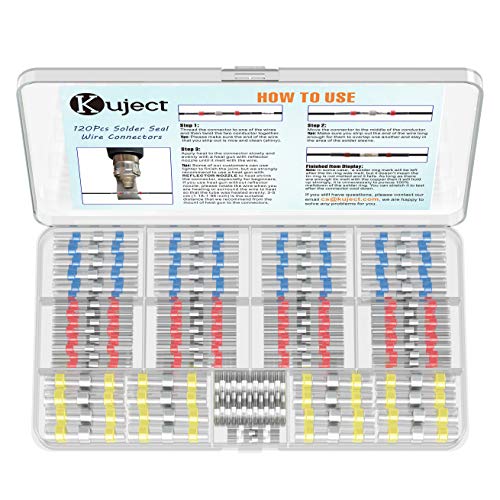


If you're serious about making reliable wire connections without hauling out a soldering iron, the Kuject 120-piece kit is the set to buy in 2026. This kit covers the four most common wire gauge ranges — red (22–18 AWG), blue (16–14 AWG), yellow (12–10 AWG), and white (26–24 AWG) — giving you flexibility across automotive, marine, trailer, and general electrical work. Each connector houses two hot-melt adhesive rings that liquefy under heat and flow into the wire strands, creating a bond that resists both moisture and pull-out force. You don't need a soldering iron. You don't need a crimping tool. A standard heat gun does the job in under 10 seconds per connector.
What sets Kuject apart from cheaper alternatives is consistency. The solder ring in each connector melts evenly and distributes along the stripped wire ends without cold spots or gaps. Once the shrink tubing contracts and the adhesive cures, the joint is genuinely waterproof — not just splash-resistant. This matters enormously in marine and underhood applications where condensation, spray, and fluid exposure are facts of life. The ability to bend the completed connector is another practical win: in confined spaces like behind a dashboard or inside a door panel, a rigid connector is a liability. The Kuject flexes after connection, so you can route the wire wherever it needs to go without stressing the joint.
The 120-piece count is generous enough to work through a full rewiring project without running short. Whether you're replacing corroded wiring on a trailer hitch, doing a stereo install, or tackling a more involved job like adding accessories to a fishing boat, this kit has you covered. If you're also working on diagnosing electrical issues in your vehicle, pairing these connectors with a quality OBD2 gauge display gives you both the repair and monitoring capability you need. The Kuject kit strikes an excellent balance between price, quantity, and genuine build quality — it earns its reputation as the go-to choice for professionals and serious hobbyists alike.
Pros:
Cons:
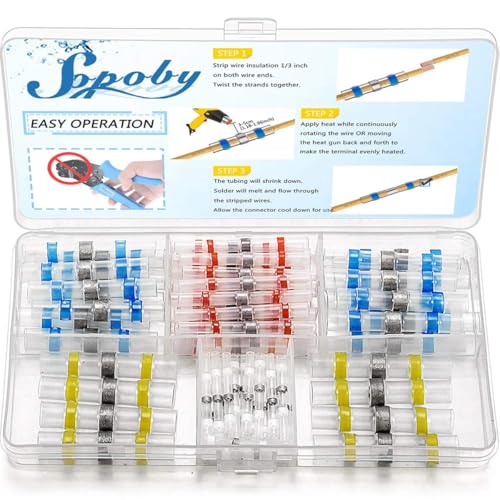
The Sopoby 50-piece kit is the right choice when you want quality solder seal connectors at a lower entry price — without compromising the waterproofing performance that makes these connectors worth using in the first place. The kit includes 23 red (22–18 AWG), 12 blue (16–14 AWG), 10 white (26–24 AWG), and 5 yellow (12–10 AWG) connectors, which reflects a realistic distribution for most small-to-medium electrical projects. Red connectors are the most-used size for standard automotive and marine wiring, so having nearly half the kit dedicated to that gauge range is a practical design decision.
Sopoby uses a double-wall construction that combines a polyolefin outer sleeve with hot-melt adhesive on the interior. When you apply heat, the outer tubing shrinks and grips the wire jacket while the inner adhesive melts around the stripped conductor ends. The result is a sealed, insulated, and mechanically strong joint that resists both pull-out force and lateral stress. The premium tube material is rated for harsh environments — abrasion, cutting, scuffing, and low-impact situations — which is exactly what you need when running wire through a vehicle chassis or along the exterior of a boat hull. The solder ring itself contains enough material to flow fully through the stripped wire ends, ensuring a complete electrical connection rather than just a surface contact.
Where the Sopoby kit wins on value, it's slightly outpaced by the Kuject in sheer kit size and gauge variety. But for a focused job — adding lights to a trailer, wiring a bilge pump, or extending sensor wires on a vehicle — 50 pieces is sufficient, and the per-connector quality is very competitive. If you do a lot of outdoor wiring work and also need to locate buried utility lines before digging, check out our guide to the best underground wire locators for a tool that pairs well with any wiring project. The Sopoby connectors are a smart buy for anyone who doesn't need a large kit and wants to keep project costs lean without settling for flimsy construction.
Pros:
Cons:
| Product | Price | Rating |
|---|---|---|
| Kuject Heat Shrink Solder Seal Wire Connectors Kit 120PCS, W | Check Amazon | |
| 50pcs Solder Seal Wire Connector, Sopoby Solder Seal Heat Sh | Check Amazon | |
Solder seal connectors look simple — a tube with a ring of solder inside — but the quality gap between a good connector and a bad one is significant. Here's what you need to evaluate before you buy.
The first thing to check is whether the connectors match your wire gauges. Standard automotive wiring runs 18–22 AWG for accessories and sensors, 14–16 AWG for moderate-load circuits, and 10–12 AWG for high-current runs like battery cables and inverters. Most kits are color-coded: red for small gauges, blue for mid-range, yellow for heavy gauge, and white or black for the finest wire. Check the AWG range printed on the connector before you buy — a mismatch means either a poor grip on the wire jacket or a connection that won't heat properly. Look at the ratio of sizes in the kit too. A kit that gives you 10 connectors in each size may not serve you well if 90% of your project uses 18 AWG wire.
The hot-melt adhesive inside the connector is what makes these butt connectors genuinely waterproof rather than just weather-resistant. Budget connectors often use a thin, sparse adhesive ring that melts and pools at the ends of the tubing without flowing into the wire strands. Quality connectors — like the Kuject and Sopoby reviewed here — use dual rings or thick single rings of adhesive that flow completely around and between the individual wire strands when heated. When the connector cools, this adhesive solidifies into a solid, flexible seal. Look for connectors that explicitly describe dual-ring or double-wall adhesive construction, and avoid anything that only lists "adhesive lined" without detail. If you're also working with sensitive electronics or testing electrical systems, a power supply tester can help you verify circuit integrity before and after your connections.
Not all solder rings are created equal. Some connectors include a bare minimum of solder — enough to create a conductive contact but not enough to fully penetrate the wire strands and form a true soldered joint. The best connectors use enough solder to flow through the entire stripped section of both wire ends, creating a continuous metallic bond. Lead-free solder rings are now standard in quality products, both for environmental compliance and because they maintain integrity across a wide temperature range. When you heat the connector, watch the solder: it should liquify, flow visibly along the wire, and then cool to a shiny, uniform finish. If it balls up and refuses to flow, the ring is too small or the temperature is too low.
The outer tubing must do two things: shrink tightly enough to grip the wire jacket without gaps, and remain flexible after cooling. Polyolefin is the standard material for quality heat shrink connectors — it has a consistent shrink ratio (typically 3:1 or 4:1), handles temperatures up to 125°C, and resists oils, fuels, and most automotive fluids. Cheap PVC tubing shrinks unevenly and becomes brittle in cold weather. Always verify that the product specifies polyolefin tubing, particularly if you're working in a marine environment or under the hood of a vehicle where temperature swings are extreme. You'll want a heat gun that delivers controlled, even heat — if you're using torches for other electrical or metalwork tasks, our butane torch buying guide covers heat application tools in detail.
For most automotive and marine applications, yes. A properly made solder seal connection creates a waterproof, mechanically strong, and electrically sound joint. The solder ring melts into the wire strands just as a hand-soldered joint does. Where traditional soldering still has an edge is in high-precision electronics work where joint quality can be individually inspected and controlled. For wire splicing in vehicles, boats, and outdoor installations in 2026, solder seal connectors are entirely professional-grade.
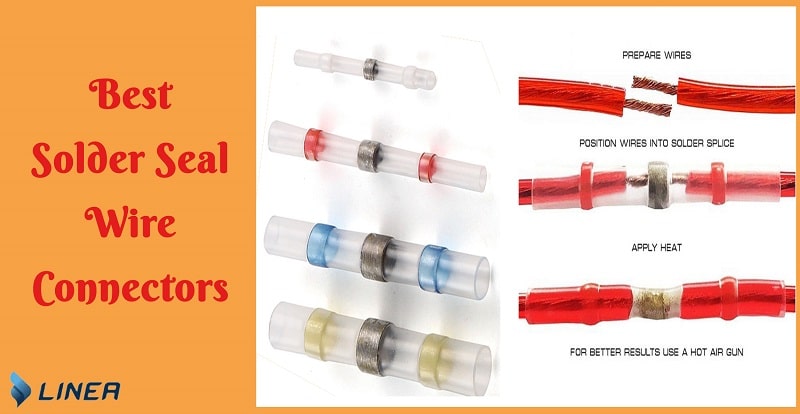
Most solder seal connectors require heat in the 200–300°C range to fully activate. A standard dual-temperature heat gun set to its high setting (typically around 300°C/570°F) works well. Apply heat evenly by moving the gun back and forth along the connector — don't hold it in one spot. You'll see the tubing shrink first, then the solder ring melt and flow, and finally the adhesive rings melt and ooze slightly from the ends. That adhesive bleed is a good sign: it means the seal is complete.
You can, but results are inconsistent. An open flame heats the connector unevenly, often scorching the outer tubing before the solder ring fully melts. A heat gun gives you controlled, directional heat that activates the connector properly. If you're doing occasional field repairs and only have a lighter available, keep the flame moving constantly and never hold it in contact with the tubing. A butane heat tool is a better compromise — more focused than a lighter, more controlled than an open flame.
Yes — quality solder seal connectors with dual adhesive rings are rated for continuous moisture exposure and are widely used in marine wiring. The combination of the polyolefin shrink tube, the hot-melt adhesive seal, and the soldered wire joint creates a barrier that keeps water out of the connection point. For below-waterline wiring or submerged applications, you'd want additional protection like heat-shrink tubing over the outside or liquid electrical tape, but for above-waterline marine work, these connectors are fully up to the task.
Most kits cover the range from 26 AWG (very fine sensor wire) to 10 AWG (heavy-duty power runs). The color coding is standard across most brands: white or clear for 26–24 AWG, red for 22–18 AWG, blue for 16–14 AWG, and yellow for 12–10 AWG. For wire heavier than 10 AWG — like battery cables or main power feeds — you'll need specialized heavy-gauge connectors or a traditional crimp-and-solder approach. Always match the connector gauge range to your wire before applying heat.
A successful connection shows four visible signs: the outer tubing has shrunk uniformly with no bubbles or gaps; the solder ring has melted and is no longer visible as a distinct ring (it has flowed into the wire); a small amount of hot-melt adhesive has seeped from both ends of the connector; and the connector grips the wire jacket firmly with no slipping. After cooling, give the wire a firm tug — a good joint should hold without any movement. You can also test with a multimeter for continuity to confirm a solid electrical connection before closing up the panel or junction box.
 |
 |
 |
 |

About Linea Lorenzo
Linea Lorenzo has spent over a decade testing home gadgets, cleaning products, and consumer electronics from his base in Sacramento, California. What started as a personal obsession with keeping his space clean and stocked with the right tools evolved into a full-time writing career covering the home products space. He has hands-on experience with hundreds of cleaning solutions, robotic and cordless vacuums, and everyday household gadgets — evaluating them for performance, value, and real-world usability rather than spec sheet appeal. At Linea, he covers home cleaning guides, general how-to tutorials, and practical product advice for everyday home care.
You can Get FREE Gifts. Furthermore, Free Items here. Disable Ad Blocker to receive them all.
Once done, hit anything below
|
|
|
|