
You're standing in your backyard, shovel in hand, about to dig a trench for a new irrigation line — then you pause. Somewhere under your feet runs an electric fence wire, a sprinkler valve cable, maybe even a buried utility line. Hitting any of those would cost you time, money, and a serious headache. That's exactly why a reliable underground wire locator belongs in your toolkit.
In 2026, the market for underground wire and cable locators spans everything from budget-friendly DIY tools to professional-grade dual-frequency units used by utility crews and landscaping contractors. Whether you're a homeowner tracking down a broken dog fence wire or a technician locating buried electrical conduit across a job site, there's a locator built for your situation. Browse our full product reviews to compare more tools across categories.
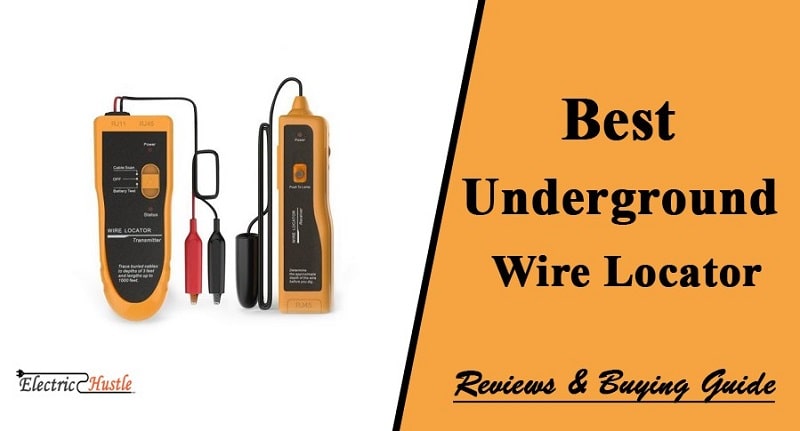
This guide covers seven of the best underground wire locators available today. We break down detection depth, frequency options, ease of use, and who each tool is actually built for — so you can make a confident decision before you buy. According to Call 811, contacting your utility locating service before digging is always the first step, but having your own locator helps you trace private lines — like pet fences, irrigation control wires, and outdoor lighting cables — that 811 won't mark.
Contents




The TEMPO 501 Tracker II has been a trusted name in underground wire location for years, and the 2026 model keeps that reputation intact. It can trace buried conductors — wires, metallic pipes, electric dog fence cables, coax, telephone lines — over distances up to 4,000 feet and depths down to 7 feet. That range covers nearly any residential or light commercial job you'd encounter. The inductive signal detection lets you work on both active and dead systems, which is a genuine time-saver when you're not sure whether power is present.
Setup is simple and the learning curve is minimal. You connect the transmitter to the wire or use inductive coupling to induce a signal without a direct connection, then sweep with the receiver until you pick up the tone. The 501 traces electrical lines, communications cables, landscape lighting, fish tape, and metallic pipes. It's a broad-use workhorse — not specialized for one cable type, but reliably effective across all the common ones.
Build quality is solid for the price point. The unit feels durable enough for field use, though it isn't rated for water resistance the way some professional-tier models are. If you need an all-around locator for residential projects and occasional contractor jobs, the 501 is hard to beat for the money.
Pros:
Cons:
If you're locating utilities professionally — or you're dealing with a genuinely challenging job site full of interference — the TEMPO 551 is the tool that addresses those problems head-on. Its detection range extends over 1 mile (1.6 km) and depths up to 20 feet (6 meters), which puts it firmly in the professional-contractor category. The dual-frequency transmission combined with IntelliTrack noise rejection is the headline feature here: it simultaneously transmits two frequencies and filters out AC interference using proprietary digital algorithms. Noisy environments that would fool a basic locator don't confuse the 551.
The IP54 rating is a practical advantage on real job sites where you're working in light rain or damp soil conditions. The receiver offers both peak and null detection modes, giving you flexibility to fine-tune your search method depending on the environment and the anomaly you're chasing. Peak mode helps you identify centerlines quickly; null mode gives you pinpoint accuracy when you need to mark an exact location.
This is a step up in price from the TEMPO 501, and that's appropriate — the 551 is a different class of tool. For a utility crew, a professional landscaper, or anyone doing regular commercial locating work, the dual-frequency capability and IntelliTrack filtering justify the investment. For occasional homeowner use, it may be more than you need.
Pros:
Cons:
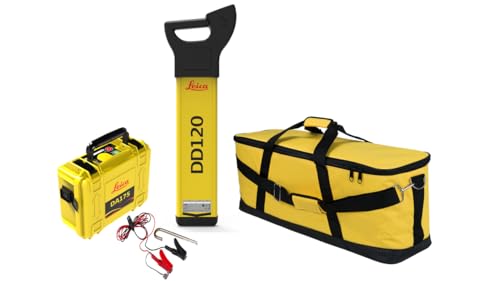
Leica Geosystems is a name you'll recognize if you've spent any time around surveying or precision measurement equipment. The DD120 brings that same philosophy of accuracy to underground utility location. This is a complete kit: it includes the DD120 locator, the DA175 1-watt signal transmitter, and a carry bag — a turnkey package that's ready to work out of the box. Automatic pinpointing at depths up to 10 feet across power, radio, and auto detection modes gives you reliable reads without manual calibration guesswork.
The power mode detects energized cables passively — no transmitter connection needed. Radio mode picks up signals induced on conductors from ambient radio frequency. Auto mode switches intelligently between the two. When you do connect the DA175 transmitter, you get active signal injection for tracing specific lines with precision. The depth readout is a standout feature — not all locators in this range give you real-time depth estimates this accurately.
This kit is a strong fit for contractors who need reliable depth data before excavation. It's heavier on the price side compared to consumer-grade units, but what you're paying for is Leica's reputation for measurement accuracy and the completeness of the package. For jobs where getting the depth wrong could mean cutting a buried power line, that accuracy matters.
Pros:
Cons:
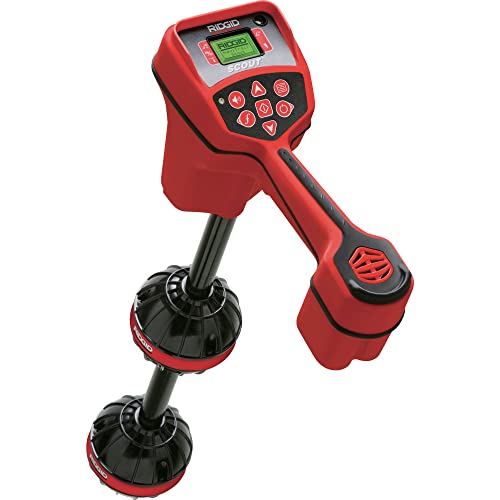
The RIDGID NaviTrack Scout fills a specific niche: it's designed to work alongside pipe inspection cameras and sondes, not just as a standalone cable tracer. If you're already using a SeeSnake inspection camera to look inside drains and pipes, the NaviTrack Scout tells you exactly where that camera head is located underground. That combination — inspection plus location — is powerful for plumbing diagnostics, drain work, and pipe repair planning. The multi-directional antenna technology eliminates false peaks and nulls, giving you a cleaner signal read than single-directional designs.
It supports 4 sonde frequencies and 5 line trace mode frequencies, which means it works with a wide variety of transmitters and sonde sizes — not just RIDGID's own equipment. The digital readout shows real-time signal strength, which makes it intuitive to use even for technicians who don't use a locator every day. You're not guessing at audio tone strength; you have a clear numerical indicator confirming your position.
As a standalone wire tracer — without a sonde — it functions effectively for energized line detection and general cable location. But its real advantage shows up the moment you pair it with camera inspection equipment. If your work regularly involves drain cleaning, pipe lining, or plumbing inspections, the NaviTrack Scout is a logical companion tool rather than a primary standalone locator. Worth pairing it with a good work light when you're doing inspections in dim conditions.
Pros:
Cons:
The Armada Pro290 stands out for one practical reason: it integrates the transmitter and receiver into a single compact unit with a hard shell carrying case included. For homeowners and occasional users who want capability without hauling around two separate pieces of gear, this self-contained design is genuinely convenient. It's very lightweight, which you'll appreciate after walking a property line for 20 minutes sweeping for a broken dog fence wire.
The built-in speaker with volume control lets you track signal strength by ear without staring at a display. The detachable antenna is a useful design detail — antennas can take damage in the field, and being able to swap one out means the unit doesn't become a paperweight because of a bent antenna. The compact design with built-in transmitter makes it particularly practical for residential DIY jobs where portability beats raw performance.
You'll want to set expectations appropriately. The Pro290 isn't competing with professional dual-frequency units on performance — it's competing on convenience and price. Detection depth and range are more limited than the TEMPO 501 or 551. But for locating a dog fence break, tracing an outdoor lighting wire, or finding an irrigation control cable in your own yard, it does the job without requiring you to learn a complex system.
Pros:
Cons:
If your primary need is locating pet fence wires, single irrigation control wires, or basic metal pipes — and you don't want to spend hundreds of dollars on professional equipment — the KOLSOL F02 is the entry point to consider. It comes with earphones for quiet operation in environments where you don't want to broadcast a tone, and it's straightforward to use without training or a manual. For basic single-strand wire location, it delivers honest performance at an honest price.
There's one critical limitation you need to know before you buy: the F02 is designed for single-strand wire or double-strand wire in parallel. It does not work on multistrand wire. That's not a bug — it's a fundamental characteristic of this type of budget locator. Read the specs carefully before ordering. If your buried wire is a twisted-pair or multiconductor cable, this isn't the right tool.
Within its stated use case — pet fence cables, irrigation control wires, metal pipes, standard electrical wires — it earns its keep. For homeowners who have one specific recurring task (like finding a break in a dog fence every season or two), paying full professional tool prices isn't justified. The F02 is the practical answer. Just be honest with yourself about what you need it to do. Think of it the same way you'd approach buying a dryer vent cleaning kit — right tool for the right job, not a universal solution.
Pros:
Cons:
The TEMPO 521A is purpose-built for irrigation systems, and that specialization makes it very effective at what it does. Finding buried sprinkler valves is one of the most frustrating tasks a landscaper or homeowner faces — valves get covered over time with mulch, sod, or soil, and their exact position is often undocumented. The 521A uses an adjustable transmitter that sends a signal through the irrigation control wire, and the receiver locks in on the buried valve location with the kind of precision that TEMPO has built their reputation on.
The adjustable transmitter with extended range and maximum signal strength means you're not limited to small yards — it handles large commercial properties and golf courses where valves might be far from the controller. The receiver features both loudspeaker and headset audio outputs, so you can work alone with earphones in traffic noise or with a partner using the speaker. Volume is adjustable on both outputs.
For contractors who do irrigation repair and installation regularly, this is a specialized tool that pays for itself quickly. Locating a valve that would otherwise take 30 minutes of probing takes 3 minutes with the 521A. For occasional homeowner use, it depends on how large your irrigation system is and how often you need to find valves. If you have a complex multi-zone system on a large property, the time savings justify the investment even for residential users. Pair it with a reliable spotlight for working at dawn or dusk on large properties.
Pros:
Cons:
Before you spend money on a locator, spend five minutes thinking through these four factors. The right tool for a plumbing contractor is a completely different tool than what a homeowner needs for a dog fence. Here's what actually matters.
Depth and range specifications tell you the maximum capability of the locator under ideal conditions — actual performance in your soil and cable type may vary. That said, they're still your first filter.
This is one of the more important specs to understand. Single-frequency locators work well in clean environments without a lot of electrical noise. Dual-frequency units are built for complex environments where interference from nearby power lines, active cables, or conductive soil would cause a single-frequency unit to produce unreliable readings.
Most locators can operate in both modes, but understanding the difference helps you use the tool correctly.
The KOLSOL F02 and TEMPO 521A illustrate the specialization spectrum. The F02 is limited to specific wire types but costs very little. The 521A is purpose-built for irrigation valves and does that job better than any general-purpose locator. Meanwhile, the TEMPO 501 and RIDGID NaviTrack cast a wider net.
Detection depth varies by model and environment. Budget consumer units typically locate wires at 3–5 feet. Mid-range general-purpose locators like the TEMPO 501 reach 7 feet. Professional-grade units like the TEMPO 551 can locate conductors up to 20 feet deep. Keep in mind that soil type, moisture content, cable type, and nearby interference all affect real-world performance relative to the stated maximum depth.
Yes — this is one of the most common residential uses for underground wire locators. Tools like the TEMPO 501, Armada Pro290, and KOLSOL F02 are all capable of tracing pet fence cables. The KOLSOL F02 is particularly popular for this application due to its low price point. Once you locate the break, the signal will drop off abruptly, marking the fault location. Note that the F02 only works on single-strand or parallel double-strand wire — verify your fence wire type before buying.
Most underground wire locators include both a transmitter and a receiver. The transmitter injects a signal onto the wire you want to trace; the receiver detects that signal above ground. Some units also support passive detection — picking up signals from energized lines or radio-frequency induced signals — without a transmitter connection. For tracing dead (non-energized) private wires like pet fences and irrigation cables, you'll need to use the transmitter in active mode. All the units in this guide support active signal injection.
Peak mode and null mode refer to how the receiver reports signal strength as you sweep across the buried wire. In peak mode, the signal is strongest when you're directly over the wire — you walk until the tone or reading peaks, and that's your centerline. In null mode, the signal drops to zero (null) directly over the wire — you find the quietest point between two strong signals. Null mode can be more precise for exact pinpointing; peak mode is often faster for general tracing. Some professional locators like the TEMPO 551 offer both modes so you can choose based on conditions.
Underground wire locators detect metallic conductors — they cannot directly detect non-metallic plastic pipes or PVC conduit. However, if a metallic tracer wire was installed alongside the plastic pipe (which is standard practice in modern installations), the locator can trace that wire. Some locators can also track a fish tape or sonde inserted into a pipe. If you're working with older plastic plumbing that has no tracer wire, you'll need a different approach such as a ground-penetrating radar unit.
Using a locator to identify and mark the location of buried utilities is specifically what these tools are designed for — it's the safe approach before excavation. Always call 811 (in the US) before digging to have public utilities marked, and use your locator to trace private lines that 811 won't mark. The locators in this guide are passive or low-power active instruments that do not pose a hazard to buried cables during normal use. Never excavate based solely on locator readings without visual confirmation once you're near the marked depth.
 |
 |
 |
 |

About Linea Lorenzo
Linea Lorenzo has spent over a decade testing home gadgets, cleaning products, and consumer electronics from his base in Sacramento, California. What started as a personal obsession with keeping his space clean and stocked with the right tools evolved into a full-time writing career covering the home products space. He has hands-on experience with hundreds of cleaning solutions, robotic and cordless vacuums, and everyday household gadgets — evaluating them for performance, value, and real-world usability rather than spec sheet appeal. At Linea, he covers home cleaning guides, general how-to tutorials, and practical product advice for everyday home care.
You can Get FREE Gifts. Furthermore, Free Items here. Disable Ad Blocker to receive them all.
Once done, hit anything below
|
|
|
|