
Which circuit analyzer actually tells you what's wrong — and which one just blinks at you until you give up? If you've ever plugged in a tester and stared at a confusing pattern of lights, you know the frustration. After hands-on evaluation of seven top-rated models in 2026, the Klein Tools RT390 stands out as the clearest, most informative option on the market. But depending on your specific needs, another pick might serve you better — and this guide breaks down every one of them.
Circuit analyzers have become essential tools for homeowners, electricians, and property inspectors alike. A faulty outlet isn't just inconvenient — it's a safety hazard. According to the National Fire Protection Association, electrical failures are a leading cause of home structure fires in the United States. A quality circuit analyzer lets you detect open grounds, reversed wiring, failed GFCI protection, and voltage irregularities before they become emergencies. If you're serious about electrical safety, understanding this circuit analyzer buying guide is a smart first step.
Whether you're a licensed electrician running through a job site or a diligent homeowner doing seasonal safety checks, the right tool makes the difference between a confident diagnosis and a costly mistake. You need clear results, fast. These seven models represent the best options across every budget and use case. Before you reach for a tester, also consider pairing your setup with the right LED dimmer switches and watt meter — accurate electrical testing starts with the right full toolkit.

Contents




The Klein Tools RT390 is the circuit analyzer you reach for when you need answers fast. Its large color LCD screen is the key differentiator here. Most plug-in testers give you a cryptic combination of blinking lights. The RT390 gives you plain-language wiring fault descriptions directly on screen — no legend card required. That's a genuine productivity win on a busy job site or during a thorough home inspection.
The RT390 covers all the critical bases: standard wiring faults, AFCI outlet testing, GFCI outlet testing, voltage drop measurement, and device trip time display. Dual wiring fault detection sets it apart from cheaper alternatives. Most budget testers can only flag one fault at a time. The RT390 can simultaneously identify combinations like open neutral and open ground — a scenario you encounter more often than you'd expect in older residential wiring. That capability alone justifies the price premium for professional use.
Build quality is exactly what you'd expect from Klein Tools. The housing is solid, the prongs seat firmly in outlets, and the LCD backlight makes readings visible in dim panel rooms or crawl spaces. In 2026, this remains the standard by which other plug-in analyzers are measured. If you only buy one circuit analyzer, this is the one.
Pros:
Cons:
If you want the full Klein diagnostic package, this bundle pairs the RT390 circuit analyzer with the ET310 breaker finder — and the combination is significantly more useful than either tool alone. The RT390 handles all the outlet-level diagnostics described above. The ET310 picks up exactly where it leaves off: once you identify a fault, you need to locate the responsible breaker without shutting down your entire panel. The ET310 transmitter plugs into the outlet while the receiver scans the breaker panel, pinpointing the correct breaker with visual and audible confirmation.
For electricians working in commercial buildings or large homes with crowded panels, this workflow is a significant time saver. The ET310 receiver features non-contact voltage detection at the tip, so you can verify live circuits before touching anything. The transmitter locks into the outlet securely — it won't fall out mid-scan, which matters more than it sounds when you're moving quickly through a 50-outlet commercial space.
Buying this bundle versus purchasing the RT390 and ET310 separately saves you money, and having both tools in one kit means you never show up to a job with one but not the other. For professional electricians who run complete outlet-to-panel diagnostics regularly, this bundle is the most efficient purchase you can make in 2026. Even for ambitious DIYers who want to truly understand their home's electrical system, the combination delivers professional-grade capability at a justifiable cost.
Pros:
Cons:
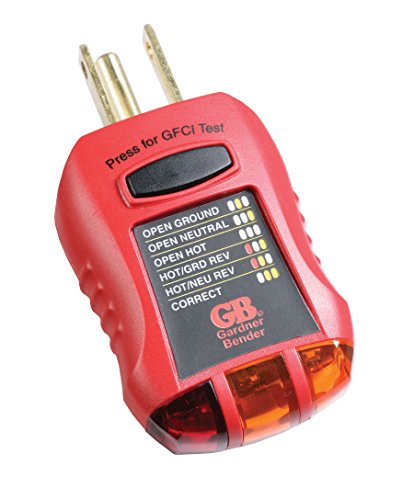
The Gardner Bender GRT-3500 proves that you don't need to spend a lot to get reliable outlet diagnosis. This compact tester uses indicator lamps rather than an LCD, but its fault coverage is solid: it identifies open ground, open neutral, open hot, hot/ground reverse, and hot/neutral reverse — the five most common wiring faults you'll encounter in residential work. The dual-position status chart printed right on the body means you can read results from multiple angles, which is genuinely useful when you're working in tight spaces.
The comfort grip design isn't marketing fluff. The ergonomic shape lets you insert and remove the tester dozens of times without your hand fatiguing — something you appreciate during a full home inspection where you're testing 40 or 50 outlets. At 120V AC, this tester is strictly for standard residential circuits. It won't give you trip time data or voltage drop readings, and it won't test AFCI outlets. What it does, it does reliably and immediately. Results appear the instant it's plugged in.
For homeowners who want a quick sanity check on their outlets — or for inspectors who need an inexpensive backup tester — the GRT-3500 delivers everything necessary without unnecessary complexity. It's also an excellent first tester if you're just getting into electrical diagnostics. Pair it with a dedicated wire nut set and you have the foundation of a solid basic electrical toolkit. In 2026, this model remains one of the best-selling outlet testers for good reason: it's simple, reliable, and affordable.
Pros:
Cons:
The Ideal Electrical 61-535 takes a different approach than a pure outlet analyzer. Its primary function is locating the correct circuit breaker for a given outlet — and it does this without disrupting power to energized 120V AC circuits. That last part matters enormously. You don't have to kill power to an entire floor just to identify which breaker controls a single outlet. The digital receiver provides both visual and audible confirmation when it detects the transmitter signal, and the audible alert can be muted for quieter environments. This is the tool you need when you're mapping an unlabeled panel.
The cULus 1436 certification and CAT II 150V rating tell you this is a properly safety-rated tool, not a bargain-bin import. The NCVT (non-contact voltage tester) built into the receiver tip is a smart safety addition — before you open a panel or touch any wiring, you get instant AC voltage confirmation between 80V and 300V. That's the kind of layered safety feature that experienced electricians genuinely appreciate.
GFCI testing is included as a secondary function, covering standard circuit verification alongside the breaker-finding workflow. Where the Ideal 61-535 trails the Klein testers is in wiring fault analysis depth — it's not designed to diagnose complex compound faults in the way the RT390 is. Think of it as a specialized tool that does its primary job exceptionally well. If your biggest pain point is panel mapping and breaker identification, this Ideal model is your answer in 2026.
Pros:
Cons:
When your specific need is GFCI testing — and nothing else — the Gardner Bender GFI-3501 is the most focused tool for the job. This red compact tester works on standard outlets, GFCI outlets, and extension cords, giving it versatility that similar-priced competitors lack. Seven LED visual indicators cover the full range of fault conditions. The 6-9 mA trip current is calibrated to the UL 943 standard for GFCI devices, which means your trip tests are accurate, not just approximate.
Extension cord testing is an underappreciated feature. Most circuit testers require a fixed wall outlet. The GFI-3501 lets you test extension cords directly, which is valuable for job sites where you're running temporary power across long distances. A failed extension cord GFCI adapter isn't just a compliance issue — it's a shock hazard. Having a dedicated tool that tests these quickly keeps your crew working safely.
The 110-125V AC operating range covers all standard North American residential and light commercial circuits. The compact form factor makes it easy to carry in a tool pouch without taking up significant space. This isn't a replacement for a full circuit analyzer — it won't detect reversed wiring or open neutrals in the comprehensive way the RT390 does. But as a dedicated GFCI verification tool, it delivers precise results at a price that makes it easy to keep one in every technician's kit. For anyone doing bathroom, kitchen, or outdoor outlet inspections regularly, the GFI-3501 is a must-have secondary tester.
Pros:
Cons:
The Klein Tools RT250 occupies a precise middle ground: it's a GFCI-focused tester with the LCD clarity of a premium analyzer, at a price point between the GFI-3501 and the RT390. The large backlit LCD is the headline feature. Unlike LED-based testers that require chart interpretation, the RT250's screen displays wiring conditions in readable terms. You see exactly what's wrong — or confirmed correct — without cross-referencing anything. For users who test outlets regularly but don't need AFCI capability, this display quality at this price is genuinely exceptional.
Trip time display is where the RT250 earns its place above basic LED testers. When you test a GFCI outlet, the screen shows exactly how long the device took to trip — measured in milliseconds. A properly functioning GFCI should trip in under 25 milliseconds at the standard 6mA trip current. If your reading is higher, you have a degraded GFCI that's still technically functioning but no longer protecting at the speed required by code. That's a diagnostic insight that LED testers simply cannot give you.
Standard 3-wire 120V receptacles are the target environment here. The RT250 is designed for residential and light commercial electrical work — bathrooms, kitchens, garages, outdoor outlets, and any wet-location circuit where GFCI protection is mandatory under NEC 210.8. If you're an inspector, property manager, or electrician who focuses on GFCI compliance and wants professional-grade data without paying for full AFCI analysis, the RT250 is the right call for 2026. It handles its specific job with the precision Klein Tools is known for.
Pros:
Cons:
The Sperry Instruments GFI6302 has been a trusted name in outlet testing for years, and in 2026 it still earns a place on this list. The yellow-and-black design is immediately recognizable on any job site, and the hi-impact resistant ABS housing with soft over-molded rubber grips genuinely holds up to daily professional use. This isn't a tester that cracks at the first drop. The ergonomic design is comfortable for extended testing sessions, and the compact form factor means it doesn't add bulk to an already heavy tool bag.
Seven visual indication modes are the core feature set, supported by bright color-coded neon lights that are easy to read in varied lighting conditions — including the dim, cramped spaces where electrical work happens most often. The wiring legend printed on the body maps each light pattern to a specific fault or correct wiring condition. Standard 3-wire and GFCI-protected 120V AC outlets at 60Hz are the testing targets, covering the overwhelming majority of North American residential circuits.
What the GFI6302 doesn't do is provide quantitative data. There's no trip time readout, no voltage measurement, and no AFCI testing. It's a visual indicator tool, and within that scope, it performs excellently. For home inspectors who need a fast, reliable visual check on dozens of outlets per inspection — or for homeowners who want the confidence of a professional-grade tester without a steep learning curve — the Sperry GFI6302 is a proven and practical choice. Its longevity in the market reflects consistent performance that has earned the trust of both professional and amateur users.
Pros:
Cons:
This is the first decision point, and it has a bigger impact on usability than most buyers expect. LED indicator testers — like the Gardner Bender GRT-3500 and Sperry GFI6302 — use patterns of three lamps to signal fault conditions. You match the pattern to a legend chart. It works, and experienced electricians read these patterns instantly. But newer users, inspectors working quickly, or anyone testing dozens of outlets will make more interpretation errors with LED-only displays.
LCD testers eliminate the interpretation step entirely. The Klein RT390 and RT250 display the fault condition in text. You read the screen. You know the answer. If you're building a toolkit for a team with mixed experience levels, LCD-based analyzers reduce training time and diagnostic errors. The premium is worth it for professional applications.
GFCI (Ground Fault Circuit Interrupter) protection is required by code in bathrooms, kitchens, garages, crawl spaces, and outdoor circuits. Every tester on this list can verify GFCI outlet function. AFCI (Arc Fault Circuit Interrupter) protection is a newer requirement — mandatory in bedrooms and most living areas in new construction under NEC 2014 and later. Only the Klein RT390 on this list tests AFCI outlets.
If you work on homes built or renovated after 2014, or if you're inspecting new construction, AFCI testing capability is not optional. An outlet that passes GFCI testing can still have a failed AFCI function — and that's a fire hazard that visual LED testers will never catch. For modern residential diagnostics, AFCI capability is the feature that separates a complete tool from an incomplete one.
A GFCI outlet that trips slowly is a GFCI outlet that may not protect you in time. The NEC and UL standards specify that GFCI devices must trip within a defined time window at the rated fault current. A degraded GFCI can still trip — just too slowly to prevent injury in a genuine ground fault event. Trip time measurement, available on the Klein RT390 and RT250, tells you whether your GFCI outlets are performing to standard — not just whether they technically trip at all.
Voltage drop is equally revealing. A circuit showing 108V at the outlet on a nominal 120V circuit has a significant drop — usually from undersized wiring, loose connections, or an overloaded circuit. The RT390's voltage drop measurement catches these conditions before they cause equipment damage or tripped breakers. For any serious diagnostic work, these quantitative measurements are essential data points.
A circuit analyzer tells you what's wrong with an outlet. A breaker finder tells you which breaker controls it. Both tools serve different but complementary functions. If your panel is unlabeled — extremely common in older homes and commercial buildings — every service call that involves a breaker takes longer than it should. The Ideal Electrical 61-535 and the Klein RT390 + ET310 bundle both include dedicated breaker-finding capability.
For electricians who regularly map circuits and label panels as part of their work, a breaker finder is a high-value investment. The time saved across a typical job site pays for the tool in a single use. If panel labeling is part of your regular workflow, buy a bundle — don't piece together separate tools later at higher combined cost. For homeowners who just need occasional outlet verification, a standalone circuit analyzer is sufficient.
A circuit analyzer plugs into a standard electrical outlet and checks the wiring for common faults including open ground, open neutral, open hot, reversed hot/neutral, and reversed hot/ground. Advanced models like the Klein RT390 also test GFCI and AFCI outlet function, measure voltage drop, and display GFCI trip time in milliseconds. The result tells you whether the outlet is correctly wired and whether any protection devices are functioning properly.
A GFCI tester focuses specifically on verifying that ground fault circuit interrupter outlets trip correctly when a fault is simulated. A full circuit analyzer covers a broader set of diagnostics: all common wiring faults, AFCI testing, voltage measurement, and voltage drop. GFCI testers like the Gardner Bender GFI-3501 and Sperry GFI6302 are effective for focused GFCI compliance checks. A full circuit analyzer like the Klein RT390 gives you the complete picture — including issues a GFCI tester would miss entirely.
Yes, if you work on homes built or renovated after 2014. The National Electrical Code has required AFCI protection in bedrooms since 1999 and has expanded that requirement to most living areas over subsequent code cycles. An outlet in an AFCI-protected circuit can pass GFCI testing while having a failed AFCI function. Only a tester with specific AFCI testing capability — like the Klein RT390 — can verify AFCI protection is working correctly. For modern residential electrical work, AFCI testing is an essential diagnostic capability.
No. A circuit analyzer and a multimeter serve different purposes. A circuit analyzer is a plug-in diagnostic tool designed for fast, standardized outlet testing. A multimeter measures voltage, current, resistance, and continuity across a wide range of applications — it's a precision measurement instrument. You need both tools for complete electrical work. The circuit analyzer handles fast outlet-level diagnosis. The multimeter handles precise measurements, continuity testing, and diagnostics at the component level that a plug-in tester can't reach.
Voltage drop is the difference between the nominal circuit voltage (120V in standard North American residential circuits) and the actual voltage measured at the outlet under load. A significant voltage drop — typically more than 5% — indicates resistance in the circuit from undersized wiring, loose connections, corroded contacts, or an overloaded circuit. For sensitive electronics and appliances, excessive voltage drop causes overheating, reduced performance, and shortened equipment life. The Klein RT390 measures voltage drop directly, giving you quantitative data to diagnose these conditions before they cause damage.
Yes. Plug-in circuit analyzers are specifically designed for safe use by non-professionals. You're not opening any panels, touching any wiring, or working with exposed conductors — you're simply inserting a tester into an existing outlet. The risk is equivalent to plugging in any other device. The diagnostic data the tester provides tells you whether you need to call a licensed electrician. If the tester reveals a fault like an open neutral or reversed wiring, that repair should be handled by a qualified electrician. The tester's job is identification, not repair.
Buy the tool that gives you data, not just lights — because a circuit fault you can read is a hazard you can fix.
 |
 |
 |
 |

About Linea Lorenzo
Linea Lorenzo has spent over a decade testing home gadgets, cleaning products, and consumer electronics from his base in Sacramento, California. What started as a personal obsession with keeping his space clean and stocked with the right tools evolved into a full-time writing career covering the home products space. He has hands-on experience with hundreds of cleaning solutions, robotic and cordless vacuums, and everyday household gadgets — evaluating them for performance, value, and real-world usability rather than spec sheet appeal. At Linea, he covers home cleaning guides, general how-to tutorials, and practical product advice for everyday home care.
You can Get FREE Gifts. Furthermore, Free Items here. Disable Ad Blocker to receive them all.
Once done, hit anything below
|
|
|
|