
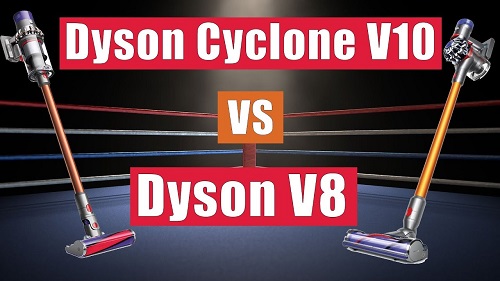
The weight difference between these two vacuums is negligible — under 100 grams — so physical fatigue is rarely a meaningful factor when choosing between them. The filtration gap is considerably more significant: the V10's whole-machine sealed filtration captures particles down to 0.3 microns across the entire airflow path, compared to the V8's post-motor HEPA stage, which is effective but less comprehensive in allergen containment. The faster charge time on the V10 is also a practical advantage for households that vacuum frequently throughout the week.
Selecting between these two vacuums works best when home users evaluate their actual cleaning context rather than defaulting automatically to the higher-specification model. Our team has encountered situations where the V10 was purchased for environments where the V8 would have performed equally well, and the reverse is also true. A methodical approach to the decision avoids both outcomes and ensures the investment matches genuine household needs from the outset.
Homes under 1,500 square feet with mostly hard floors and light foot traffic rarely push the V8 to its limits during a standard cleaning session. The V8's 40-minute maximum runtime on its lowest power setting handles most standard apartments and smaller homes without requiring a mid-session recharge. Larger spaces, low-frequency vacuuming schedules, or high debris accumulation all benefit noticeably from the V10's 60-minute runtime and stronger boost-mode suction.
Pro insight: Running either Dyson model in standard mode rather than boost preserves battery life significantly — our team recommends reserving boost mode for targeted problem areas like thick rugs or congested corners only.
Both vacuums include attachments for carpet and hard floors, but the V10's stronger motor extracts embedded debris from high-pile carpet more effectively than the V8 across our testing. For predominantly hard-floor homes — tile, laminate, or hardwood — the V8 performs capably, and our experience on those surfaces has been consistently positive. Our guide on vacuuming carpets and rugs covers technique-level recommendations that apply equally well to both models in mixed-floor environments.
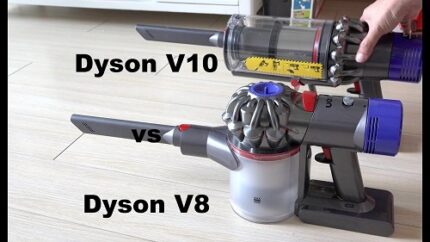
One of the most useful frames for the Dyson V8 vs V10 comparison is to consider cleaning intensity rather than specs in isolation. Our team has observed that most households fall into distinct usage profiles, and each profile maps more naturally to one model than the other. That pattern makes the purchasing decision considerably more straightforward once the correct profile is identified.
The V8 suits smaller households with occasional vacuuming needs, fewer pets, and predominantly smooth floor surfaces throughout. It handles everyday tasks — quick cleanups, regular maintenance passes, and handheld-to-stick transitions — with lighter and quieter operation that many find more approachable for frequent short sessions. At a lower price point than the V10, the V8 delivers an excellent return for standard-use scenarios where peak suction is rarely the priority.
High-demand homes with multiple pets, children, or documented allergy concerns represent the V10's core use case, where its stronger suction and sealed filtration produce tangible differences in both debris removal and post-vacuum air quality. Our team has also found the V10 better suited to larger homes requiring extended cleaning sessions without pause. Homes with thick-pile carpets that demand consistently high suction also benefit more from the V10's stronger motor across repeated use.
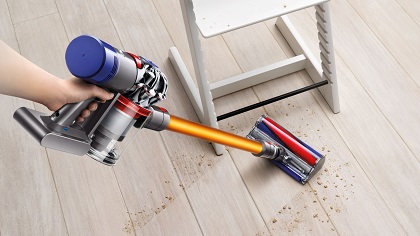
Technical specifications only tell part of the story — the real measure is how each vacuum performs in the specific conditions that home cleaning involves daily. Our team's hands-on assessment of both models across varied environments provides a grounded perspective on where each excels and where meaningful limitations appear in practice.
The V10 holds a clear advantage in pet hair and allergen households, where its whole-machine HEPA filtration prevents fine particles from escaping back into the air during use. Our guide on removing pet hair from the home highlights why filtration quality matters as much as suction in pet-heavy environments, and both models represent that principle differently. The V8 filter performs adequately for low-shedding animals, but multi-pet homes consistently benefit more from the V10's sealed system in our team's experience.
On hard floors, both vacuums perform strongly, though the V10's direct-drive cleaner head transitions between surface types with less adjustment needed during a typical session. Mixed-surface homes — combining tile entryways, hardwood living areas, and carpeted bedrooms — represent the environment where the V10's cross-surface consistency becomes most noticeable in day-to-day use. The V8 handles these transitions well too, though it may benefit from slightly more power-mode adjustment when encountering high-pile carpet sections mid-session.
Important note: Dyson recommends washing filters monthly under cold water only and allowing at least 24 hours of drying time before reinsertion — running either model with a damp filter risks motor damage over time.
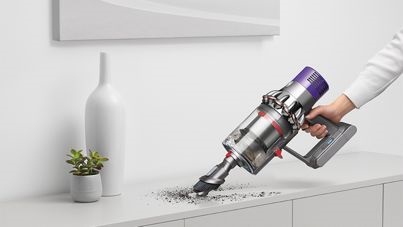
Several persistent myths circulate about the V8 and V10, and our team has encountered them frequently enough to address directly. The first myth is that the V8 is effectively obsolete now that the V10 exists. This isn't accurate — the V8 continues to receive Dyson support and remains a capable vacuum for most standard-use households. A second misconception holds that the V10 is substantially heavier and more fatiguing to use, when the actual weight difference is under 100 grams and rarely perceptible during normal cleaning. The third myth worth addressing is that higher suction always produces better cleaning results. On delicate rugs or fine debris, lower power settings on either model capture more effectively, since maximum boost mode can scatter light particles before the vacuum head reaches them.
The Dyson V8 vs V10 comparison is ultimately not about which vacuum is superior in absolute terms, but which one matches the cleaning demands of a specific home. Our team has found that both models perform reliably when well-maintained and used in contexts suited to their respective capabilities, and neither represents a poor investment within its intended use case.
Regardless of which model home users select, ongoing maintenance preserves vacuum performance more reliably than most people expect. Both models have washable filters requiring monthly cleaning to maintain optimal airflow — a step that is frequently skipped and often responsible for gradual suction decline. Our team recommends emptying the bin before it reaches maximum capacity, rather than waiting until completely full, since a full bin measurably reduces suction efficiency on both models. Checking the brush bar every two to three weeks for hair wrap prevents motor strain and keeps cleaning performance consistent across all floor surfaces in regular use.
Storing either vacuum with the battery partially charged rather than fully depleted after each session preserves lithium-ion cell health over the long term, a practice our team recommends for both models. Both vacuums also benefit from occasional dry-cloth wipe-downs of the cyclone shroud and bin interior, which prevents fine dust accumulation from affecting separation efficiency across repeated cleaning sessions.
The longer-term picture in the Dyson V8 vs V10 comparison involves battery degradation, replacement part availability, and resale value. Both models use lithium-ion battery packs that degrade gradually with charge cycles. Most users note a noticeable runtime decline after approximately three to four years of regular weekly use, which is a predictable and manageable outcome for either model. Replacement batteries are available for both through Dyson and third-party suppliers, extending the practical lifespan of either vacuum meaningfully beyond its initial battery cycle.
The V10 currently enjoys broader parts availability as the more recently manufactured model, though the V8's ecosystem remains well-supported through Dyson's service network. From a resale perspective, both hold value reasonably well in the secondhand market, particularly when sold with original accessories and documentation intact. Most people find that whichever model was the correct fit initially continues to deliver satisfactory results well into its second half of expected service life with proper care.
For households with pets, allergy concerns, or larger floor areas, the V10's additional suction, longer runtime, and whole-machine HEPA filtration justify the price difference in our team's assessment. Smaller homes with standard cleaning needs often find the V8 delivers equivalent real-world results at a more accessible price point.
The V8's 40-minute runtime on standard power handles homes up to approximately 1,200–1,500 square feet comfortably, assuming manageable debris levels throughout. Larger homes or spaces with thick carpet may require a mid-session battery recharge, which is worth factoring in for floor plans above that threshold.
The V10's whole-machine sealed filtration captures particles down to 0.3 microns across the entire airflow path, providing more thorough allergen containment than the V8's post-motor HEPA filter. For households with documented allergy or asthma concerns, our team's assessment consistently favors the V10's sealed approach as the more comprehensive solution.
Dyson recommends washing the filters on both the V8 and V10 once per month under cold running water, followed by a full 24-hour dry period before reinsertion. Our team advises against warm water or cleaning agents, as both can degrade filter material and reduce long-term filtration effectiveness on either model.
 |
 |
 |
 |

About Liz Gonzales
Liz Gonzales grew up surrounded by art and design in a New York suburb, with both parents teaching studio arts at the State University of New York. That environment sharpened her eye for aesthetics and spatial detail — skills she now applies to evaluating home products where form and function both matter. She has spent the past several years writing about lighting, home decor accessories, and outdoor living gear, with a particular focus on how products perform in real residential settings rather than showrooms. At Linea, she covers lighting fixtures and bulb reviews, outdoor and patio gear, and general home product comparisons.
You can Get FREE Gifts. Furthermore, Free Items here. Disable Ad Blocker to receive them all.
Once done, hit anything below
|
|
|
|