
You walk into a hardware store looking for a work light, and the sheer number of options is immediately overwhelming. Cordless battery-powered models sit next to towering tripod flood lights, and compact magnetic rechargeable units compete with high-lumen corded powerhouses. Choosing the wrong one means struggling through a welding project, an engine repair, or a basement renovation in inadequate light — a frustration that wastes time and risks mistakes.
Whether you are setting up a dedicated workshop, tackling mobile automotive repairs, or outfitting a professional jobsite, the right work light makes a measurable difference in safety and productivity. In 2026, the LED work light market has matured considerably, offering options at every price point and lumen output. This guide covers seven of the top-rated models available today, with a focus on welders, mechanics, contractors, and serious DIYers who need reliable, bright, and durable illumination. For a broader overview of lighting solutions, visit the lighting category page.
Before selecting a work light, it helps to understand what lumen output actually means in practice. If you need a primer, the guide on how bright a lumen is will give you the foundational knowledge to compare these products intelligently. The picks below range from a compact 300-lumen battery-powered articulating light to a 15,000-lumen corded flood — matched to different use cases and budgets.
Contents




The DEWALT DCL050 is a bare-tool cordless work light that runs on any DEWALT 20V MAX battery, making it an obvious choice for tradespeople already invested in the DEWALT ecosystem. It delivers 1,000 lumens on high and 300 lumens on low, giving you flexibility for detail work versus broad area illumination. The 140-degree pivoting head is the standout mechanical feature — you can angle it straight down to illuminate a workbench, straight forward for a flood effect, or anywhere in between.
Build quality is solid throughout. The rubber overmold grip provides control in oily or damp conditions, and the hook on the base allows hands-free hanging from scaffolding, framing lumber, or overhead fixtures. Battery life depends entirely on the pack you select — a 4Ah battery delivers extended runtime at the low setting, making this viable for all-day use on a construction site. The three-LED array produces a clean, even spread with minimal hotspots, which is particularly useful for welding prep and inspection work where shadow elimination matters.
This is a tool-only purchase, so factor in the cost of a compatible battery and charger if you are not already in the DEWALT 20V platform. It is not the brightest light on this list, but for a cordless, one-handed, fully portable solution that you can clip to almost anything, the DCL050 performs without compromise.
Pros:
Cons:
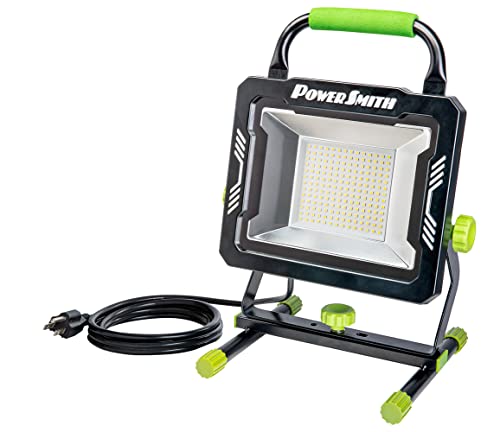
When raw lumen output is the priority, the POWERSMITH PWLS150H is the most powerful corded work light on this list. Its 15,000-lumen maximum output is suitable for large open areas — full garage bays, construction floor slabs, outdoor jobsite perimeters, or any space where a single portable light needs to replace overhead shop fixtures. The metal housing is a significant advantage over plastic-bodied competitors; it dissipates heat more effectively and withstands the physical abuse of a working jobsite.
The adjustable tilt mechanism — 30 degrees downward and 90 degrees upward — uses large thumbwheels that tighten securely without tools. The sealed rocker on/off switch is a well-considered detail that prevents moisture intrusion and extends the switch lifespan in damp environments. At the lower 7,500-lumen setting, the PWLS150H still outperforms most competing lights at full power, making the high mode reserved for only the most demanding situations. The 10-foot power cord provides useful reach without requiring an extension cord in most scenarios.
The 5-year warranty is exceptional for this product category and signals POWERSMITH's confidence in the metal housing and LED array longevity. For any stationary high-output application — including welding stations and spray booths — this is the benchmark corded option in 2026.
Pros:
Cons:
The Bayco SL-1522 solves a common jobsite problem: how do you eliminate shadows across an uneven work surface when a single-head flood creates a strong directional shadow? The answer is two independently adjustable 20W LED fixtures mounted on a six-foot tripod. Each fixture produces 3,000 lumens for a combined 6,000 lumens total, but the real value is the ability to aim each head in a different direction simultaneously — one angled toward the left side of an engine bay, the other lighting the right.
The tripod design raises the light heads to a height that clears most vehicle profiles and workbench setups, and both fixture heads are removable from the base unit for low-angle or floor-level illumination. This detachability transforms the SL-1522 from a standing flood into a ground-level worklight for undercar or tight-space applications. The build quality matches Bayco's professional-grade reputation — the fixtures feel robust, the tripod legs lock firmly, and the cord management is clean. For mechanics, the dual-head design mirrors professional automotive lighting standards referenced by organizations like OSHA workplace lighting guidelines, which emphasize shadow-free illumination for precision work.
If you work frequently around vehicles or in spaces where a single light creates problematic shadows, the SL-1522 is the most practical solution on this list.
Pros:
Cons:
The BOSCH GLI18V-300N takes a different approach to cordless work lighting by prioritizing articulation and runtime over raw lumen count. Six LED lights deliver a combined 300 lumens, which is focused and adequate for close-quarters work — inside cabinets, under dashboards, in junction boxes, or within confined mechanical assemblies. The articulating design allows precise positioning in tight spaces where a larger light cannot physically fit or be directed accurately.
Where the GLI18V-300N truly distinguishes itself is runtime. At 300 minutes of output per amp hour of battery capacity, a standard 4Ah BOSCH 18V battery delivers over 20 hours of continuous use. That level of endurance is exceptional for all-day tradespeople who cannot stop to recharge mid-job. The light is also noticeably compact and lightweight, making it comfortable to carry in a tool belt pouch and easy to hold in one hand while working with the other. This pairs well with similar tools reviewed in the guide to the best penlights for mechanics — both prioritize access over output in confined environments.
For users who need maximum brightness across a wide area, the 300-lumen ceiling is a limitation. However, for targeted close-up work in dark confined spaces, no other light on this list matches the GLI18V-300N's combination of runtime, portability, and directional flexibility.
Pros:
Cons:
Milwaukee's M12 Rover is designed for the service and repair professional who needs a reliable, portable flood light that works in wet and dirty environments. The water-resistant construction is a genuine field advantage for mechanics working in rain-exposed bays, plumbers dealing with pipe leaks, or any tradesperson whose jobsite involves moisture. The USB charging port adds utility as a power bank for charging phones and small devices during long service calls.
The M12 battery platform is one of the most widely adopted compact tool batteries in the industry, and the Rover integrates seamlessly into it. The flood light design produces a wide, even beam pattern that fills a workspace rather than concentrating on a single point — ideal for service bay work where you need ambient illumination rather than a spotlight. The modern, compact profile means the Rover fits into tight spaces that a larger tripod unit cannot access, and it is easy to set on a shelf, wheel well, or engine compartment ledge without a dedicated stand.
For Milwaukee M12 users already carrying a full kit, adding the Rover as a battery-powered supplemental light is an efficient and cost-effective decision. For those outside the ecosystem, the Rover alone may not justify platform entry without other M12 tools to justify the battery investment.
Pros:
Cons:
The BRIMMEL dual-head work light punches above its price class with a feature set that rivals professional-grade units. At 12,000 lumens maximum from 288 LED beads across two heads, it delivers serious coverage for large jobsites, renovation projects, and warehouse work areas. The three color temperature options — 3,000K warm, 4,500K neutral, and 5,000K daylight — are a practical differentiator. Daylight color temperature at 5,000K is the correct choice for welding preparation, paint inspection, and color-sensitive finishing work, where warm light can mask surface defects.
The quick-release buckle system expands the stand from a compact 40-inch folded configuration to a working height of 75 inches without tools. That range covers most jobsite scenarios from low workbench angle to overhead flood. The heat dissipation blade design keeps the LED head temperature controlled during extended operation, which protects the 50,000-hour rated lifespan. Unlike many budget tripod lights that use thin plastic legs, BRIMMEL's foldable stand feels stable at full extension. The dual-head configuration also allows each head to be angled independently, mirroring the shadow-elimination advantage of the Bayco SL-1522 at a different price point.
For contractors, renovation crews, and serious hobbyists who need adjustable color temperature alongside high lumen output, the BRIMMEL represents the strongest overall value on this list in 2026.
Pros:
Cons:
The COB Magnetic Rechargeable Work Light is the most versatile handheld option on this list, combining a COB flood panel on one face with an LED spotlight on the opposite side — two distinct light sources in a single tool. The 5,000mAh lithium battery delivers between 3.5 and 9 hours of runtime depending on brightness setting, and the Type-C fast charge refills the battery in approximately 2.5 hours. It also functions as a USB power bank, allowing you to charge a phone or tablet directly from the work light during extended remote work.
The 360-degree adjustable stand, integrated rear magnet, hidden hook, and 1/4-inch tripod thread give this light four distinct mounting options — more than any other product on this list. You can attach it magnetically to a vehicle frame, hang it from a hook in an attic, mount it on a camera tripod, or stand it on any flat surface. Stepless dimming (rather than fixed brightness steps) allows precise tuning from minimum ambient glow to full output. The waterproof construction adds confidence for outdoor and under-vehicle use. For those who carry a flashlight for supplemental use, pairing this light with a unit from the best 1,000-lumen flashlight reviews provides comprehensive coverage across short-throw and wide-flood scenarios.
This light does not replace a high-output tripod flood for large spaces, but for a single rechargeable tool that handles the widest possible range of mounting positions and use cases, it has no direct equivalent on this list.
Pros:
Cons:
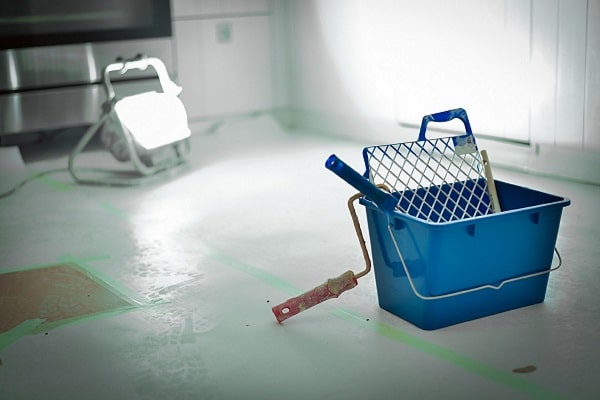
Lumen count is the single most important specification on a work light. However, raw lumens do not tell the complete story. A 1,000-lumen light with a focused beam pattern covers less area than a 1,000-lumen flood. Consider your typical workspace dimensions and task type before selecting a target output:
Color temperature also affects how you perceive brightness and surface detail. Warm white (3,000K) is comfortable for ambient light but obscures surface texture. Daylight (5,000K) is the professional standard for inspection, welding prep, and finish work because it reveals detail and color accurately.
The choice between corded and cordless determines where and how long you can work:
For a primary shop or jobsite flood light, corded is the reliable choice. For mobile repair work, welding in the field, or any task that takes you away from outlets, battery power is non-negotiable.
A work light is only useful if you can get it into the right position. Evaluate the mounting options before purchasing:
Jobsite conditions are harsh. A work light that fails after moderate use is not a savings — it is a loss. Look for these durability indicators:
LED arrays themselves are highly durable — rated lifespans of 30,000 to 50,000 hours mean the LED is unlikely to fail before the housing or switch does. The mechanical components determine real-world longevity far more than the light source itself.
For welding applications, prioritize a work light with a 5,000K daylight color temperature, as it reveals surface detail and weld pool characteristics most accurately. The BRIMMEL 12,000-lumen dual-head light with its 5,000K setting is the top choice for a stationary welding station. The POWERSMITH PWLS150H is the best single-head corded option for maximum illumination. Avoid warm white (3,000K) lights for welding prep — they obscure surface contaminants and weld seam detail.
The lumen requirement depends on your workspace size. For confined spaces and close-up work (under a dashboard, inside a cabinet), 300 to 1,000 lumens is adequate. For a standard single-car garage bay, 3,000 to 6,000 lumens provides comfortable coverage. For large construction areas, spray booths, or multi-bay garages, you need 10,000 lumens or more. Always match the beam spread to the task — a wide flood at 6,000 lumens covers more area than a narrow spot at the same output.
In most cases, corded work lights deliver higher sustained lumen output than cordless alternatives. Battery-powered lights are constrained by battery voltage and capacity, which limits the wattage available to the LED array. The brightest corded models on this list reach 15,000 lumens, while the brightest cordless option delivers around 1,000 lumens from dedicated tool-platform lights. Rechargeable standalone units (like the COB magnetic light) claim higher output but are best used as portable supplemental lighting rather than primary flood sources.
5,000K daylight color temperature is the professional standard for work lighting. It closely approximates natural sunlight, which means colors appear accurate, surface textures are visible, and your eyes experience less fatigue during extended work sessions. Warm white (3,000K) is comfortable but reduces contrast and detail visibility. Neutral white (4,500K) is a practical compromise for general tasks. If your work light offers selectable color temperature — as the BRIMMEL does — select 5,000K for any inspection, finishing, or precision work.
Yes, provided the light is rated for outdoor or wet-environment use. Look for products with an IP (Ingress Protection) rating or an explicit weather-resistance claim. The COB Magnetic Rechargeable Work Light and the Milwaukee M12 Rover both carry water-resistant designations. Corded lights used outdoors should be connected through a GFCI-protected outlet. Always verify that the power cord and any switches are sealed or rated for damp locations before using corded equipment in rain-exposed areas.
If you do not already own a compatible battery platform, the cost of entry — a bare-tool light plus battery plus charger — is significantly higher than purchasing a corded alternative. However, if you plan to expand into other cordless tools from the same brand, the shared battery platform delivers long-term value. For a standalone purchase with no ecosystem commitment, the COB Magnetic Rechargeable Work Light with its built-in battery is the more economical starting point. It requires no additional platform investment and provides flexibility across four mounting configurations.
The best work light is not the one with the most lumens — it is the one you can position precisely, power reliably, and trust completely in the conditions where your work actually happens.
 |
 |
 |
 |

About Liz Gonzales
Liz Gonzales grew up surrounded by art and design in a New York suburb, with both parents teaching studio arts at the State University of New York. That environment sharpened her eye for aesthetics and spatial detail — skills she now applies to evaluating home products where form and function both matter. She has spent the past several years writing about lighting, home decor accessories, and outdoor living gear, with a particular focus on how products perform in real residential settings rather than showrooms. At Linea, she covers lighting fixtures and bulb reviews, outdoor and patio gear, and general home product comparisons.
You can Get FREE Gifts. Furthermore, Free Items here. Disable Ad Blocker to receive them all.
Once done, hit anything below
|
|
|
|