
Which 1000 lumen flashlight is actually worth buying in 2026 — and how do you tell the difference between a well-engineered torch and one that just looks impressive in photos? If you've spent any time browsing Amazon listings, you already know how overwhelming it gets. Lumen counts keep climbing, brand names blur together, and every product page promises "military-grade" performance. The good news: we've narrowed it down. The Streamlight ProTac HL USB stands out as the go-to choice for most buyers, but your specific needs might point you in a different direction entirely.
A 1000-lumen output sits in a practical sweet spot. It's bright enough to light up a trail at night, search a large warehouse, or handle emergency situations — without draining your battery in twenty minutes. To understand what that really means in everyday terms, check out our guide on how bright a lumen actually is, because manufacturers measure things differently and the raw number alone doesn't tell the whole story. Whether you're a first responder, a weekend camper, or just someone who wants a dependable light in the garage, the right flashlight comes down to more than peak brightness.
Below you'll find six in-depth reviews covering everything from tactical units to everyday carry options, followed by a buying guide and answers to the questions shoppers ask most. All of these picks are available through our affiliate links, and prices reflect current Amazon listings as of 2026.
Contents




Streamlight has been building professional-grade lighting gear for decades, and the ProTac HL USB shows exactly why they have such a loyal following among law enforcement and first responders. At its core, you get 1000 lumens on high with a beam reach of 219 meters — that's enough to identify objects at serious distance in complete darkness. The beam is tight and focused without sacrificing the surrounding flood light you need for situational awareness.
What really separates this light from the competition is its fuel flexibility. It runs on Streamlight's proprietary USB-C rechargeable battery pack, but it also accepts CR123A lithium batteries as a backup — a critical feature if you're in the field and can't always guarantee access to a charging port. The USB-C port supports convenient recharging from any modern power bank, laptop, or wall adapter. Drop down to low mode (around 65 lumens) and you're looking at roughly 23 hours of runtime, which is genuinely useful for overnight operations or extended tasks.
Build quality is exactly what you'd expect from Streamlight. The aluminum body is machined to tight tolerances, the included holster fits snugly without being fussy, and the tail-cap switch gives you a clean, predictable click every time. Three output modes keep things simple — no complex button sequences to remember under pressure. If you're shopping in the lighting category and want something you can hand to a professional and know they won't have complaints, this is the one.
Pros:
Cons:
The Nitecore P12GT is built around a Cree XP-L HI V3 LED paired with precision digital optics — a combination that produces a noticeably tighter, longer-throw beam than most 1000-lumen competitors. Nitecore's crystal coating technology contributes to a cleaner, more defined hot spot, which matters a great deal if you're using this light for precision tasks like scanning a tree line or identifying an object at distance rather than simply flooding an area with light.
This is a fundamentally tactical flashlight. The body is slim, the pocket clip is usable, and the user interface is streamlined for quick one-handed operation. It runs on a single 18650 cell or two CR123A batteries — a smart design choice that gives you field flexibility similar to the Streamlight above. Output settings span from ultra-low firefly mode all the way up to 1000 lumens, with an intermediate Turbo mode that briefly pushes past the rated ceiling before thermal regulation steps in.
If you're also in the market for specialty illumination tools, you might find our roundup of the best penlights for mechanics useful for comparison — the ergonomics philosophy is similar but the application is different. The P12GT is a no-frills, high-performance option that rewards users who know exactly what they need from a tactical light. It's not the flashiest package, but the output quality speaks for itself.
Pros:
Cons:
Most flashlight reviews skip past color rendering index (CRI) without much comment, but if you use a flashlight for detailed work — inspecting wiring, reading fine print, examining items in low light — it changes everything. The Wurkkos FC11C uses a 90 CRI LED at 5000K, which means colors look natural and accurate rather than washed-out or artificially blue. At up to 1200 lumens with a 155-meter beam distance, this little light punches well above its size class.
The charging setup is straightforward: built-in USB-C port, anti-reverse battery installation to prevent user error, and an indicator light that tells you exactly where your charge level stands. When power drops below 15%, the indicator flashes red as a warning. That kind of thoughtful design shows up throughout the FC11C. The constant-current circuit (non-PWM) means the brightness doesn't fluctuate or flicker — a genuinely meaningful detail for anyone sensitive to visual fatigue during extended use.
IP68 waterproofing to 155 meters sounds dramatic, but in practice it means you don't have to worry about rain, drops in puddles, or damp environments. The magnetic tail cap adds another layer of convenience — stick it to any metal surface and you've got a hands-free work light. For its price, the FC11C offers a feature set that typically costs significantly more from established brands. It's the smart pick if everyday carry and color quality are your priorities.
Pros:
Cons:

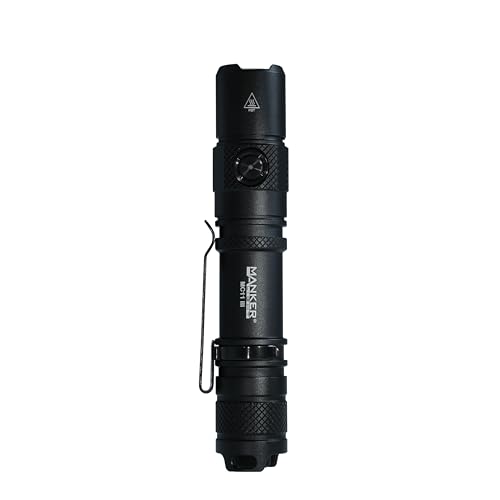
The MANKER MC11 III steps beyond the 1000-lumen baseline with a rated 1400 lumens and a beam distance of 410 meters — that's longer than a standard American football field. The LUMINUS SFT25R LED driving this output is paired with a reflector optimized for throw, making it a natural fit for hunting, search and rescue, and any scenario where you need to identify something far away rather than illuminate a nearby area. Five brightness levels plus a strobe mode give you enough range to cover most situations.
Battery life is where the MC11 III genuinely impresses. The included 3500mAh 21700 cell supports PD/QC fast charging via USB-C, and the ECO mode stretches runtime to an extraordinary 360 hours — 15 full days of continuous use. In practice, you'll run it at higher modes, but knowing there's that much reserve is reassuring on long expeditions. The triple-color battery indicator (blue for full, purple for mid, red for low) takes the guesswork out of knowing when to recharge.
The chassis is A6061-T6 aluminum with HA-III hard anodizing, giving it 2-meter drop resistance alongside IP68 waterproofing. If you've ever dropped a flashlight on concrete and had the head crack, you'll appreciate that extra durability margin. This is a purpose-built tool for outdoor use in challenging conditions — not the most compact option, but absolutely the right choice when long-distance performance is non-negotiable.
Pros:
Cons:
The ThruNite TC15 V3 breaks out of the 1000-lumen category entirely with an extreme output of 2403 lumens using an XHP 35.2 LED. If you're reading this because you thought 1000 lumens might not be enough, this is where you land. ThruNite calls this one of their brightest rechargeable flashlights for good reason — the TC15 V3 delivers a beam that reaches 223 meters while still being compact enough to fit in a jacket pocket.
Charging is handled through a built-in USB Type-C port with an IMR battery cell that works with the integrated battery level indicator. You always know how much runtime you have left before heading out. Setup is simple: charge it fully before first use by screwing down both the head and tail cap tightly — a small detail that matters for maintaining the electrical connection and preventing charging issues. ThruNite includes clear usage instructions that help first-time users avoid the common pitfalls.
The TC15 V3 is a good example of how 2026's flashlight market has pushed the lumen ceiling dramatically higher without a matching increase in physical size. You can throw this in a bag for camping, keep it in your car for emergencies, or use it in security work. The one caveat worth noting: running at 2403 lumens generates real heat, and thermal protection will step down output after sustained high-mode use. That's not a flaw — it's physics — but it's worth factoring into your expectations.
Pros:
Cons:
Sofirn's SP31 has been a community favorite for years, and the V3 upgrade doubles down on what made it popular: high output at a fair price with a no-nonsense dual-switch interface. At 2000 lumens with a throw distance of 882 feet (roughly 269 meters), it outperforms its price tag on raw numbers alone. The 110-degree light angle strikes a deliberate balance — you get meaningful flood coverage for nearby work without sacrificing the throw you need for distance.
The dual-switch layout is one of the smartest UI decisions on this list. The tail switch gives you fast access in an emergency — one click, light on. The side switch cycles you through low, medium, high, turbo, and strobe. If you want moonlight mode, hold the side switch and click the tail simultaneously. That kind of logical switch separation makes the SP31 V3 genuinely easy to operate under stress, which is the point of a tactical flashlight. You shouldn't have to think about button sequences when you need light immediately.
Runtime is equally impressive. On ECO mode, the SP31 V3 runs for 23 days. On low mode, you're looking at five days. Those numbers matter for professionals who keep a light on their person all day. The built-in USB-C port charges quickly, and the compact build means it clips to a pocket or rides in a holster without getting in the way. If you want to pair this with reliable batteries, check out our guide to the best AAAA batteries for related small-format battery knowledge. For the combination of features, build quality, and price, the SP31 V3 is the smart buy for budget-conscious buyers who don't want to compromise on performance.
Pros:
Cons:
The lumen rating on a box tells you how much total light a flashlight emits, but it doesn't tell you how useful that light is in practice. A wide floodlight at 1000 lumens looks very different from a tight thrower at the same rating — the floodlight spreads light broadly for close-range visibility, while the thrower punches a concentrated beam farther into the dark. According to Wikipedia's breakdown of the lumen unit, the measurement is based on total luminous flux, not directional intensity. So when you're comparing specs, also look at candela (peak beam intensity) and beam distance alongside lumens. A flashlight with 1000 lumens and a 410-meter throw is a fundamentally different tool than one with 1000 lumens and a 150-meter throw.
Your choice of battery type affects everything from runtime to real-world cost over the flashlight's lifetime. Built-in USB-C rechargeable models are the most convenient for daily carry — you charge them like a phone, and they're ready when you need them. Flashlights with removable 18650 or 21700 cells give you the option to carry a spare battery and swap in the field, which matters enormously for extended outdoor use or professional situations where you can't stop to recharge. Dual-fuel designs that accept both proprietary cells and off-the-shelf CR123A batteries offer the best of both worlds, at the cost of slightly more complexity. Always check the low-mode runtime, not just the headline number — that's where you'll spend most of your hours.
IP ratings follow a standardized two-digit system: the first digit covers dust resistance, the second covers water resistance. Most quality flashlights carry an IP67 or IP68 rating. IP67 means the light can survive submersion at 1 meter for 30 minutes; IP68 means it can handle 2 meters or deeper, depending on the manufacturer's specification. For everyday carry and camping, IP67 is more than sufficient. If you're working in genuinely wet environments — marine applications, heavy rainfall, or emergency flood response — IP68 with a tested depth rating gives you meaningful extra confidence. Beyond water resistance, look at drop resistance ratings. A 2-meter drop rating is noticeably more robust than the industry-standard 1-meter spec.
A flashlight's interface determines how quickly and reliably you can use it under pressure. Single-switch designs are simple and fast — one button does everything. Dual-switch designs, like the Sofirn SP31 V3, separate power control from mode cycling, which reduces the risk of accidentally cycling through modes when you just need the light on fast. For tactical use, a tail-cap clicky switch that allows momentary-on operation (press without clicking through) is often preferred by law enforcement and military users. If you only use a flashlight occasionally for camping or home use, interface complexity matters less. But if it's a professional tool, spend time thinking about how intuitive the controls are when you're cold, gloved, or stressed.
For most outdoor activities — trail hiking, camping, scanning a campsite, or navigating in the dark — 1000 lumens is more than adequate. You'll typically run at medium or low modes to preserve battery life, using the full 1000 lumens only when you need to see something at distance. For professional search and rescue or hunting over long distances, models in this roundup that push 1400 lumens or beyond offer a meaningful advantage in beam reach.
Lumens measure total light output — the amount of visible light the flashlight produces. Beam distance measures how far the light travels before it drops to a specific brightness threshold (typically 0.25 lux, roughly equivalent to a full moon's illumination at the target). A flashlight with a tight, focused reflector can throw its 1000 lumens farther than a floody design with the same lumen output. Both numbers matter depending on how you use your light.
Runtime varies dramatically by mode. At maximum 1000-lumen output, most flashlights in this category run between 1 and 3 hours. Drop to medium mode (around 300–500 lumens) and runtime typically extends to 5–10 hours. On low or ECO modes, some lights in this roundup run for 23 hours or even multiple days. Always check the runtime chart for each individual mode, not just the peak figure, because that's where real-world use happens.
It depends on your use case. USB-C rechargeable flashlights are more convenient for daily carry because you charge them from any modern power source, and they're more economical over time since you're not buying batteries regularly. Flashlights with removable cells give you field flexibility — carry a spare charged battery and swap it in seconds. The best option for professional or survival use is a dual-fuel design that accepts both a rechargeable cell and standard disposable batteries as a backup.
IP68 is the highest common waterproof rating and means the flashlight can withstand continuous submersion beyond 1 meter — typically 1.5 to 2 meters for 30 minutes, depending on the manufacturer's specification. For practical purposes, it means your flashlight can survive being dropped in a river, used in heavy rain, or accidentally submerged without failing. All six flashlights reviewed here carry at least an IP68 rating, making them suitable for outdoor and professional use in wet conditions.
Yes, if you use a flashlight for detailed work. Color Rendering Index (CRI) measures how accurately a light source reproduces colors compared to natural daylight. A 90 CRI light like the Wurkkos FC11C makes colors look natural and vivid — useful for identifying wires, inspecting surfaces, or reading labels in the dark. Standard flashlights typically have CRI ratings in the 60–75 range, which makes colors look slightly dull or distorted. For general illumination and distance use, lower CRI is fine. For close-up detail work, higher CRI is noticeably better.
Whether you're after a professional-grade tactical light, a compact everyday carry option with excellent color rendering, or the raw output of an ultra-bright USB-C rechargeable, 2026 has genuinely great options at every price point — the six picks above cover the full range. Take a look at the comparison table, match your priorities against the specs, and click through to check current Amazon pricing before you decide; the right flashlight is the one that fits your actual use, not just the one with the highest number on the box.
 |
 |
 |
 |

About Linea Lorenzo
Linea Lorenzo has spent over a decade testing home gadgets, cleaning products, and consumer electronics from his base in Sacramento, California. What started as a personal obsession with keeping his space clean and stocked with the right tools evolved into a full-time writing career covering the home products space. He has hands-on experience with hundreds of cleaning solutions, robotic and cordless vacuums, and everyday household gadgets — evaluating them for performance, value, and real-world usability rather than spec sheet appeal. At Linea, he covers home cleaning guides, general how-to tutorials, and practical product advice for everyday home care.
You can Get FREE Gifts. Furthermore, Free Items here. Disable Ad Blocker to receive them all.
Once done, hit anything below
|
|
|
|