
You're standing in front of a slow-draining sink or a yard that smells faintly of sewage, and you know it's time to look inside those pipes. Whether you're a licensed plumber running inspections daily or a homeowner trying to avoid a surprise $3,000 repair bill, a quality sewer camera pays for itself fast. The problem is that the market is flooded with options ranging from professional-grade reel systems to compact consumer endoscopes — and picking the wrong one wastes both money and time.
In 2026, sewer inspection cameras have become sharper, smarter, and more affordable than ever. HD 1080P sensors, built-in DVR recording, and dual-lens designs are now standard features even at mid-range price points. But not every camera handles the same job well. A 100-foot professional reel is overkill for inspecting a sink trap, and a 9.8-foot endoscope probe won't get you far into a main sewer line. Matching the tool to the task is everything.
This guide covers the seven best sewer cameras for drain inspection in 2026 — from RIDGID's professional-grade SeeSnake systems to capable budget-friendly options. For a broader overview of what to look for before you buy, visit our drain inspection guide. Read on for full reviews, a buying guide, and answers to the most common questions.
Contents





If you're a professional plumber or inspector who needs a sewer camera that can take daily punishment and still deliver reliable results, the RIDGID 70828 SeeSnake APX MicroReel is the benchmark. This system is built around RIDGID's proven SeeSnake platform — which means full compatibility with SeeSnake CSx monitors and a modular setup that fits into a real-world workflow. The Micro CA-350 camera head is equipped with four bright LEDs that light up pipe interiors without washing out detail, and the 100-foot cable gives you genuine reach into residential main lines and commercial drain systems alike.
What sets this unit apart from cheaper alternatives is its combination of portability and professional capability. At half the size of traditional inspection reel systems, it fits easily in a service truck without sacrificing the cable length or camera quality you actually need on the job. Recording is handled internally — still images and video save directly to the device's memory, so you're not fumbling with SD cards on a muddy job site. The built-in sonde and counter let you pinpoint blockage locations precisely, which is critical when you need to justify a camera-and-rod or excavation recommendation to a client.
This is not a consumer-grade unit dressed up in professional packaging. The build quality, the ecosystem compatibility, and the thoughtful design details — the dock handle, the kickstand, the 12V battery system — all reflect a tool built for tradespeople who use it eight hours a day. The price reflects that, but for working plumbers, the investment makes sense on day one.
Pros:
Cons:
The RIDGID 70023 SeeSnake microDRAIN APX takes professional drain inspection up a level with TruSense technology — a suite of advanced sensor features that transforms what you can learn from a single camera pass. The star of the show is the HDR image sensor, which handles high-contrast pipe environments better than conventional sensors. You've seen it in cheaper cameras: bright spots around LEDs and muddy shadows everywhere else. The HDR sensor eliminates that trade-off, delivering a balanced, detailed image across the full pipe interior even in challenging light conditions.
TruSense also includes the TiltSense inclinometer — a built-in angle measurement tool that, when paired with a SeeSnake CSx monitor, gives you precise slope readings inside drain lines. That's a genuine diagnostic advantage when you're evaluating whether a drain has proper fall or identifying low spots where debris accumulates. The Auto-Image Flip function rotates the camera image automatically without moving parts, keeping your orientation correct even as the camera navigates bends. The high-flex push cable is engineered to pass through multiple 90-degree bends in 1.5-inch drain lines — exactly the geometry you find in bathroom branch drains and kitchen sink stacks.
Like its sibling the 70828, this unit runs at half the size of traditional inspection systems. If you're evaluating both RIDGID APX models, the decision usually comes down to use case: the 70828 is your workhorse for main line runs, while the 70023 is the better tool when you need precise slope and angle data from smaller drain lines. Both are serious professional tools for serious work.
Pros:
Cons:
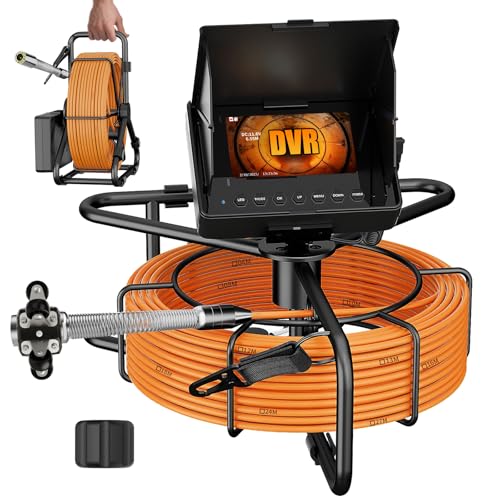
This updated 2026 model makes a strong first impression with its 7-inch IPS display — one of the largest screens in its price class. When you're crouched next to a cleanout or working in a cramped utility space, a bigger screen matters. The true HD 1080P lens with 16x zoom lets you identify cracks, root intrusion, mineral buildup, and grease blockages without squinting at a 4-inch thumbnail. Older drain cameras with TFT or small LCD screens frequently produced images too dark to be actionable — this one eliminates that frustration.
The 2026 twist-to-unlock cable reel system is a genuine upgrade over the two-screw designs common in this price range. Cable management is one of those overlooked pain points — if you've wrestled with a stiff reel lock on a dirty job site, you know how much time it wastes. The 1-second unlock mechanism on this model lets you deploy and coil cable quickly without risking jams or cable kinks. The 100-foot cable with a 5000mAh battery gives you extended run time, and the 32GB DVR card offers significantly more storage than the 8GB cards shipped with competing models. Video transfers via SD card or USB-C, so reviewing footage on a PC after the job is straightforward.
The 360° and 180° camera rotation gives you full pipe wall coverage without repositioning the camera, which is useful when you're hunting for a specific defect. If you're a property manager, a plumbing contractor doing residential work, or a serious DIYer dealing with recurring drain issues, this camera delivers professional-quality imaging at a fraction of the RIDGID price. It won't slot into a pro ecosystem the way the SeeSnake units do, but as a standalone inspection tool, it punches well above its weight class.
Pros:
Cons:
This 100-foot inspection camera earns its spot on this list through a combination of camera quality, battery endurance, and documentation features that matter in professional and insurance contexts. The AHD 1080P sensor with 12 adjustable LED lights is a reliable workhorse for main line inspection — the IP68-rated stainless steel camera head handles submersion without hesitation, and the 145-degree wide-angle lens gives you more peripheral pipe wall coverage than the standard 70-degree units you find in lower-priced cameras.
The 8500mAh battery is the standout spec here — it's large enough to sustain extended inspection sessions without a mid-job recharge interruption. For plumbers doing multiple inspections per day or property managers doing pre-purchase drain surveys, that runtime difference is real and meaningful. The 100-foot fiberglass cable includes clear depth markers in Arabic numerals, which sounds like a minor detail until you're trying to tell a client exactly where in the drain line a root intrusion is located. Audio and video recording with the built-in DVR and 16GB card makes this camera particularly useful for generating documentation for insurance claims or contractor estimates.
The 23mm camera head is sized for standard residential drain lines and most commercial branch drains. The 4.3-inch screen is smaller than the 7-inch unit above, but delivers adequate visibility for professional use, especially for plumbers who are primarily moving the camera and documenting rather than analyzing in real time. If your priority is long runtime and thorough documentation with audio narration capability, this is your camera. It pairs naturally with good practices around drain maintenance — similar to how a dryer vent cleaning kit helps you stay ahead of blockages in ventilation systems before they become emergencies.
Pros:
Cons:
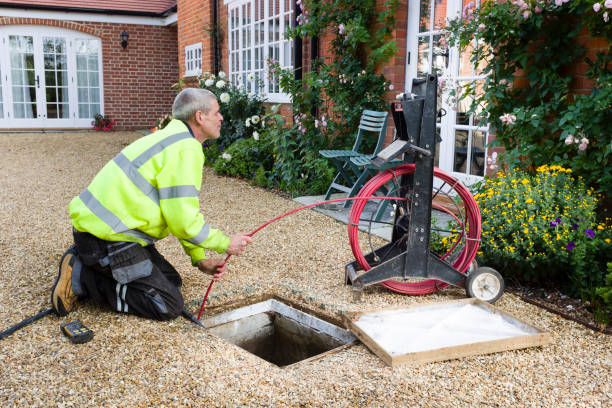
Teslong has built a reputation for delivering capable inspection cameras at accessible prices, and the 50-foot dual-lens model continues that tradition. The headline feature is the dual-camera system: a front-view camera for standard forward inspection and a side-mounted camera for a 90-degree lateral view — switchable with a single button press. That side camera is genuinely useful for spotting pipe joint separations, lateral cracks, and root intrusion points that a forward-only camera can miss when the probe passes them by.
The 50-foot IP67-rated cable is the practical trade-off with this unit. Fifty feet covers most residential drain scenarios — bathroom branch lines, kitchen sink runs, and most floor drain inspections — but it won't reach the far end of a longer main line run. For those jobs, the 100-foot models above are the right call. Where this camera excels is versatility within its range: the 4.5-inch IPS display with a 2500mAh battery gives you a solid viewing experience, the wide-angle lens shows more of the pipe wall per frame, and the dual-camera design means you're not missing lateral details that forward-only cameras leave invisible.
The Teslong is particularly popular with homeowners and property managers who want a capable tool for regular maintenance inspections without the commitment of a 100-foot professional setup. If you also do HVAC work, note that the flexible probe adapts well to duct inspection — similar to how a good inspection tool crosses over into multiple maintenance tasks around the house. For pipe-specific professional runs, pair it with a drain snake to extend the cable's effective reach, as the manufacturer suggests. The value here is hard to argue with.
Pros:
Cons:
The Teslong NTS500 takes a different approach from the drain-specific cameras above. With a 9.8-foot probe, this is an industrial endoscope engineered for precision close-range inspection — not main line sewer runs. Where it shines is in tight, confined scenarios: inspecting a P-trap from inside, checking a drain fitting before installation, evaluating a short section of pipe in a wall cavity without demolition, or inspecting mechanical components like engine combustion chambers through a spark plug hole. The 0.21-inch probe diameter is small enough to pass through openings that larger camera heads can't reach.
The dual-lens system — front-view and side-view built into the same probe tip — is a genuine engineering achievement at this size. Toggle between cameras with one button, no mirror attachment required. The 5-inch 720P IPS LCD screen is clear and readable, housed in an industrial-grade body with toughened glass that survives the kind of job site drops that kill consumer electronics. The 3500mAh battery provides solid runtime for a full day of intermittent inspections. This camera ships with a carrying case, which is a practical touch for a tool you're moving between job sites.
The 9.8-foot limitation is the honest constraint to acknowledge upfront. If you need to inspect a drain line beyond about 10 feet, this is not the right tool. But for shallow drain inspections, wall cavity checks, automotive diagnostics, and HVAC access point evaluations, the NTS500 is precise, well-built, and versatile. Think of it as a companion to a longer-reach camera, not a replacement — similar to how a wire locator is a precision tool that complements broader electrical diagnostic work rather than replacing it.
Pros:
Cons:
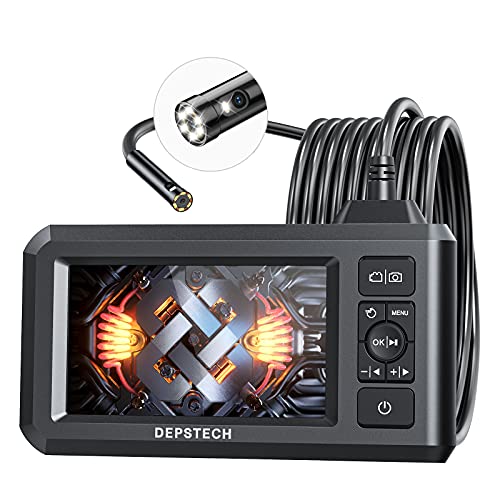
DEPSTECH's DS300 earns the all-around mid-range title by getting the fundamentals right across every category without any significant weak spots. The dual-lens design with FOV 70-degree side camera gives you the wider angle view when you need it in confined spaces, and the three observation modes — front camera, side camera, and split-screen — offer more flexibility than most cameras in this bracket. The 4.3-inch IPS TFT screen with a 170-degree horizontal viewing angle is one of the better displays at this price point, and the full 1080P video at 2.0MP photo resolution delivers footage that's genuinely usable for professional reports.
The second-generation CMOS chip in the DS300 is worth calling out. It delivers the highest recording frame rate in its class and eliminates the picture delay that plagues first-generation sensors — when you're navigating a camera through a pipe junction, real-time image feedback is not optional. The seven adjustable LED lights with DEPSTECH's Bluart 2.0 technology produce clean, even illumination without the hot-spot glare that makes detail analysis difficult. Battery life runs about four hours of continuous use, which covers most inspection sessions, and USB recharging means you can top up from any power bank between jobs.
The 16.5-foot semi-rigid cable with the included 32GB card makes the DS300 practical for shallow drain inspection, HVAC duct checks, chimney inspection, and automotive diagnostics. It won't reach deep into a main sewer line, but for the range it covers, it's thorough. If you're comparing this to the Teslong NTS500, the DS300 wins on image quality and display, while the NTS500 has the edge on probe diameter and carrying case. For most users who need one capable mid-range borescope, the DS300 is the right choice. It's also worth pairing your drain maintenance toolkit with a combustion analyzer if you work in multi-system home inspections — covering gas appliances alongside drain systems is good practice.
Pros:
Cons:
Sewer cameras look similar on product pages but differ significantly in the field. Before you buy, work through these four criteria honestly. The right camera for a licensed plumber running 15 inspections a week is a completely different tool from the right camera for a homeowner diagnosing a single slow drain.
Cable length is the most important spec to match to your use case. For residential main line inspections, you need at least 75 to 100 feet of cable — main sewer lines typically run 50 to 100 feet from the cleanout to the municipal connection. For branch drain inspections — sink, tub, floor drain, and similar — 30 to 50 feet is often sufficient. Short-probe endoscopes in the 10 to 16-foot range work for access point evaluations, P-trap inspections, and wall cavity checks, but they're not drain inspection cameras in the traditional sense.
Pipe diameter matters too. Most residential drain lines run between 1.5 inches and 4 inches in diameter. Check the camera head size against your target pipe — a 23mm head works in most standard drain lines, while specialized micro-cameras handle 1.5-inch branch drains that larger heads can't navigate. The CCTV pipe inspection standard used in municipal work typically requires full-diameter coverage, but residential work is more flexible.
In 2026, 1080P HD resolution is the standard you should insist on. Older 1000TVL analog cameras and low-resolution sensors make it genuinely difficult to distinguish a hairline crack from debris buildup or a pipe joint from a lateral intrusion. The sensor type matters alongside resolution — HDR sensors handle the high-contrast environment inside a pipe better than standard sensors, and adjustable LEDs let you dial in the right illumination level rather than coping with fixed brightness that either overexposes close-up surfaces or leaves distant pipe walls dark.
Display size is a comfort and efficiency issue. A 7-inch screen is significantly easier to read in outdoor light or awkward body positions than a 4.3-inch screen. If you're doing extended inspection sessions, that difference compounds. For documentation purposes, look for cameras with built-in DVR and at least 16GB storage — 32GB is better for high-volume recording.
Drain pipes are wet, and so is every drain inspection job. Your camera head needs to be waterproof — look for IP67 or IP68 ratings. IP67 handles temporary submersion; IP68 handles continuous submersion. The cable jacket matters too: fiberglass-reinforced cables resist kinking and corrosion better than standard PVC jackets, which matters when you're navigating through active drain lines with flow present.
For professional use, look at the overall build quality of the reel housing and the display unit. Consumer-grade plastics don't survive the daily drops and knocks of a service truck environment. RIDGID's professional units are built explicitly for trade use. Mid-range cameras from DEPSTECH and Teslong are built for lighter professional and prosumer use. Choose accordingly.
Professional sewer cameras offer features that matter in a commercial context: built-in sonde (transmitter) for above-ground locating, depth counters, inclinometers for slope measurement, and ecosystem compatibility with monitor systems that allow multiple technicians to review footage simultaneously. These features justify the price premium for plumbing companies and inspection firms.
Consumer and prosumer cameras focus on self-contained functionality: built-in screens, DVR recording, USB/SD transfer, and battery operation. They're excellent for property management, real estate inspection, DIY homeowners, and smaller service businesses. Identify which category you actually fall into before you buy — you'll save money or get exactly the capability you need, depending on the answer.
A sewer camera is a waterproof inspection camera mounted on a flexible cable or reel, designed to be inserted into drain and sewer pipes to visually identify blockages, cracks, root intrusion, pipe collapses, and joint separations. Plumbers use them to diagnose problems without destructive excavation or guesswork. Property buyers use them during pre-purchase inspections to evaluate drain condition. Homeowners use them to investigate recurring slow drains or odors. In 2026, the technology has become accessible enough that non-professionals can operate them effectively.
It depends on what you're inspecting. For residential main sewer line inspection, 75 to 100 feet covers most homes. For branch drain lines — sinks, tubs, floor drains — 30 to 50 feet is typically enough. For close-range inspection of fittings, access points, or wall cavities, a 10 to 16-foot endoscope probe is sufficient. When in doubt, buy more cable than you think you need — you can always stop short, but you can't extend a cable that's too short.
IP (Ingress Protection) ratings describe how well a device resists dust and water. The first digit (6) means the camera head is fully dust-tight. The second digit indicates water resistance: IP67 means it can be submerged in up to 1 meter of water for 30 minutes; IP68 means it can handle deeper or longer submersion. For drain inspection work, both ratings are sufficient for normal pipe conditions — you need the camera head to handle standing water and active flow without shorting out. The cable jacket should also be water-resistant, which is typically a given on purpose-built drain cameras.
Yes, with the right probe size. Shorter endoscope cameras like the Teslong NTS500 and DEPSTECH DS300 are explicitly designed for multi-purpose inspection — automotive engine cylinders, HVAC ducts, wall cavities, and electrical conduits are all valid use cases. The key constraint is probe diameter: some drain camera heads are too large for spark plug holes or tight HVAC access points. If you need a camera that crosses over between drain and other inspection work, choose a model with a slimmer probe (0.21 to 0.31 inches) rather than the larger 23mm heads on dedicated drain cameras.
Most modern sewer cameras include built-in DVR recording to an SD card or internal memory. This is a standard feature on dedicated drain inspection cameras in 2026. Look for cameras with at least 16GB of storage — 32GB is better for extended recording sessions. Some cameras also support audio recording for narrated documentation, which is useful for generating reports for clients or insurance claims. Video typically transfers via SD card slot or USB-C cable to a PC for review and archiving.
A sonde (also called a locator transmitter) is a radio frequency transmitter built into the camera head that allows an above-ground receiver to track the camera's position underground. This is essential for professional drain location work — when you find a blockage or defect, the sonde tells you exactly where to dig without guesswork. Consumer cameras typically don't include sondes. Professional-grade cameras like the RIDGID SeeSnake APX MicroReel include built-in sondes as standard. If you're doing professional inspection work where locating exact fault positions matters, a sonde-equipped camera is not optional.
Picking the right sewer camera in 2026 comes down to one honest question: what are you actually inspecting and how often? If you're a working plumber running daily inspections, the RIDGID SeeSnake APX systems are the professional standard and worth every dollar. If you're a property manager, contractor, or serious DIYer who needs capable standalone inspection equipment, the 7-inch 1080P model or the 100-foot 8500mAh unit deliver professional results at a fraction of the cost. Choose the cable length, image quality, and features that match your real use case — then go find what's actually going on inside those pipes.
 |
 |
 |
 |

About Linea Lorenzo
Linea Lorenzo has spent over a decade testing home gadgets, cleaning products, and consumer electronics from his base in Sacramento, California. What started as a personal obsession with keeping his space clean and stocked with the right tools evolved into a full-time writing career covering the home products space. He has hands-on experience with hundreds of cleaning solutions, robotic and cordless vacuums, and everyday household gadgets — evaluating them for performance, value, and real-world usability rather than spec sheet appeal. At Linea, he covers home cleaning guides, general how-to tutorials, and practical product advice for everyday home care.
You can Get FREE Gifts. Furthermore, Free Items here. Disable Ad Blocker to receive them all.
Once done, hit anything below
|
|
|
|