
Americans spend an estimated $10.2 billion annually on printer ink and toner — more per ounce than vintage champagne. Yet the actual printer you choose determines whether that cost stays manageable or spirals out of control. In 2026, the market has split into distinct camps: cartridge-free supertanks that slash per-page costs to fractions of a cent, laser workhorses built for speed and volume, and specialized photo printers that rival professional labs. The challenge is matching the right technology to your actual printing habits.
After evaluating dozens of models across inkjet, laser, and dye-sublimation categories, we narrowed the field to seven printers that represent the strongest options available today. Each serves a different use case — from the home office that prints fifty pages a month to the small business pushing thousands. Our methodology weighs cost-per-page, print speed, connectivity, and long-term reliability equally, because a printer is a multi-year investment that should pay for itself in efficiency. For more product research across home and office categories, visit our printer guide.
What separates a good printer from a regrettable purchase often comes down to understanding your volume. According to the U.S. Department of Energy, the average household prints between 50 and 100 pages per month. If you fall in that range, an EcoTank or budget laser will serve you well. If you regularly exceed 500 pages monthly, investing in a faster laser with lower toner costs makes financial sense over a two-year ownership period.

Contents




The Epson EcoTank ET-4850 has become the poster child for cartridge-free printing, and for good reason. Each set of ink bottles replaces roughly 80 individual cartridges, which translates to per-page costs that hover around one cent for black text. For anyone tired of the traditional cartridge replacement cycle — where a $30 cartridge runs dry after 200 pages — this model fundamentally changes the economics of home printing. The upfront cost is higher than a comparable cartridge-based inkjet, but the break-even point arrives within six to twelve months for moderate-volume users.
Print quality sits at 4800 × 1200 dpi, which produces sharp text documents and respectable photo output. Speeds reach 15.5 pages per minute in monochrome and 8.5 ppm in color — competitive with entry-level lasers. The all-in-one feature set includes scanning, copying, faxing, a 30-page automatic document feeder, and Ethernet connectivity alongside Wi-Fi. The Epson Smart Panel app handles mobile printing, scanning to cloud services, and basic printer management without requiring a computer.
Where the ET-4850 earns its keep is in sustained use. The included ink supply lasts approximately two years under typical home office conditions. When you do need replacements, a full four-color bottle set costs around $40 — the price of a single high-yield cartridge from competing systems. Build quality is solid if unremarkable, with a white plastic chassis that fits standard desk setups. The 250-sheet rear tray plus a 30-sheet ADF handle most daily workflows without constant paper reloading.
Pros:
Cons:
When raw throughput matters more than color capability, the HP LaserJet Pro M404n delivers 40 pages per minute — fast enough to handle bulk printing jobs without creating a backlog. This is a single-function monochrome laser, which means it does one thing exceptionally well: produce crisp black text on paper at speed. The first page emerges in under seven seconds from sleep mode, a metric that matters when you need a quick printout between meetings.
HP Wolf Pro Security is built into the hardware layer, providing protection against firmware tampering and network intrusion attempts. For small businesses handling sensitive documents, this hardware-level security differentiates the M404n from consumer-grade alternatives. The 250-sheet input tray handles letter and legal paper without manual switching, and an optional second tray expands capacity to 550 sheets for departments that burn through reams quickly. Ethernet connectivity (no Wi-Fi on the base model) provides stable, fast network printing without the latency issues that plague wireless setups in crowded office environments.
Toner costs run approximately 2.5 cents per page with high-yield cartridges, which is reasonable for a laser but notably higher than the EcoTank's sub-cent per-page cost. The trade-off is speed, text sharpness, and the inherent reliability of laser technology — no dried-out ink heads, no alignment issues after sitting idle for weeks. If your printing is overwhelmingly text-based documents, contracts, and correspondence, this printer simply works without demanding attention.
Pros:
Cons:
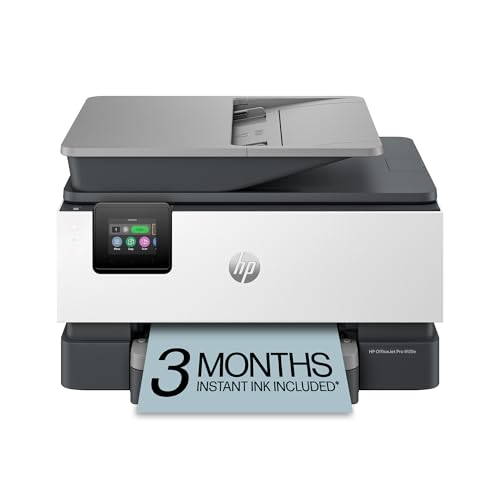
HP positions the OfficeJet Pro 9125e as the complete office workhorse, and it largely lives up to that billing. Print speeds hit 22 ppm in black and 18 ppm in color — competitive with many laser printers and significantly faster than most inkjets. The inclusion of a 35-page ADF, automatic duplex printing, automatic duplex scanning, fax, and a 250-sheet input tray means this single device replaces what might otherwise require three separate machines.
The headline feature for 2026 is HP's AI-powered print formatting. When printing web pages or emails, the software intelligently removes ads, navigation elements, and blank space to produce clean, readable output without wasted pages. It sounds like a minor convenience until you realize how much paper the average office wastes on poorly formatted web printouts. The three-month Instant Ink trial included with purchase lets you evaluate HP's subscription ink service, which can reduce per-page costs significantly for moderate-volume users who prefer predictable monthly expenses over sporadic cartridge purchases.
Color output quality targets professional documents — presentations, brochures, flyers — rather than photo printing. The results look polished and business-appropriate, though dedicated photo printers will outperform it on glossy media. Connectivity options cover every base: Wi-Fi, Wi-Fi Direct, Ethernet, USB, and Apple AirPrint. If your office regularly produces color marketing materials alongside standard text documents, the 9125e handles both workflows without compromise. Similar to how a smart LED bulb consolidates multiple lighting functions into one device, this printer consolidates an entire print room into a single footprint.
Pros:
Cons:
Color laser printing traditionally carried a steep price premium over inkjet, but the M255dw (available here as a certified renewed unit) brings that technology within reach of small offices and freelancers. Print speeds top out at 22 ppm in both color and monochrome, with the inherent laser advantage of instant-on printing — no warm-up cycles, no head cleaning routines, no dried ink from weeks of inactivity. The 2.7-inch color touchscreen simplifies setup and daily operation without requiring a connected computer.
Wireless printing works through HP Smart, which HP describes as its best-in-class mobile app. You can set up the printer, manage queues, receive low-toner notifications, and print or scan remotely. Customizable shortcuts in the app let you automate repetitive tasks, such as scanning specific document types to designated folders — HP claims this organizes documents 50% faster than manual workflows. Automatic duplex printing comes standard, reducing paper consumption and giving your output a more professional double-sided appearance.
As a renewed product, you should expect minor cosmetic wear but full functional performance backed by a warranty. The trade-off for the lower entry price is that toner replacement costs remain at laser levels — roughly 3 to 4 cents per page in black, higher in color. This model lacks scanning or copying capability, so it functions purely as a printer. For users who need color laser quality without the all-in-one premium, particularly those who already own a standalone scanner, the M255dw fills a specific and underserved niche in 2026.
Pros:
Cons:
Brother has long competed with HP in the laser space, and the HL-L2460DW represents their current answer for home offices and small teams that need dependable monochrome output without overpaying. At 36 pages per minute with automatic duplex, it handles daily document printing with minimal wait times. The compact chassis occupies less desk space than most all-in-one units, making it practical for tight home office setups where every square inch counts.
Connectivity flexibility stands out here. Dual-band wireless (both 2.4GHz and 5GHz), Ethernet, and USB give you three distinct connection methods. The 5GHz Wi-Fi band matters in environments crowded with smart home devices, where 2.4GHz channels are often congested and unreliable. The Brother Mobile Connect app provides remote management, toner tracking, and supply ordering from your phone — useful when you need to check toner levels without walking to the printer. Alexa compatibility adds voice-command printing for hands-free convenience.
Brother's Refresh subscription trial is included, offering automatic toner delivery based on usage. You can decline the subscription and purchase standard toner cartridges, which yield roughly 3,000 pages at high-yield capacity. Per-page costs land around 2.7 cents in monochrome — competitive with the HP M404n while costing less upfront. The printer handles standard letter, legal, and envelope sizes without manual tray adjustments. For the user who just needs reliable, fast black-and-white printing at the lowest possible total ownership cost, this Brother model competes aggressively on value. Much like choosing the right circuit analyzer for your specific electrical needs, selecting the right printer means matching capability to your actual daily requirements.
Pros:
Cons:
The Canon Selphy CP1500 occupies a category entirely separate from the document printers listed above. This is a dye-sublimation photo printer that produces 4×6 prints rivaling what you would receive from a professional photo lab. The dye-sub process layers cyan, magenta, yellow, and a protective overcoat in sequence, producing continuous-tone images without the visible dot patterns that plague inkjet photo prints at close inspection. Each print emerges water-resistant, fingerprint-resistant, and rated to last over 100 years under proper storage conditions.
This bundle packages the printer with 108 sheets of KP-108 photo paper and three full-size color ink cartridges — enough to produce 108 finished prints immediately. A Tudak microfiber cleaning cloth rounds out the kit. The complete bundle eliminates the guesswork of supply compatibility that often frustrates first-time photo printer buyers. Wi-Fi connectivity allows direct printing from smartphones and tablets via the Canon PRINT app, while a USB port handles direct computer connections.
The Selphy's compact, portable design means you can bring it to events, family gatherings, or client presentations where on-site printing adds immediate value. It weighs just over two pounds and runs on an optional battery pack for truly mobile operation. The limitation is obvious — this printer produces only 4×6 and smaller photo formats. It cannot handle documents, envelopes, or legal-size paper. It exists as a dedicated photo appliance, and within that scope, it performs brilliantly at a per-print cost of roughly 25 to 30 cents.
Pros:
Cons:
The ET-2803 brings Epson's cartridge-free EcoTank technology to a lower price point than the ET-4850, making it accessible to budget-conscious buyers who still want to escape the cartridge replacement cycle. Each bottle set is equivalent to approximately 80 individual cartridges and provides enough ink to print up to 4,500 pages in black or 7,500 pages in color. The box includes enough ink to last roughly two years under typical home use — a claim that holds up well in real-world testing for households printing 50 to 100 pages monthly.
This model includes scan and copy functions alongside wireless printing with Apple AirPrint support, covering the basic all-in-one requirements most households need. Print resolution matches the ET-4850 at 4800 × 1200 dpi for color output. Where the ET-2803 compromises to hit its lower price point is speed — it prints noticeably slower than its premium sibling, and it lacks the ADF, fax capability, and Ethernet port that the ET-4850 includes. For households that prioritize low running costs over speed, those trade-offs rarely matter in practice.
The value proposition becomes clear when you calculate total cost of ownership. A comparable cartridge-based inkjet might cost half as much upfront, but replacement cartridges running $30 to $50 per set multiple times per year quickly erode that savings. The ET-2803's replacement ink bottles cost roughly $15 per color and last thousands of pages. Over a three-year ownership period, the math overwhelmingly favors the supertank approach for anyone printing more than a few pages per week. Just as choosing the right air purifier for your space requires matching the device to your room size, choosing between the ET-2803 and ET-4850 depends on matching capability to your actual volume and feature needs.
Pros:
Cons:
Your first decision is technology type, and it dictates nearly everything about your ownership experience. Laser printers use toner powder fused to paper with heat, producing sharp text at high speeds with virtually zero maintenance between cartridge changes. They excel at volume and reliability but typically cost more per page for color output. Inkjet printers spray liquid ink droplets, offering better photo quality and lower upfront costs but requiring more maintenance — heads can clog if left idle, and cartridge costs accumulate quickly.
Supertank printers (like the EcoTank series) use inkjet technology but replace disposable cartridges with refillable reservoirs. The upfront cost is higher, but per-page running costs drop to near zero. If you print regularly and want color capability, supertank technology represents the best long-term value in 2026. If you print primarily text and need it fast, a monochrome laser remains unbeatable for the combination of speed, reliability, and text quality.
Manufacturers advertise per-page costs, but your real cost depends on your printing habits. Color pages cost more than monochrome. Photos consume dramatically more ink than text. Draft mode uses less ink than best-quality mode. To estimate your true cost, multiply the manufacturer's stated yield by 0.7 (accounting for real-world coverage that typically exceeds the 5% test standard), then divide the supply cost by that adjusted yield.
For context: a standard inkjet cartridge at $30 yielding 300 pages costs 10 cents per page. A high-yield laser toner at $80 yielding 3,000 pages costs 2.7 cents per page. An EcoTank bottle at $15 yielding 4,500 pages costs 0.3 cents per page. Over 1,000 pages annually, those differences compound to $97 for inkjet, $27 for laser, and $3 for supertank in annual supply costs alone.
Modern printers offer multiple connection methods, and the right choice depends on your setup. Wi-Fi provides the most flexibility — any device on your network can print without cables. Ethernet offers more stable, faster connections for office environments where reliability is non-negotiable. USB provides the simplest, most secure single-computer connection with zero network configuration.
Mobile printing support matters increasingly in 2026. Apple AirPrint, Google Cloud Print alternatives (now handled through individual manufacturer apps), and Wi-Fi Direct all enable printing from phones and tablets. If you work from multiple devices or share the printer with family members, prioritize models with robust wireless support and dedicated mobile apps. Check that your specific phone or tablet OS is supported before purchasing.
All-in-one printers bundle scanning, copying, and sometimes faxing with printing. You pay a premium for this versatility. If you rarely scan or copy, a single-function printer costs less and typically offers better print quality or speed at any given price point. However, if you do scan even occasionally, the convenience of having an integrated scanner often justifies the incremental cost over buying separate devices.
Automatic duplex printing (two-sided) saves paper and gives documents a more professional appearance. An automatic document feeder (ADF) saves time when scanning or copying multi-page documents. Neither is essential for light home use, but both become indispensable in any office environment handling more than a handful of pages daily. Consider these features non-negotiable if you print business documents regularly.
Supertank printers like the Epson EcoTank series offer the lowest per-page costs available, often under one cent per page for black text. While the upfront purchase price exceeds standard inkjets by $100 to $200, the savings on replacement ink typically recover that difference within six to twelve months of regular use. For users printing more than 100 pages monthly, supertank technology provides the best long-term value.
A well-maintained laser printer typically lasts five to seven years under moderate office use, with some models exceeding 10 years. Inkjet printers average three to five years, though supertank models may extend that range due to reduced mechanical stress from fewer cartridge changes. The most common failure point in inkjets is the printhead — on models with integrated heads (built into the cartridge), replacement is automatic with each cartridge swap. Fixed-head models require professional servicing or replacement if the head fails.
Inkjet printers produce superior photo output compared to laser printers. The liquid ink droplets blend more smoothly and reproduce a wider color gamut on photo paper. For dedicated photo printing, dye-sublimation printers like the Canon Selphy CP1500 deliver lab-quality results that exceed both inkjet and laser. Laser printers handle photos adequately for internal documents but cannot match inkjet or dye-sub quality for prints intended for display or client presentations.
Fax capability remains relevant for specific industries — healthcare, legal, real estate, and government agencies still regularly require faxed documents for compliance or workflow reasons. If you work in these sectors or interact with businesses that do, integrated fax saves you from maintaining a separate machine or subscribing to an online fax service. For general home and office use, fax capability is unnecessary and should not drive your purchasing decision.
Services like HP Instant Ink charge a monthly fee based on page count rather than ink volume. For consistent, predictable printing volumes (typically 50 to 300 pages monthly), subscriptions often reduce per-page costs by 30 to 50 percent compared to retail cartridge prices. However, unused pages expire monthly with most plans, and canceling the subscription can disable cartridges already in your printer. Evaluate whether the savings justify the commitment and loss of flexibility.
Most home office users find 15 to 20 pages per minute entirely adequate. Speed ratings above 30 ppm primarily benefit environments printing large batch jobs — reports, mailings, or document sets exceeding 50 pages at a time. First-page-out time (how quickly the printer wakes from sleep and delivers one page) matters more for typical home office use, where you print one to five pages at a time. A printer with a six-second first-page time and 20 ppm speed will feel faster in daily use than one rated at 40 ppm but requiring 15 seconds to wake.
 |
 |
 |
 |

About Liz Gonzales
Liz Gonzales grew up surrounded by art and design in a New York suburb, with both parents teaching studio arts at the State University of New York. That environment sharpened her eye for aesthetics and spatial detail — skills she now applies to evaluating home products where form and function both matter. She has spent the past several years writing about lighting, home decor accessories, and outdoor living gear, with a particular focus on how products perform in real residential settings rather than showrooms. At Linea, she covers lighting fixtures and bulb reviews, outdoor and patio gear, and general home product comparisons.
You can Get FREE Gifts. Furthermore, Free Items here. Disable Ad Blocker to receive them all.
Once done, hit anything below
|
|
|
|