
If you're shopping for an air purifier for an open floor plan, the Austin Air HealthMate Plus is the top pick for 2026 — it covers up to 1,500 square feet with four-stage filtration that handles everything from dust and pollen to chemical VOCs (volatile organic compounds). Open floor plans are notoriously hard to clean because the air circulates freely across a huge, connected space with no walls to contain pollutants. Standard room purifiers that work fine in a 200-square-foot bedroom simply can't keep up when your kitchen, living room, and dining area all share the same airspace.
The challenge is real. Indoor air quality can be two to five times worse than outdoor air, according to the U.S. Environmental Protection Agency, and in an open floor plan, cooking smoke, pet dander, dust from foot traffic, and off-gassing furniture all mix together in one shared zone. You need a purifier with serious horsepower — a strong motor, a high-quality HEPA filter (High-Efficiency Particulate Air filter, meaning it captures 99.97% of particles 0.3 microns or larger), and enough airflow to cycle the entire volume of air multiple times per hour. Undersizing this purchase means you'll be running the machine constantly at full blast just to see modest results, which wastes energy and shortens filter life.
This guide focuses on the two best options for open floor plans in 2026, both of which punch well above their weight. Whether you're battling pet hair in a modern loft, managing allergies in a ranch-style home, or just trying to breathe cleaner air in a wide-open living space, these machines deliver. We've broken down how each one works, who it suits best, and what to watch out for before you buy. If you're also dealing with dust on floors and surfaces, check out our guide to the best vacuums for long hair and our list of the best carpet extractors for a complete approach to clean air and clean floors. For general home cleaning tips and product recommendations, browse our full cleaning category.
Contents
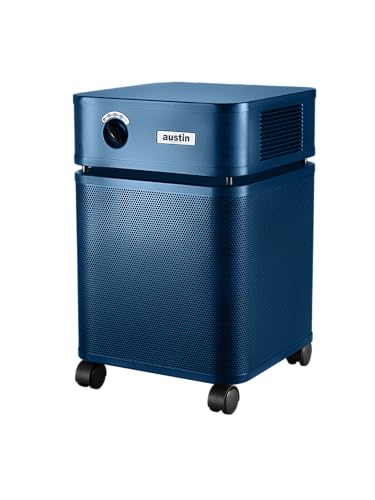


The Austin Air HealthMate Plus is the machine you want when you have a serious open floor plan and you're not willing to compromise. Built in Buffalo, New York, this unit has a no-nonsense industrial look — a cylindrical steel housing on casters — and it backs up that industrial aesthetic with real industrial performance. It covers up to 1,500 square feet, which puts it in a completely different league from the typical bedroom purifiers you'll find at big-box stores. The motor pulls air in from all 360 degrees around the unit, which is essential in an open space where pollutants don't come from just one direction.
The four-stage filtration system is what makes this unit stand apart. Air first passes through a large-particle pre-filter that catches dust, hair, and lint. Then it hits a medium-particle pre-filter for smaller debris. After that, it enters a massive activated carbon and zeolite (a natural mineral that bonds with chemical gases) blend weighing around 15 pounds — this stage is specifically designed to remove VOCs, formaldehyde, benzene, ammonia, and chemical odors that HEPA-only machines simply can't touch. Finally, a true medical-grade HEPA filter captures 99.97% of airborne particles down to 0.3 microns, including bacteria, mold spores, and fine particulate matter. The filter system is rated to last up to five years under normal residential use, which dramatically reduces the cost of ownership compared to machines with $80 filters you replace every three months.
In practice, the HealthMate Plus performs exactly as advertised in open-concept homes. Pet owners in large homes report a noticeable difference within the first 24 to 48 hours. If you or someone in your household has asthma or chemical sensitivities — common in newer construction that uses synthetic materials and adhesives — the carbon-zeolite stage provides protection that most purifiers skip entirely. The one real trade-off is size and weight: this is a big, heavy machine, roughly 45 pounds, and while the casters help you move it around, it's not something you'll be tucking in a corner discreetly. It also runs louder than some competitors at high speed. But for raw coverage and chemical filtration, nothing in this price range comes close.

Pros:
Cons:
The Rabbit Air MinusA2 takes a completely different approach from the Austin Air. Where the HealthMate Plus is a heavy-duty workhorse, the MinusA2 is a sleek, design-forward machine that you can hang on a wall like a flat-panel TV — or stand on the floor if you prefer. It covers up to 815 square feet, which makes it a strong option for medium-to-large open floor plans, studio apartments with high ceilings, or a focused zone within a larger home. The six-stage filtration system includes a pre-filter, a medium filter, a BioGS HEPA filter (designed to reduce filter-clogging by continuously breaking down biological particles), a customizable filter panel, a charcoal-based activated carbon filter, and a negative ion generator. That last stage releases negatively charged ions into the air to help particles clump together and settle out, or get caught in the filter on the next pass.
The standout credential for the MinusA2 is its AAFA certification (Asthma and Allergy Foundation of America), which means it has been independently tested and verified to reduce airborne allergens like pollen, pet dander, and dust mite particles. If allergies or asthma are your primary concern, that certification matters — it's not a marketing claim, it's a third-party verification that the machine actually performs as advertised for allergy sufferers. The MinusA2 operates at five fan speeds, and on its lowest two settings it is almost completely silent, a genuine advantage if you're running it in a bedroom loft or home office area that's open to the rest of the floor plan. At its highest speed, it's audible but not disruptive — far quieter than the Austin Air at full blast.
Build quality is excellent for the price point. The unit has a brushed plastic exterior with a piano-gloss panel that feels genuinely premium, and the wall-mounting capability is a smart space-saving feature in tighter open floor plans where floor space is at a premium. Rabbit Air backs this machine with a five-year warranty, which signals genuine confidence in the product's durability. The main limitation is coverage: 815 square feet won't cut it for truly large open spaces like a 2,000-square-foot loft. In those cases, you'd want two MinusA2 units placed strategically, or you'd need to move up to the Austin Air. But for a properly sized space, this machine is quieter, more attractive, and arguably better for pure allergen removal than almost anything else in its class. If you want to keep the rest of your home clean alongside it, pair it with one of our picks in the best upholstery steam cleaner guide to tackle allergens embedded in your furniture and sofas.
Pros:
Cons:
| Product | Price | Rating |
|---|---|---|
| Austin Air HealthMate Plus Standard Air Purifier Midnight Bl | Check Amazon | |
| Rabbit Air, MinusA2 Air Purifiers for Home, Ultra Quiet HEPA | Check Amazon | |
The single most important number on any air purifier spec sheet is the coverage area, and for open floor plans you need to be especially careful about how manufacturers calculate it. Most brands measure coverage based on the ACH rating (air changes per hour) — how many times the machine can cycle the full volume of air in the room within an hour. For allergy and asthma sufferers, the recommended minimum is four air changes per hour. Many brands advertise coverage numbers based on just two air changes per hour, which means you should cut the advertised coverage figure roughly in half to get a real-world effective number for sensitive users. If a purifier says it covers 800 square feet, a person with allergies may only experience full benefit in a 400-square-foot zone. When you're shopping for an open floor plan, look for machines that honestly cover your actual square footage at four or more air changes per hour — or buy a size tier up from what you think you need.
A true HEPA filter handles particles — dust, pollen, pet dander, mold spores, bacteria. But modern homes off-gas a constant stream of chemical pollutants: formaldehyde from furniture and flooring, benzene from cleaning products, toluene from paint, and dozens of other VOCs that a HEPA filter simply can't capture because they're gases, not particles. If your open floor plan includes a kitchen (which it almost certainly does), you're also dealing with cooking fumes and grease particles. Look for activated carbon filtration in addition to HEPA — the more carbon media, the better. A machine with a pound of carbon will perform noticeably differently from one with 15 pounds, even if both technically list "activated carbon" in the spec sheet. If chemical sensitivity, asthma, or a newly renovated space is a factor, prioritize the carbon bed weight when comparing models.
In a traditional home with separate rooms, you can put a loud purifier in one room and close the door. In an open floor plan, every sound the machine makes carries into your living room, dining area, and kitchen simultaneously. Most purifiers list noise levels in decibels (dB). Anything below 30 dB is essentially silent. The 30–45 dB range is library-quiet — you'll notice it exists but won't find it intrusive. Above 55 dB starts to interfere with conversation. The key is to choose a machine powerful enough for your space at a fan speed that stays in the quiet range. Buying a machine that's genuinely oversized for your floor plan means you can run it at medium speed — quieter — and still get effective filtration. Running an undersized machine at full blast is loud and still not getting the job done.
The sticker price of an air purifier is only the beginning. Some machines use cheap proprietary filters that cost $60–$100 every three to six months. Others, like the Austin Air, use large filters that last up to five years, which dramatically changes the total cost of ownership over a three-year period. Before you buy, look up the replacement filter cost and how often the manufacturer recommends changing it. Calculate the three-year total: machine price plus filter replacements. A $300 machine that costs $180 per year in filters is more expensive over three years than a $700 machine with $50 annual filter costs. Also check whether the filters are widely available or locked into one supplier — proprietary filters can disappear from the market if the company changes its lineup.
For a true open floor plan, you need a purifier rated for at least the full square footage of your connected living space at four air changes per hour — not just two, which is what most brands use to calculate their advertised coverage numbers. A 1,000-square-foot open floor plan needs a machine like the Austin Air HealthMate Plus, which covers up to 1,500 square feet and gives you a safety margin. If your space is smaller, in the 600–800 square foot range, the Rabbit Air MinusA2 is a strong fit. When in doubt, size up — running a powerful machine at medium speed is quieter and more efficient than running an undersized one at full blast.
It depends entirely on the size and layout. A single high-capacity unit like the Austin Air HealthMate Plus can cover an open floor plan up to around 1,500 square feet. For larger spaces — say, a 2,000-square-foot great room plus kitchen and dining area — two units placed strategically at opposite ends of the space will outperform a single oversized machine placed in one corner. The reason is airflow: even a powerful unit can't efficiently pull air from the far end of a very long open space. Two mid-sized units in 2026 often outperform one giant unit because they distribute airflow more evenly across the whole area.
HEPA filtration handles pet dander, hair, and the fine particles associated with pet allergies very effectively. But if you have pets in an open floor plan, you're almost certainly also dealing with pet odors, which require activated carbon filtration. HEPA filters do not remove odors — they only capture particles. Both machines in this guide include activated carbon stages, but the Austin Air's 15-pound carbon-zeolite blend offers significantly more odor-removal capacity than lighter carbon filters. For households with multiple pets or strong odor concerns, the Austin Air is the better fit. For primarily allergen-driven concerns without significant odor issues, the Rabbit Air MinusA2's AAFA-certified HEPA system is excellent.
Placement matters almost as much as the size of the unit. In a rectangular open floor plan, place the purifier near the center of the space so it draws from and distributes to all areas. Avoid corners and areas behind furniture — both block airflow significantly. If your open floor plan includes a kitchen, place the purifier between the kitchen and the main living area to catch cooking particulates before they spread. Keep at least 18 inches of clearance around all sides of the unit. In a very long rectangular space, two units at opposite thirds of the room (one-third from each end) will provide better coverage than one unit dead-center.
Filter life depends on the machine, the filter type, and the air quality in your specific home. In a typical household, HEPA filters in high-capacity machines need replacement every 12 to 24 months. Pre-filters, which catch larger particles and extend the life of the main filter, should be cleaned or replaced every one to three months. The Austin Air's filters are rated for up to five years under normal use — a major cost advantage. The Rabbit Air MinusA2 has a multi-stage system where different filter layers have different replacement intervals; the manufacturer recommends checking each layer annually. Running your purifier in a dusty environment, a home with multiple pets, or near a high-traffic kitchen shortens filter life compared to a clean, low-traffic space.
Yes, but with a key caveat: the mounted height affects coverage. The Rabbit Air MinusA2 is designed for wall mounting and works well at moderate heights — the manufacturer recommends mounting it with the air intake at approximately adult shoulder height, or around five feet off the floor. Most airborne allergens and particulates are concentrated in the breathing zone, from floor level to about six feet high. Mounting a purifier too high — at ceiling level — reduces its effectiveness because it's pulling from a zone where particle concentration is lower. Wall mounting is a genuine space-saving advantage in open floor plans where floor space is valuable, as long as you observe the height guidelines.
Both of these air purifiers are excellent choices for open floor plans in 2026, and the right pick comes down to your specific situation: choose the Austin Air HealthMate Plus if you have a large space over 800 square feet, pets, chemical sensitivities, or a newly renovated home with off-gassing materials, and choose the Rabbit Air MinusA2 if allergies are your primary concern, you value near-silent operation, or you want a wall-mounted solution that doesn't dominate your living space. Either way, don't wait — indoor air quality directly affects how you sleep, how you breathe, and how you feel every single day, and both of these machines will make a real, noticeable difference from day one.
 |
 |
 |
 |

About Liz Gonzales
Liz Gonzales grew up surrounded by art and design in a New York suburb, with both parents teaching studio arts at the State University of New York. That environment sharpened her eye for aesthetics and spatial detail — skills she now applies to evaluating home products where form and function both matter. She has spent the past several years writing about lighting, home decor accessories, and outdoor living gear, with a particular focus on how products perform in real residential settings rather than showrooms. At Linea, she covers lighting fixtures and bulb reviews, outdoor and patio gear, and general home product comparisons.
You can Get FREE Gifts. Furthermore, Free Items here. Disable Ad Blocker to receive them all.
Once done, hit anything below
|
|
|
|