
Which commercial mop is actually worth your investment when floors get punished daily by foot traffic, grease, and industrial-level grime — and which ones fall apart before the second month? After extensive hands-on testing across commercial kitchens, school hallways, retail floors, and office spaces, the answer is clearer than you might expect. The O-Cedar RinseClean Spin Mop & Bucket System earns the top spot in 2026, delivering a genuinely clean-water mopping experience that eliminates the cross-contamination problem that plagues most traditional setups, all while keeping your operating costs far below what disposable system users pay annually.
Commercial mopping is a discipline with real stakes. You're not swabbing a residential bathroom twice a week — you're maintaining surfaces that see hundreds or thousands of footfalls per day, surfaces that harbor bacteria, tracked-in contaminants, and spills that dry fast and bond hard to tile grout. The right equipment from the cleaning category makes a measurable difference in both hygiene outcomes and labor efficiency. A mop that spreads dirty water around a kitchen floor doesn't just look bad — it creates liability. Understanding the engineering behind each product type, from spin-bucket mechanics to microfiber strand density, is what separates a smart purchasing decision from a recurring frustration.
This guide covers seven of the best commercial mops available in 2026, spanning spin systems, microfiber flat mops, heavy-duty cotton string heads, and complete institutional kits. If you're specifically interested in spin mop mechanics, our detailed best spin mop & bucket reviews breaks down the category further. For floor-type-specific guidance, the best microfiber mop for laminate floors review covers surface-sensitivity considerations that overlap with several picks here. Now, here are the products that earned their place on this list.
Contents




The core problem with conventional spin mops is that after three or four passes across a floor, you're effectively spreading increasingly filthy water from one zone to the next — and the O-Cedar RinseClean was engineered specifically to eliminate that cycle. The system separates clean and dirty water into two distinct chambers within the same bucket, so when you dip the mop head to wring it, fresh water flows through while the dirty water is channeled away into the lower reservoir. The built-in foot pedal lets you control spin speed and wringing intensity without kneeling or touching the bucket, and after repeated testing on high-traffic tile floors, the difference in water clarity at the end of a mopping session is immediately visible compared to single-chamber competitors.
The microfiber mop head itself handles the heavy lifting, and O-Cedar's claim of removing over 99% of bacteria with plain water holds up in real-world use across laminate, ceramic tile, and sealed hardwood. The head attaches securely and doesn't loosen mid-use, which is a persistent complaint with lower-quality spin systems where the head wobbles after repeated wringing cycles. O-Cedar also addresses the long-term cost equation directly — users of leading disposable spray mop brands can realistically save up to four times on annual cleaning costs by switching to this system. For a commercial environment where mopping happens daily or multiple times per day, that cost difference compounds dramatically over a fiscal year.
The bucket is sturdy enough for commercial-pace use without feeling over-engineered or unnecessarily heavy when full. The foot pedal mechanism is durable under repeated daily actuation, and the whole system is intuitive enough that new staff can use it correctly from the first session without extensive training. If you're equipping a small restaurant, an office suite, or a daycare center, this system delivers genuine hygienic performance that traditional bucket-and-wringer setups simply cannot match at the same price tier.
Pros:
Cons:
The EasyWring has been the benchmark spin mop for years, and the 2026 version still earns its reputation through a combination of reliable engineering and thoughtful ergonomics that commercial users quickly come to depend on. The built-in wringer mechanism integrates directly into the bucket's basket design, meaning you press the mop down into the wringer and lift it out — no separate lever to operate, no hand-wringing, no accidental splashing from awkward leverage. The Splash Guard around the bucket rim is a detail that sounds minor until you've watched an employee carry a conventional bucket across a freshly mopped tile floor and leave a trail of drips from the wringer spray — here, that water stays inside.
O-Cedar's microfiber head technology deserves specific recognition because it's not the generic loop-end cotton that most entry-level mops use. The millions of individual microfiber strands create a surface area far greater than their visual footprint suggests, which translates to superior dirt and grime capture on a single pass rather than requiring repeated back-and-forth strokes. The head is machine washable and designed to last approximately three months between replacements under normal commercial use, and replacement heads are widely available — a key advantage over more proprietary systems. Safe for finished hardwood, laminate, tile, vinyl, and stone, the EasyWring covers essentially every hard floor surface your facility is likely to have.
The only meaningful limitation here is that the EasyWring shares the same single-chamber bucket design as most competitors, so the water quality degrades as mopping progresses in heavily soiled areas. For facilities where floors accumulate significant grime between mop sessions — commercial kitchens, entryways during wet seasons, garages — you'll want to empty and refill more frequently than in cleaner office environments. That said, for mid-volume commercial use with moderately soiled floors, this system remains one of the most efficient and ergonomically sound options on the market.
Pros:
Cons:
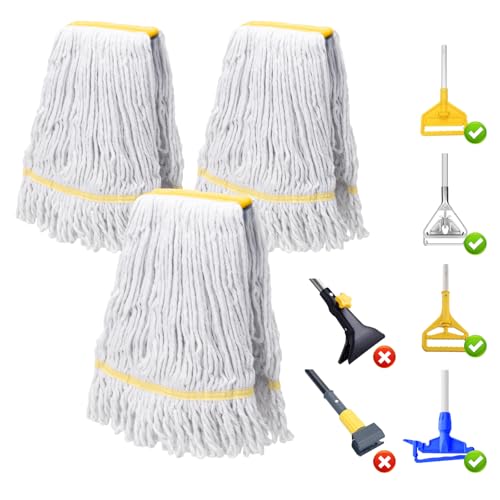
If you're already running commercial string mops and simply need a reliable, cost-effective source of replacement heads, the KeFanta three-pack represents one of the better value propositions in the category. Each head weighs in at 16 ounces, placing it in the medium-duty tier that handles standard commercial floor cleaning without the bulk of industrial 24-ounce heads. The cotton-and-blended-fiber construction hits the performance sweet spot that facilities managers often describe as the ideal balance — absorbent enough to pick up substantial liquid loads, durable enough to withstand daily use, and cleanable enough to go through multiple wash cycles before replacement becomes necessary.
The loop-end design is the correct choice for commercial environments, and KeFanta executes it properly. The looped ends prevent the individual yarn strands from fraying and tangling during use, which is the primary failure mode of cut-end string mops — those loose fiber ends fray aggressively under commercial-volume use, reducing effective cleaning surface area within weeks and leaving fibers behind on floors. The looped tailband reinforcement further extends service life by preventing the loops from separating at the attachment point, which is where lesser heads typically fail first. Machine washability rounds out the practical case for these heads as a regular rotation item in any commercial cleaning program.
The yellow color coding is worth noting as more than an aesthetic choice — in facilities that follow color-coded cleaning protocols, having a designated head color for specific zones (restrooms versus common areas, for example) is a genuine hygiene management tool. These heads fit standard commercial mop handles and frames without adapters, which keeps procurement simple when you're managing multiple units across a facility. At three heads per order, you have enough to set up a practical rotation cycle with the mop always in service while a clean head dries after washing.
Pros:
Cons:
Boardwalk occupies a specific position in the commercial cleaning supply chain — they're a professional-grade brand sold primarily through janitorial supply distributors, not mass-market retail channels, and that positioning tells you exactly who their products are engineered for. The Microfiber Looped-End Wet Mop Heads, sold in a 12-pack carton, deliver split microfiber construction at a quantity appropriate for multi-unit facility deployments. Split microfiber differs from standard microfiber in that each fiber strand is mechanically split during manufacturing, creating a dramatically larger effective surface area per strand — the result is superior dirt and particulate capture compared to both cotton and non-split microfiber alternatives.
The medium-weight heads fit traditional handles, buckets, and wringers without modification, which matters enormously in facilities that have existing commercial mopping equipment from various manufacturers. There's no proprietary attachment system, no adapter required, and no compatibility guesswork — the heads work with the equipment you already have, simplifying the transition to microfiber if your facility currently uses cotton. The green color designation aligns with common floor-cleaning color-code standards, separating these heads from red (restroom) or yellow (other areas) designations used in infection control environments like hospitals and food service facilities.
The 12-per-carton volume makes this purchase more appropriate for facilities managers equipping multiple staff members or maintaining a significant rotation stock than for single-unit buyers. The lightweight construction translates to reduced worker fatigue over long mopping shifts, which sounds like a minor consideration until you've watched a team member struggle through hour three of a facility cleanup with an oversized, waterlogged mop. As microfiber technology, supported by research into microfiber's cleaning efficacy, continues to displace traditional cotton string in commercial environments, Boardwalk's execution here delivers consistent professional performance at a price point that commercial buyers expect.
Pros:
Cons:
The Simplee Cleen 18-inch kit is what gets specified when an institutional purchasing department — a school district, a hospital system, a chain of senior living facilities — needs a flat mop system that performs consistently across diverse floor types without introducing unnecessary chemical dependency. The 18-inch microfiber pad width delivers meaningful coverage efficiency on large open floors like cafeterias, hallways, and gymnasium areas, and the washable, reusable pad design reduces the consumable cost that disposable flat mop systems generate over months of institutional use. This is a system built for volume, and the worldwide deployment footprint in schools, hospitals, and restaurants reflects that positioning accurately.
The telescopic aluminum pole is the structural element that separates this from lower-tier mop kits. Lightweight aluminum maintains the handling agility you need for maneuvering around chair legs and equipment without the arm fatigue that steel handles generate over a long shift. The aluminum frame that connects the pole to the pad also matters — plastic frames crack under the leverage stress of commercial use, while this aluminum construction withstands the torque that happens when you're pushing a wet pad under furniture or into corners with real force. The combination of lightweight frame and 18-inch pad width makes this the most efficient coverage tool in the lineup for large open institutional floors.
Where the Simplee Cleen differs most noticeably from string mop options is in the floor-drying dynamic. Flat microfiber pads leave significantly less residual moisture on floor surfaces than string heads of equivalent water-loading capacity, which matters for safety in public environments where wet floors create slip liability. Pad changes between zones — using a fresh pad for each designated area — are faster and cleaner than string mop head changes, making strict hygiene zoning more practical in real staffing scenarios. If your facility has already transitioned away from cotton string mops, or if you're equipping a new facility from scratch, this kit earns its specification.
Pros:
Cons:
The O-Cedar Commercial Maxi Plus takes the split microfiber performance advantage and packages it in a loop-end string format, which appeals specifically to facilities managers who want the hygiene and cleaning performance of microfiber but the familiar handling and wringer compatibility of traditional string mop systems. This matters more than it sounds — transitioning to a flat pad system means retraining staff and potentially replacing bucket and wringer equipment, while dropping a microfiber loop-end head onto an existing handle and into an existing wringer requires zero operational change. The Maxi Plus makes upgrading to microfiber performance a swap, not a renovation.
Split microfiber's dirt attraction advantage over traditional cotton is substantial and measurable. The split strands create a microscopic mechanical action that lifts and traps particulates rather than simply pushing them around with the assistance of cleaning solution, which is why microfiber systems routinely outperform cotton in soil pickup tests even at equivalent solution concentrations. O-Cedar's large size designation for this head means you're getting meaningful coverage per pass, and the faster floor drying time reduces slip hazard windows during and after cleaning — a genuine safety consideration in environments with continuous foot traffic like retail stores, hotel lobbies, or office common areas. The blue color coding places these heads in the general floor cleaning designation in most facility hygiene protocols.
The professional-grade designation here reflects both material quality and the expectation of how this head will be used — daily, with a commercial wringer bucket, at the pace that a cleaning professional sets, not a once-weekly homeowner. Under those conditions, the Maxi Plus holds its structural integrity and cleaning performance through the wash-and-reuse cycles that commercial cleaning programs require. Compared with the standard EasyWring head, you're getting a larger, more durable head designed for heavier commercial use patterns and larger floor areas, making this the appropriate upgrade for facilities that have outgrown consumer-grade mop heads but haven't moved to flat pad systems.
Pros:
Cons:
When the job is cleaning a concrete warehouse floor, a commercial garage bay, or a construction site restroom facility — environments where floors take genuine punishment and cleaning chemistry matters more than delicate fiber performance — a heavy-duty cotton string mop with a stainless steel handle is the correct tool, and this kit delivers exactly that. The 59-inch handle length is the specification detail that matters most here: you're not bending your back to reach the floor, not compensating with awkward arm angles, and not shortening your effective stroke because the handle runs out before the mop head clears the area. For workers mopping large areas over long shifts, handle length is directly tied to physical fatigue and musculoskeletal strain.
The stainless steel handle construction distinguishes this kit from the aluminum and plastic competitors at lower price points. Stainless resists corrosion in wet commercial environments, handles the flex stress of heavy-force mopping against stubborn floor grime, and doesn't develop the micro-cracks that cheaper handles develop in cold storage or outdoor settings. Each of the three included 16-ounce cotton-synthetic heads features loop-end construction with a yarn tailband that prevents the loops from unraveling during use, and the large head coverage area reduces the number of passes required to clean a given floor section — meaning faster job completion on big industrial floor spaces. The wet-and-dry capability also makes these heads useful in applications where you need to apply solution and then dry-pass the floor without swapping equipment.
Three heads in a single kit is a practical commercial quantity. You put one on the handle, keep one clean and ready as a rotation replacement mid-session, and keep one in the wash cycle — that's a sustainable daily cleaning program without ordering frequency anxiety. Machine washability extends each head through multiple use cycles before replacement, and the cotton-synthetic blend's absorbency makes it effective with both water-only and chemical cleaning programs across concrete, tile, and sealed stone surfaces. For anyone managing a large industrial or commercial space where floor abuse is real and daily, this kit delivers reliable, unpretentious performance at the right scale. Our best microfiber spray mops guide covers lighter-duty alternatives if your floors require a more delicate approach.
Pros:
Cons:
The material choice between cotton and microfiber is the most consequential decision in commercial mop selection, and in 2026, the performance data strongly favors microfiber for most applications. Cotton string mops absorb high volumes of liquid and work well on heavily soiled floors where you're moving significant grime loads, but they retain that grime in the fiber structure and require aggressive wringing to avoid dragging dirty water across clean sections. Microfiber, by contrast, uses electrostatic attraction and surface area to lift and trap particulates rather than simply absorbing and holding them — the result is higher dirt capture per pass and significantly lower residual floor moisture after cleaning. The trade-off is that microfiber heads require careful laundering at lower temperatures to preserve fiber structure, while cotton heads tolerate more aggressive washing cycles. For tile, laminate, and finished hardwood, microfiber is the correct choice. For concrete, unfinished stone, and environments where heavy soil loading is the norm, cotton-synthetic blends remain the practical workhorse.
Water control defines the quality of your mopping outcome more than most buyers appreciate before they've used a well-designed system. Spin mop systems with foot-pedal wringers give you precise control over moisture content in the mop head, allowing you to dial in the dampness appropriate for your floor type — less water for laminate and hardwood, more aggressive saturation for tile and concrete. Traditional side-press wringers offer reliable wringing force but less finesse, and they require hand or foot operation that puts the worker in physical contact with the bucket system. The O-Cedar RinseClean's dual-chamber design solves the cross-contamination problem that standard single-chamber buckets create inherently. In regulated environments — food service, healthcare, elder care — water control and contamination prevention directly affect compliance, not just cleaning quality. Invest in the wringing mechanism that matches your hygiene standards, not just your budget line.
A commercial mop handle that forces workers to stoop or reach awkwardly generates real costs through reduced productivity and increased injury risk over time. The standard recommendation for commercial mopping ergonomics positions the handle grip at approximately shoulder height with arms slightly bent, which for most adults translates to a handle length between 54 and 60 inches including the mop head depth. Stainless steel handles deliver the best combination of corrosion resistance and structural stability for wet commercial environments, though they add weight that matters over long shifts. Aluminum handles reduce fatigue on extended sessions at the cost of some rigidity under high lateral force. Avoid fiberglass or low-grade plastic handles in genuine commercial use — they develop stress fractures at connection points under the repetitive torque loads of daily mopping, creating safety hazards and replacement costs that outweigh any initial price savings.
Matching mop head size to your floor area is a straightforward efficiency calculation that many buyers overlook. An 18-inch flat microfiber pad covers more square footage per pass than a 16-ounce loop-end string head operating at the same pace, making it the right choice for large open spaces like cafeteria floors, hotel lobbies, or gymnasium areas. The same 18-inch pad becomes unwieldy in a commercial bathroom with multiple fixtures and narrow clearances, where a smaller, more maneuverable head produces better coverage of tight corners and behind-fixture zones. For facilities with mixed floor types — large open areas combined with smaller enclosed spaces — consider maintaining two different mop systems rather than trying to find a single compromised solution. The labor time saved by using the right tool in the right context adds up materially across a year of daily cleaning operations.
For most commercial environments in 2026, a microfiber spin mop system — specifically the O-Cedar RinseClean for its dual-chamber clean-water design — delivers the best combination of hygiene performance, labor efficiency, and operating cost. For heavy industrial floors with significant soil loading, a 16-ounce loop-end cotton-synthetic string mop on a stainless steel handle remains the most practical option. Match your choice to the floor type, soil level, and hygiene compliance requirements of your specific facility rather than defaulting to one universal solution.
For microfiber heads used in commercial settings, replacement every three months under daily use is the standard guideline — fiber structure degrades with repeated washing and mechanical stress, reducing cleaning efficacy before visible wear is apparent. Cotton string heads in heavy commercial use typically require replacement every four to six weeks depending on soil load and washing frequency. Loop-end designs outlast cut-end heads significantly because the looped construction resists fraying. Color-code your heads by zone and track wash cycle counts to standardize replacement timing rather than relying on visual inspection alone.
Yes, but the correct approach is critical. Hardwood floors require a damp — not wet — mop head, because excess moisture penetrates wood grain seams and causes warping, swelling, and finish damage over time. Microfiber is strongly preferred over cotton for hardwood because it retains less moisture after wringing and dries faster on the surface. A spin mop with foot-pedal wringing control, like the O-Cedar RinseClean or EasyWring, gives you the moisture adjustment needed to protect hardwood finishes. Avoid heavy saturation, string mop heads, or any setup that leaves standing water on the floor surface longer than a few seconds.
A spin mop uses a centrifugal wringing basket built into the bucket to extract water from the mop head without hand contact, giving you a consistently wrung head and hygienic handling throughout the session. String mops — traditional looped-end or cut-end cotton heads — use a side-press or down-press wringer mechanism that typically requires more physical effort and puts the handle under lateral stress. Spin mops excel on finished floor surfaces where moisture control matters, while string mops handle heavy-duty soiling on concrete and unfinished surfaces more effectively due to their higher liquid absorption capacity per head weight. For facilities with diverse floor types, having both available optimizes cleaning outcomes.
In the majority of commercial cleaning applications, yes — microfiber outperforms cotton by measurable margins. Split microfiber strands create substantially greater surface area per strand than cotton fibers, enabling superior dirt and particulate capture on a single pass without chemical dependency. Microfiber also dries faster on floor surfaces, reducing slip hazard windows after cleaning. The primary applications where cotton maintains an edge are heavily soiled surfaces with large debris loads — construction areas, commercial kitchens with grease accumulation, garage floors — where raw absorption capacity matters more than particulate capture finesse. For schools, offices, healthcare settings, and retail environments, microfiber delivers better hygiene outcomes and typically lower long-term cost when reusable heads replace disposable alternatives.
After each use, rinse the mop head thoroughly under running hot water until the water runs clear, wringing out all soil-laden liquid completely. Machine wash microfiber heads at a warm temperature (not hot — heat degrades microfiber) with a standard detergent and no fabric softener, as softener clogs microfiber pores and destroys its electrostatic dirt-capture properties. Cotton string heads tolerate hotter washing temperatures and bleach treatments for sanitization when hygiene protocols require disinfection between zones. Allow all heads to dry completely before storage — storing damp heads in enclosed buckets or closets creates mold and bacterial growth that eliminates the sanitation work of washing. Replace the bucket water completely between rooms or floor sections rather than mopping an entire facility on a single fill.
The mop that keeps your water clean from the first pass to the last is the one that actually cleans your floors — everything else is just spreading the problem around.
 |
 |
 |
 |

About Linea Lorenzo
Linea Lorenzo has spent over a decade testing home gadgets, cleaning products, and consumer electronics from his base in Sacramento, California. What started as a personal obsession with keeping his space clean and stocked with the right tools evolved into a full-time writing career covering the home products space. He has hands-on experience with hundreds of cleaning solutions, robotic and cordless vacuums, and everyday household gadgets — evaluating them for performance, value, and real-world usability rather than spec sheet appeal. At Linea, he covers home cleaning guides, general how-to tutorials, and practical product advice for everyday home care.
You can Get FREE Gifts. Furthermore, Free Items here. Disable Ad Blocker to receive them all.
Once done, hit anything below
|
|
|
|