
Hardwood floors cover an estimated 1.5 billion square feet of American residential space. Industry research confirms that improper cleaning degrades the surface finish in a large proportion of those installations within the first five years. Knowing precisely how to clean hardwood floors is among the most consequential pieces of maintenance knowledge a homeowner can possess. Our team at Linea has evaluated cleaning methods, products, and routines extensively, and this guide distills those findings for anyone seeking accurate guidance on floor cleaning.
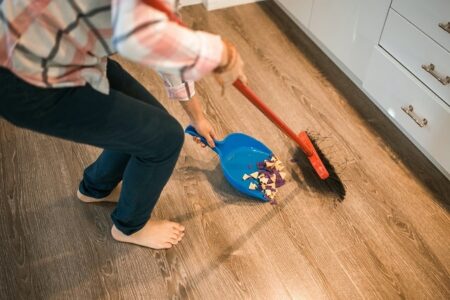
The difference between a floor that ages gracefully and one that dulls prematurely almost always comes down to habits established in the first months of ownership. Our team has observed that most people underestimate the cumulative damage caused by moisture, abrasive particles, and incorrect cleaning chemistry. Each of these factors is easily controlled with the right knowledge, and our team addresses all three in detail throughout this guide.
The principles outlined here draw from manufacturer specifications, flooring industry consensus, and our hands-on evaluation of products across multiple hardwood types. Whether a household has newly installed solid hardwood or is maintaining an older engineered floor, the structured approach described in this guide applies consistently across both categories.
Contents
Hardwood floors are not a uniform category, and the cleaning method appropriate for one surface type can cause lasting harm to another. Our team distinguishes between two primary classifications as a foundational step before selecting any cleaning product or tool.

Finished hardwood carries a protective topcoat — typically polyurethane or aluminum oxide — that serves as the primary barrier between cleaning products and the wood itself. Unfinished hardwood relies instead on penetrating oils or wax sealed directly into the grain, and it requires entirely different products and handling procedures. The vast majority of floors in modern homes are finished, but our team recommends verifying the finish type before selecting any cleaning product. According to the USDA Forest Products Laboratory, wood is inherently hygroscopic, absorbing and releasing moisture in response to ambient conditions. This property makes finish integrity critical, because any topcoat degradation exposes the wood grain directly to moisture infiltration and permanent damage.
Solid hardwood, engineered hardwood, and parquet each respond to liquid exposure differently, and our team treats all three with the same fundamental caution: minimal moisture contact at all times during cleaning. Engineered hardwood, which consists of a real wood veneer bonded to a plywood core, is particularly vulnerable to delamination when exposed to standing water. Parquet, with its adhesive-bonded geometric patterns, presents the greatest sensitivity at the seams and joints between individual pieces, where even small amounts of liquid can compromise the bond over time.
Our team recommends a layered, sequential approach for anyone learning how to clean hardwood floors correctly — beginning with dry methods and introducing liquid only when dry cleaning proves insufficient for the level of soiling present.
Fine dust, grit, and tracked-in particles act as an abrasive against the floor finish with every footstep, making daily dry mopping the single most protective habit a household can establish. A microfiber dry mop captures particulate more effectively than a traditional broom while eliminating the scratch risk associated with stiff bristles. For homes with pets or heavy traffic, our team recommends vacuuming at least twice per week with the brush bar fully disengaged. Our pet owner vacuum buying guide explores equipment selection for this purpose in considerably greater depth, covering suction modes and attachment configurations suited to bare-floor use.
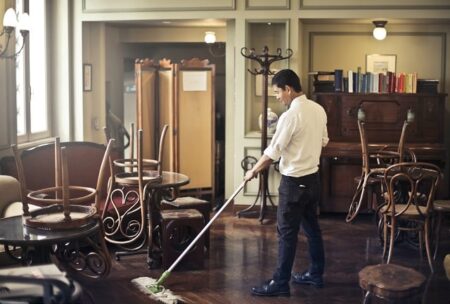
When damp cleaning becomes necessary, the technique requires both discipline and restraint. Our team consistently recommends a microfiber mop wrung to near-dryness before any contact with the floor surface, moving always in the direction of the wood grain to prevent moisture from entering plank seams. No section of the floor should remain visibly wet for more than thirty seconds, and the mop should be re-wrung frequently to maintain an appropriately dry application throughout the session.
Our team's standing rule: if water beads or pools on the surface after a pass, the mop carries too much moisture — wring it out further before continuing with the next section.
The gap between routine maintenance and a full deep clean is wider than most home users expect. Conflating the two — applying deep-clean products on a daily schedule, for instance — is one of the most frequent causes of finish degradation our team documents in residential settings.
Routine maintenance for hardwood floors centers on three consistent practices: daily dry mopping, weekly vacuuming with the brush bar off, and monthly damp mopping with a pH-neutral solution. Most people find that this straightforward schedule prevents the accumulation of grime that eventually requires more aggressive and potentially damaging intervention. Our team also recommends applying felt pads to all furniture legs and placing a quality mat at every exterior entrance, as these two passive measures reduce incoming particulate by a substantial margin without requiring ongoing effort.
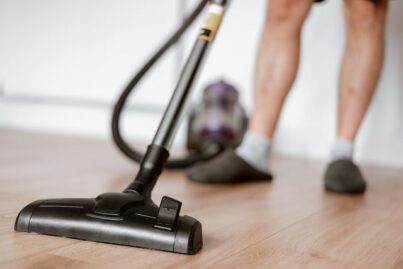
A full deep clean — involving a dedicated hardwood floor cleaner applied at the manufacturer-specified concentration — is appropriate no more than four times per year for most households. Our team works in small sections during a deep clean, applying solution sparingly, agitating gently with a soft-bristle brush in areas of stubborn soiling, and buffing the surface dry immediately after each section. The objective is to restore clarity to the finish without introducing enough moisture to stress either the topcoat or the underlying wood structure.
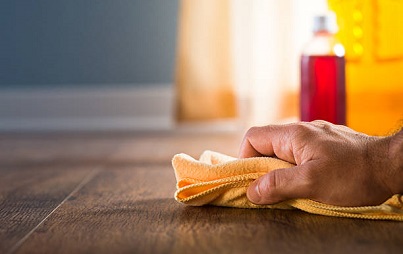
The market offers dozens of cleaning product options for hardwood floors, and our team has evaluated a broad cross-section to identify which categories genuinely protect the finish and which accelerate its deterioration over time.
pH-neutral, hardwood-specific cleaners remain the clear choice, consistently outperforming both DIY solutions and general-purpose floor products in long-term finish preservation according to our team's evaluation. Vinegar solutions, despite widespread popularity in home cleaning circles, are mildly acidic and break down polyurethane finishes with repeated use, leaving the wood surface progressively more vulnerable. Oil-based soaps leave a waxy residue that accumulates over time, producing a dull and streaked appearance that is difficult to correct without professional intervention. Steam mops represent the single most dangerous option for hardwood floors, as the combination of heat and concentrated moisture causes rapid structural damage to both the finish and the wood itself.
Our team has confirmed through direct testing that even a single session with a steam mop can cause irreversible warping in solid hardwood planks — these devices have no place in any hardwood floor care routine.
The following table summarizes the relative suitability of common cleaning approaches for finished hardwood, based on our team's evaluation and review of manufacturer guidance across multiple flooring brands and finish types.
| Method | Safety for Finished Hardwood | Moisture Level | Recommended Frequency |
|---|---|---|---|
| Dry microfiber mop | Excellent | None | Daily |
| Vacuum — hard-floor mode, no brush bar | Excellent | None | 2–3× weekly |
| pH-neutral damp mop | Good | Minimal | Monthly |
| Hardwood-specific cleaner concentrate | Good | Minimal | Quarterly |
| Vinegar-based solution | Poor | Moderate | Not recommended |
| Oil-based soap | Poor | Minimal | Not recommended |
| Steam mop | Dangerous | Very high | Never |
Understanding how to clean hardwood floors correctly is inseparable from understanding what not to do. Our team has documented a consistent pattern of errors across a wide range of households, and the consequences are often more severe and more permanent than most people anticipate before the damage is visible.
The most consequential error is excess moisture, which causes planks to swell, cup, and eventually separate at the seams in ways that are costly to reverse. The second most frequent mistake is running a vacuum with the rotating brush bar engaged, which scratches the finish as effectively as a coarse abrasive pad. The rotating brush bar deserves particular emphasis, as it is the default setting on most upright vacuums and must be manually switched off before use on hardwood. Our team also documents cases where home users applied the wrong finish-specific product — a water-based cleaner on an oil-finished floor, for instance — producing white hazing that requires professional-grade correction to resolve.
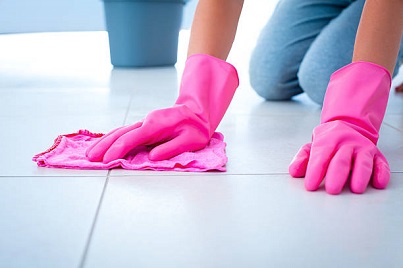
When residue buildup has dulled the surface, a hardwood floor cleaning concentrate — applied at the manufacturer's recommended dilution ratio — can dissolve accumulated film without harming the finish underneath. Our team also recommends inspecting the floor with a UV flashlight before any deep cleaning session, as ultraviolet light reveals biological residue and pet stains that are invisible under normal lighting and that require targeted spot treatment before general cleaning can proceed effectively. For households managing multiple floor types, our guide comparing carpet versus laminate in the bedroom provides useful context for understanding why hardwood demands its own entirely distinct care protocol.
Our team approaches hardwood floor care as a long-term investment, not merely a periodic cleaning task. The decisions made consistently over months and years determine whether a floor reaches its full lifespan — typically 25 to 100 years for solid hardwood — or requires costly intervention well before that point.
Maintaining indoor relative humidity between 35 and 55 percent is the single most impactful environmental factor in hardwood floor longevity. This measure supersedes even cleaning frequency in practical importance, according to most major flooring manufacturers' published specifications. Significant humidity fluctuations cause the wood to expand and contract in ways that widen plank gaps, stress adhesive bonds, and accelerate surface finish wear. Our team recommends monitoring humidity with a calibrated hygrometer and adjusting levels with a humidifier or dehumidifier as seasonal conditions require throughout the year.
Solid hardwood is unique among flooring materials in that it can be sanded and refinished multiple times across its full service life, making diligent surface care between refinishing cycles especially valuable from an investment standpoint. Our team observes that most floors benefit from a screen-and-recoat procedure every three to five years, which renews the topcoat without removing any wood material beneath. This interval extends to seven or more years in households that follow a consistent cleaning routine and maintain appropriate ambient humidity. Applying a compatible hardwood floor polish two to three times per year adds a supplemental protective layer and restores surface sheen between the major maintenance events in the refinishing cycle.
Our team recommends damp mopping finished hardwood floors no more than once per month under normal household conditions. More frequent wet cleaning introduces unnecessary moisture exposure that gradually degrades the protective finish, particularly at plank seams and edges where the risk of moisture infiltration is highest.
Our team does not recommend vinegar for hardwood floor cleaning. Despite its popularity as a natural household cleaner, vinegar is mildly acidic and degrades polyurethane and water-based finishes with repeated use, leaving the wood surface progressively more vulnerable to moisture damage and permanent staining over time.
Our team consistently recommends a hard-floor or bare-floor setting that fully disengages the rotating brush bar. The brush bar — highly effective for agitating carpet fibers — acts as a scratch-inducing abrasive against hardwood finish and should never contact the surface during any routine vacuuming session.
Our team strongly advises against steam mops on any hardwood surface, whether finished or unfinished. The combination of heat and concentrated moisture penetrates finish layers and enters plank seams rapidly, causing cupping and warping that in many cases cannot be corrected without full professional refinishing or board replacement.
Our team looks for three clear indicators: visible scratches that penetrate through the finish to the wood grain, areas where the finish has worn completely through in high-traffic zones, and a surface that remains persistently dull even after thorough cleaning. A screen-and-recoat procedure addresses surface-level wear without requiring a full sand-down of the wood beneath.
 |
 |
 |
 |

About Liz Gonzales
Liz Gonzales grew up surrounded by art and design in a New York suburb, with both parents teaching studio arts at the State University of New York. That environment sharpened her eye for aesthetics and spatial detail — skills she now applies to evaluating home products where form and function both matter. She has spent the past several years writing about lighting, home decor accessories, and outdoor living gear, with a particular focus on how products perform in real residential settings rather than showrooms. At Linea, she covers lighting fixtures and bulb reviews, outdoor and patio gear, and general home product comparisons.
You can Get FREE Gifts. Furthermore, Free Items here. Disable Ad Blocker to receive them all.
Once done, hit anything below
|
|
|
|