
Backpack sprayers account for over 40% of all handheld sprayer sales in the U.S. lawn and garden market — and it's not hard to see why. Whether you're treating a half-acre yard for weeds, applying fertilizer to a vegetable garden, or tackling pest control on a commercial property, a good backpack sprayer saves you from countless trips back to the garage to refill a handheld bottle. The right one can cover thousands of square feet in a single session without leaving your back in ruins by lunchtime.
But here's the thing: not all backpack sprayers are created equal. You've got manual pump models, battery-powered units, chemical-resistant diaphragm pumps, and everything in between. Tank sizes range from 3 to 6 gallons, pressure outputs swing wildly between 40 and 150 PSI, and the quality of the harness system can mean the difference between a comfortable morning of yard work and a sore back that haunts you for days. In 2026, the market has only gotten more crowded — which makes picking the right one genuinely confusing.
We've put together this in-depth guide to cut through the noise. Below you'll find detailed reviews of five of the best backpack sprayers available today, a practical buying guide covering what actually matters, and answers to the questions we hear most often. Whether you're a homeowner with a modest lawn or a professional landscaper running multiple jobs a week, there's a solid option here for you. And if you're building out your full outdoor cleaning arsenal, check out our cleaning category for more equipment reviews and guides.
Contents



Chapin has been making sprayers since 1884, and the 61900 is the kind of product that reflects more than a century of refinement. This is a 4-gallon commercial-grade unit made and designed in the USA — specifically at Chapin's facility in Batavia, New York — and it's backed by a 5-year limited warranty that you'll actually feel confident leaning on. The translucent poly tank is a small but genuinely useful detail: you can see exactly how much chemical remains without guessing, which matters when you're mid-job and trying to gauge whether you need a refill before hitting the back section of the property.
The pump action is smooth and consistent, delivering reliable pressure for general lawn and garden applications including herbicides, pesticides, and liquid fertilizers. What really separates the Chapin 61900 from cheaper alternatives is its 3-stage filtration system — one filter at the shut-off, one inside the tank near the pump, and a basket filter at the cap. That's three separate layers of debris protection, which dramatically reduces clogging issues even when you're working with slightly turbid mixes or tank residue. The stainless steel wand adds durability without excess weight, and the three included nozzles let you switch between fan, cone, and stream patterns to suit different tasks.
That said, the harness system on this model is functional but not exceptional. The shoulder straps lack the thick padding you'd want for extended sessions over an hour or more. For occasional home use or shorter professional runs, it's perfectly comfortable. But if you're spraying several hours daily, you may find yourself wanting more cushioning. The 4-gallon capacity is also a consideration — smaller than some competitors at 5 gallons, though the reduced weight when full can be a genuine advantage for older users or those with back concerns.
Pros:
Cons:
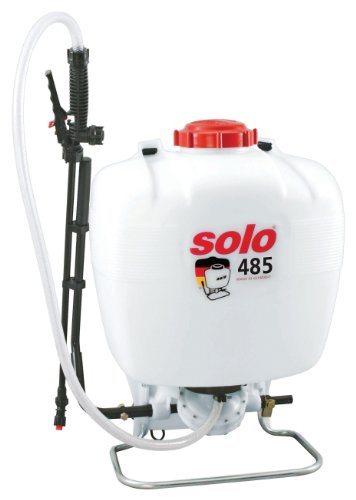
If coverage is your primary concern, the Solo 485 is built around that exact priority. Its 5-gallon tank is one of the largest in the manual backpack sprayer category, which means fewer interruptions during big landscaping jobs, pest control applications across large lots, or outdoor cleaning and disinfecting projects. Solo is a German-engineered brand with a serious reputation among professional landscapers, and this model reflects that pedigree in how it handles extended, demanding work sessions.
The standout technical feature here is the bleach-resistant diaphragm pump. This is a big deal if you're working with harsh disinfectants, bleach-based solutions, or other aggressive chemicals that would quickly degrade a standard rubber pump. Diaphragm pumps are also generally easier to prime and maintain than piston designs, and they handle particulates in your mixture more gracefully. For janitorial contractors, property managers, or anyone regularly applying chlorine-based solutions, this chemical tolerance is a genuine differentiator — not just a spec-sheet checkbox.
The padded shoulder strap system is noticeably more comfortable than budget models. Weight distribution across the back is reasonable, though at full capacity — about 42 pounds of water-weight equivalent — you'll feel the load regardless of harness quality. That's just physics. The Solo 485 manages it better than most through its ergonomic back panel design. One area where it falls slightly short: the pump handle ergonomics won't impress users who've used premium European models, and the fill opening could be wider for easier pouring from jugs. Still, for sheer capacity and chemical versatility, this is a top-tier choice.
Pros:
Cons:
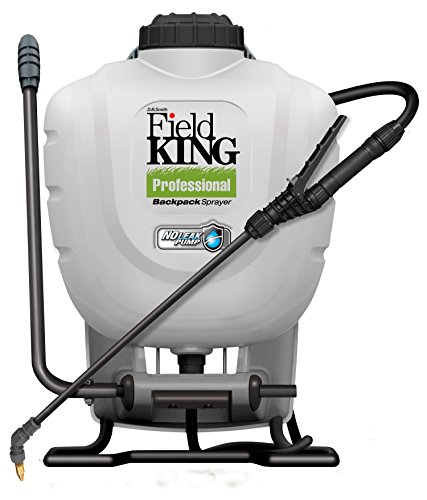
The Field King 190328 takes a design-first approach to a problem that anyone who's used cheap backpack sprayers knows all too well: chemical dripping. With a conventional external pump design, seals can degrade and chemical can drip down the pump handle — and onto your back. The Field King solves this with an internal no-leak pump design that keeps the pump mechanism enclosed within the tank, dramatically reducing drip risk during operation. It's a simple but meaningful safety improvement, especially if you're regularly working with herbicides or pest control chemicals you don't want soaking through your shirt.
Beyond the clever pump placement, the Field King delivers genuinely impressive pressure — up to 150 PSI from its internal piston pump. That's nearly double what many competitors in this price range achieve, and it shows in the spray pattern consistency and reach. The 21-inch poly wand uses premium Viton seals, which means it can handle wettable powders in addition to liquid formulations — a flexibility that most comparable units can't claim. The lockable brass shut-off valve adds professional-grade durability at the business end of the tool, and the in-line filter helps keep the system running clean between uses.
The 4-gallon tank is adequate for most residential and light commercial applications, and the overall build quality feels solid without being unnecessarily heavy. For users who mix their own chemical solutions from powder concentrates, the Viton seal compatibility is worth its weight in gold. If you're the type who also deals with exterior surfaces — and wants something to complement tools like a vinyl siding cleaner — the Field King's high-pressure output makes it versatile enough to handle a range of outdoor tasks beyond just lawn care. Our main critique is that the harness isn't quite as refined as the Solo 485's, but it's functional for sessions under two hours without complaint.
Pros:
Cons:
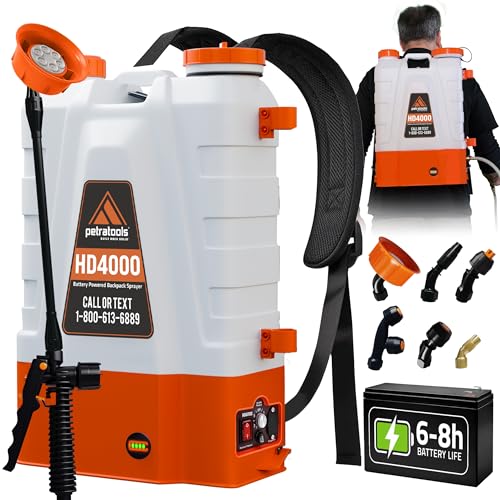
If you've ever spent 20 minutes manually pumping up pressure on a conventional backpack sprayer, you'll immediately understand the appeal of the PetraTools HD4000. This is a fully battery-powered unit — no manual pumping required. The 12V 8Ah battery is genuinely capable, rated to pump over 200 gallons per charge and lasting 6 to 8 hours of continuous use. That's not marketing puffery; it's a substantial runtime advantage over competing lithium-ion battery sprayers, many of which use smaller 2.0Ah cells that run down within two hours. For professional landscapers doing full-day applications, this runtime matters enormously.
The HD4000 maintains a consistent adjustable pressure up to 90 PSI without you having to think about it. You set the pressure, lock it in, and the battery-driven pump maintains it automatically. That consistency translates to more even spray coverage — something manual pump models struggle with as pressure gradually drops between pumping strokes. The unit ships with six spray nozzles covering everything from a fine mist to a concentrated stream, giving you real flexibility across different application types. PetraTools, a family-owned American company since 2019, backs the unit with 24/7 customer support and what they describe as a strong satisfaction guarantee.
The double-padded shoulder straps and back pad are legitimately comfortable — noticeably more so than the manual sprayers in this roundup. The squeeze handle's locking feature lets you spray continuously without holding the trigger, which reduces hand fatigue during long sessions. The trade-off with any battery-powered sprayer is the added weight of the battery and motor components, and the HD4000 is heavier than comparable manual units even with the same tank fill level. You'll also want to keep the battery charged between uses; letting it fully discharge repeatedly can reduce long-term battery lifespan. But if you're tired of pumping and want set-it-and-forget-it convenience, this is the most compelling option in 2026.
Pros:
Cons:
Birchmeier is a Swiss manufacturer with a reputation among professional horticulturalists and agricultural workers that goes back generations. The Iris 15K is their mid-range offering, and it shows what thoughtful engineering looks like when cost-cutting isn't the primary design priority. The externally mounted 87 PSI pump is the most distinctive feature here — it's positioned for easy access and ergonomic pumping without awkward reaching or contorted body positions. After an hour of use, that ergonomic advantage becomes noticeably apparent compared to models with less considered pump placement.
The 4-gallon UV-stabilized impact-resistant plastic tank is built to handle years of outdoor exposure without degrading, cracking, or becoming brittle — a legitimate concern for equipment stored in a shed through multiple seasons. UV stabilization means the tank won't chalk, fade, or lose structural integrity from sun exposure the way cheaper tanks eventually do. The carrying belt system is individually adjustable, which is more than you get from most competitors. That adjustability lets you dial in the fit to your specific body proportions, improving both comfort and load distribution over a full workday.
Where the Birchmeier earns its premium price is in the long-term ownership experience: parts availability, build longevity, and the kind of pump smoothness that comes from tighter manufacturing tolerances. Where it loses points for some buyers is upfront cost — this is one of the pricier manual backpack sprayers on the market. If you're a weekend gardener applying herbicide twice a year, you probably don't need to spend this much. But for a professional who uses a sprayer daily and values reliability over saving a few dollars, the Iris 15K is a sound long-term investment. Think of it the way you'd think of buying a quality heavy-duty spray bottle versus a dollar-store version — the difference compounds over time.
Pros:
Cons:
Tank size directly determines how often you'll need to stop and refill. For small residential yards under a quarter acre, a 3–4 gallon tank is typically sufficient and keeps the loaded weight manageable. For larger properties, commercial landscaping, or agricultural applications, a 5-gallon tank (or larger) dramatically reduces downtime. Most tanks today are made from high-density polyethylene (HDPE) or similar poly materials, which are lightweight and chemical-resistant. Look for UV-stabilized tanks if the sprayer will spend time in direct sunlight — non-stabilized plastic becomes brittle over seasons of UV exposure.
Translucent tanks are worth seeking out. Being able to see your fill level at a glance without removing the lid is a small convenience that adds up over dozens of sessions. The fill opening size also matters — wider is better when you're pouring from large concentrate jugs.
This is the most important mechanical decision you'll make when choosing a backpack sprayer. Piston pumps deliver higher pressure — often 90 to 150 PSI — and are excellent for general herbicide and pesticide applications. They're also typically more affordable and easier to service. The downside is that piston seals can degrade faster when exposed to harsh chemicals like bleach or high-concentration acids.
Diaphragm pumps operate at lower pressures (usually 40–90 PSI) but are inherently more chemical-resistant. They're the right choice when you're regularly working with disinfectants, bleach-based solutions, or other corrosive chemicals. For most homeowners applying standard lawn care products, a piston pump is perfectly adequate. For professional applications involving harsher chemistry, invest in a diaphragm pump.
The mechanics of pump design have a direct impact on which chemicals can safely be used in your sprayer — always cross-reference chemical compatibility with your pump type before adding anything unusual to the tank.
You'll be wearing this thing on your back for potentially hours at a time. The harness quality is not a secondary consideration — it's central to the ownership experience. Look for padded shoulder straps that are at least an inch thick, a contoured back panel with some ventilation, and ideally a chest strap or hip belt for distributing weight off your shoulders. Individually adjustable straps let you customize the fit to your body proportions, which matters more as session length increases.
Consider the pump handle ergonomics too. An awkwardly positioned or stiff pump handle will fatigue your arm faster than it should. Battery-powered models eliminate this concern entirely, which is their single biggest practical advantage over manual sprayers for users who do extended daily applications.
Clogging is the most common complaint about backpack sprayers, and it's almost always a filtration problem. Multi-stage filtration — at the fill cap, inside the tank near the pump, and at the shut-off — gives you the best protection against debris blocking the nozzle or pump. A single-stage filter at just the nozzle is the minimum; anything less is a liability, particularly when working with granular-dissolve mixes or slightly turbid chemical solutions.
Nozzle versatility determines how many different tasks you can accomplish with one sprayer. Fan nozzles are ideal for broad coverage applications like herbicide on lawns. Cone nozzles work well for shrub and tree applications. Stream nozzles are useful for targeted spot treatments and reaching into dense vegetation. If your sprayer only comes with one nozzle type, check whether replacements and accessories are readily available for that brand before buying. This ties into the broader question of parts availability — a sprayer with no aftermarket support becomes disposable the moment something breaks.
You should rinse your backpack sprayer thoroughly after every single use — no exceptions. Residual chemical left in the tank, pump, wand, and nozzle can dry and crystallize, causing clogs and degrading seals over time. After rinsing with clean water, run a tank of clean water through the full system to flush the pump and wand. For heavy-duty cleaning between different chemical types, a diluted baking soda solution helps neutralize acidic or alkaline residue. Deep-clean the nozzle tips with a soft brush at least once a month if you use the sprayer regularly.
It depends on your pump type. Standard piston pumps with rubber seals are not bleach-compatible — the chlorine degrades the rubber fairly quickly and you'll start seeing seal failures and leaks within weeks of regular bleach use. If you need to spray bleach-based solutions, choose a model with a bleach-resistant diaphragm pump and Viton or EPDM seals, like the Solo 485 reviewed above. Always rinse thoroughly after every use, and store with the tank empty to extend seal life.
Piston pumps use a reciprocating piston to build pressure, typically achieving higher maximum PSI (90–150 PSI) at lower cost. They're excellent for standard pesticide and herbicide applications. Diaphragm pumps use a flexible membrane that flexes rather than sliding, which makes them inherently more resistant to chemical damage and particulates in the mixture. They generally operate at lower pressures but handle a wider range of chemicals safely. For most homeowners using standard lawn care products, a piston pump is sufficient. For professionals working with harsher chemicals, a diaphragm pump is worth the investment.
Water weighs approximately 8.34 pounds per gallon, so a 4-gallon tank filled with water-based solution weighs roughly 33–35 pounds when full, plus the weight of the sprayer body itself (typically 5–9 pounds depending on construction). A full 4-gallon backpack sprayer weighs approximately 38–44 pounds in total. A 5-gallon unit can hit 50+ pounds when completely full. This is worth keeping in mind if you have back concerns, are a smaller user, or plan on working on uneven terrain where shifting weight can become a balance issue.
For users who spray frequently or for extended sessions, yes — often significantly so. Battery-powered sprayers eliminate the need for manual pumping, which reduces arm fatigue and allows more consistent pressure throughout the application. The PetraTools HD4000, for instance, maintains up to 90 PSI automatically without you touching the pump. The trade-offs are higher upfront cost, the added weight of the battery and motor, and the need to charge the battery between sessions. For occasional homeowners treating a small yard a few times per season, a good manual sprayer is probably the more economical choice.
Loss of pressure is almost always a seal issue, a clog, or a pump failure. Start by checking the nozzle — it may simply be clogged with mineral deposits or dried chemical. Remove the nozzle tip and soak it in warm water or a commercial nozzle cleaner. If the nozzle is clear but pressure is still weak, inspect the pump seals for cracking or deterioration; worn cup seals on piston pumps are one of the most common failure points and are inexpensive to replace. Also check all O-rings at connection points. If the diaphragm on a diaphragm-pump model has developed a crack, you'll see visible moisture or chemical seeping into the pump housing — replace the diaphragm immediately. Most reputable brands sell replacement seal kits.
 |
 |
 |
 |

About Linea Lorenzo
Linea Lorenzo has spent over a decade testing home gadgets, cleaning products, and consumer electronics from his base in Sacramento, California. What started as a personal obsession with keeping his space clean and stocked with the right tools evolved into a full-time writing career covering the home products space. He has hands-on experience with hundreds of cleaning solutions, robotic and cordless vacuums, and everyday household gadgets — evaluating them for performance, value, and real-world usability rather than spec sheet appeal. At Linea, he covers home cleaning guides, general how-to tutorials, and practical product advice for everyday home care.
You can Get FREE Gifts. Furthermore, Free Items here. Disable Ad Blocker to receive them all.
Once done, hit anything below
|
|
|
|