
You've spent twenty minutes scrolling through Amazon listings, comparing lumens to color temperatures, wondering whether "eye-caring" is a real spec or just marketing copy. Buying a desk lamp for studying feels like it should be simple — until you realize how much riding on it: your sleep, your focus, and your eyes after a six-hour study session. The right lamp makes a real difference, and in 2026 there are more solid options than ever across every price range.
Proper study lighting isn't just about brightness. Color temperature, flicker control, and coverage area all determine whether you can read for hours without headaches or eye strain. A lamp that's too dim forces your eyes to work harder; one that's too harsh washes out your screen and disrupts your sleep cycle if you study at night. Lighting researchers at institutions like the U.S. Department of Energy recommend task lighting in the 450–500 lux range for sustained reading — a spec most of the lamps below meet or exceed.
Whether you're a college student furnishing a dorm room or a professional setting up a home office, this guide covers seven of the best desk lamps for studying available right now. We've evaluated each one on build quality, light output, adjustability, and value, so you can skip the scrolling and get straight to studying. For more lighting picks across other categories, browse our lighting reviews. And if you've ever wondered exactly what a lumen actually means in practical terms, this breakdown of lumen output gives you a solid reference point before you buy.




The BenQ e-Reading Desk Lamp is the go-to pick for serious students in 2026, and it earns that title for concrete reasons. Its OVAL-Light technology spreads illumination across a 35.4" × 26.7" coverage area — wide enough to light your laptop, notebook, and reference materials simultaneously without repositioning the lamp head. That coverage floor is set at a minimum of 500 lux, which meets the threshold recommended for sustained reading and task work.
What really sets this lamp apart are its two smart dimming modes. Tap the touch panel once to switch between Screen Mode and Paper Mode. Screen Mode uses a zone-light optical design that's deliberately brighter at the sides and darker in the center, reducing glare bouncing off your monitor. Paper Mode floods the desk evenly for reading physical books or handwriting notes. Beyond those presets, you get 13 levels of color temperature spanning 2700K to 5700K, and 23 brightness steps — controlled by a single physical knob that feels intuitive and precise. The built-in ambient light sensor adjusts output as room conditions change, so you're never squinting after the sun sets.
Build quality is solid throughout. The matte silver finish resists fingerprints, the arm holds its position without drooping, and the base is heavy enough to stay put during active use. This is a lamp designed for people who spend three to eight hours at a desk daily — and it performs like it.
Pros:
Cons:
If you want the smartest, most adaptive desk lamp money can buy in 2026, the Dyson Solarcycle Morph™ is it. Dyson engineered this lamp to track your local daylight in real time — it automatically adjusts both brightness and color temperature throughout the day based on your geographic location and the time. That means cooler, energizing light during morning study sessions and warmer, gentler output as evening arrives. You don't have to touch a dial to get the right light; the lamp handles it.
The Morph name isn't just branding. This lamp transforms between four distinct modes: Task (direct downward beam for focused work), Indirect (upward-diffused ambient fill), Feature (accent illumination), and Ambient (soft room fill). That versatility makes it useful beyond just studying — you're buying a complete lighting solution for an entire room. The build quality is unmistakably Dyson: aerospace-grade materials, a base that anchors with confidence, and a hinge mechanism that moves with deliberate, well-damped precision.
The trade-off is price. The Solarcycle Morph costs significantly more than every other lamp on this list. If your budget allows it and you want technology that actively works for your circadian rhythm and focus levels, there's nothing better. But for students looking for a reliable, bright study lamp at a reasonable cost, the BenQ above delivers the better value.
Pros:
Cons:
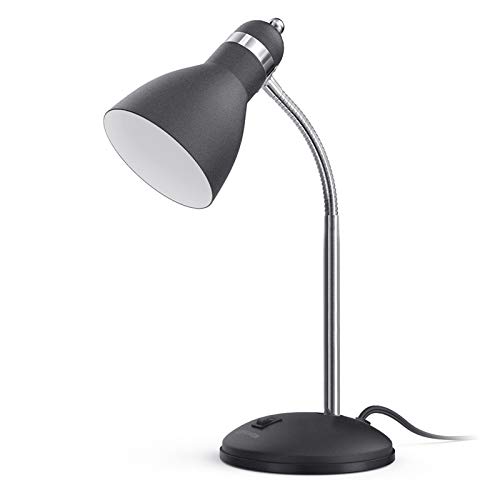
Not every student needs smart dimming or auto-daylight tracking. Sometimes you need a solid, good-looking lamp that turns on, stays on, and doesn't cost more than your textbooks. The LEPOWER Metal Desk Lamp fills that role perfectly. It's built from real metal — both the lampshade and the base — which gives it durability and a matte black finish that looks genuinely sharp on a desk rather than cheap plastic.
The design is refreshingly simple. The on/off switch sits on the base for quick access without fumbling around the shade, and the E26 screw base means you choose the bulb — swap in a daylight LED for focused study sessions or a warm bulb for evening reading. The heat dissipation design keeps the lamp running cool during long study sessions, which matters when you're grinding through finals and the lamp is on for six-plus hours at a stretch. The flexible gooseneck lets you aim light exactly where you need it.
This lamp doesn't have dimmable settings, USB charging ports, or smart features. That's the trade-off for the price. What you get is a sturdy, attractive, functional lamp that works reliably. For students who already have a quality bulb lying around and want something that won't wobble, overheat, or fall apart after a semester, the LEPOWER is the smart budget choice.
Pros:
Cons:
OttLite built its reputation on eye-friendly lighting, and the Pivot LED Desk Lamp demonstrates exactly why. The dual-head design pivots up to 180 degrees, letting you direct light from two angles simultaneously — useful when you're splitting attention between a monitor and physical materials. OttLite's ClearSun LED technology is the real differentiator here: it's specifically engineered to reduce glare and eyestrain, and a CRI of 97 means colors render almost identically to natural daylight. That matters when you're reading charts, annotating documents, or doing any task where visual accuracy is important.
Three color modes — warm, bright, and ClearSun natural daylight — are activated via a touch panel, and brightness is continuously dimmable through the same interface. If you're studying at night and worried about disrupting your sleep, the warm mode is genuinely warm without being orange. The built-in 40-minute auto-shutoff timer is a practical feature: set it when you take a break and the lamp turns itself off automatically. LEDs are rated to 40,000 hours, so this is a lamp you buy and use for years. If you care about how long you can study without your eyes aching, this is the pick to consider. Students can also refer to this guide on full-time student schedules for context on how many hours of focused study your lighting needs to support.
The touch controls are smooth and responsive. The adjustable neck holds position reliably. If you've ever used a cheap lamp and noticed your eyes getting tired after an hour, this is the correction.
Pros:
Cons:
Standing desks change your lighting geometry — a floor lamp or a lamp with a fixed base often doesn't follow you as the desk surface moves. The UPLIFTDESK E7 solves this with a clamp mount that secures to surfaces up to 2.25 inches thick without scratching the finish, and a premium aluminum architect arm with multiple swivel joints that lets you reposition the light head to wherever you're working. If your desk height shifts throughout the day, this lamp adapts without any hassle.
The three color modes are ergonomist-designed for real work scenarios: warm 3000K for evening sessions, neutral 4000K for focused daytime work, and cool 5000K for high-alertness tasks. Tapping cycles through them. Brightness adjusts by pressing and holding — no harsh jumps, just smooth continuous control. The diffused LED panels eliminate flickering and ghosting, which are the two most common causes of the headaches you get after staring at a poorly lit desk for hours. The E7 is also 80% more energy efficient than incandescent alternatives.
For students with a proper desk setup — especially anyone running dual monitors — the architect-arm design and clamp mount free up desk space while keeping light exactly where you need it. It's a serious piece of equipment that matches serious study setups.
Pros:
Cons:
Dorm life comes with specific constraints: limited outlets, a roommate trying to sleep while you study, and not much space on a tiny desk. The Lepro LED Desk Lamp addresses all three with a practical, well-priced package. The built-in USB charging port means one outlet powers both your lamp and your phone, which genuinely matters when your dorm room has two outlets and four devices. At 650 lumens, it's bright enough for serious study sessions without flooding the room.
Five color modes and five brightness levels give you a total of 25 lighting combinations — more granularity than most lamps at this price. The frosted shade and long lamp head diffuse light evenly, eliminating the harsh glare halos and shadows that cheap single-point LED lamps throw. Touch control on the base is smooth and responsive. You won't accidentally blast your roommate with full-brightness cool light when you're adjusting at midnight.
The lamp head adjusts on a flexible arm, and the whole unit folds compactly for dorm move-in and move-out days. At under thirty dollars in most configurations, this is genuinely one of the best-value study lamps available in 2026. It doesn't have the wide-area coverage of the BenQ or the adaptive intelligence of the Dyson, but for a single-student desk in a shared room, it does everything you need.
Pros:
Cons:
The ELECTRI LED Desk Lamp takes a different design approach: three independent joints that bend and rotate across a full 360-degree range. This isn't just marketing — the articulation means you can position the lamp low and close to a book without blinding yourself, angle it to eliminate monitor glare, or fold it completely flat when you're done. For anyone who moves between multiple workspaces or stores their lamp when not in use, that portability is a real practical advantage.
Five color modes cover the full warm-to-cool spectrum, from amber for winding down to daylight for focused work. Brightness control is stepless — no locked levels, just slide left or right on the touch panel to dial in exactly the output you want. That's more control than most lamps at any price point. The white finish is clean and minimal, and the folding design means it travels well.
This lamp pairs well with the kind of flexible routines many students run — studying at a desk in the morning, moving to a coffee table in the evening, then folding the lamp away when company arrives. If you want a lamp that adapts to how you actually live rather than just how you study, the ELECTRI delivers. If you're also shopping for portable lighting solutions for other activities, our review of the LuminoLite Rechargeable LED Book Light covers a great companion option for reading away from your desk.
Pros:
Cons:
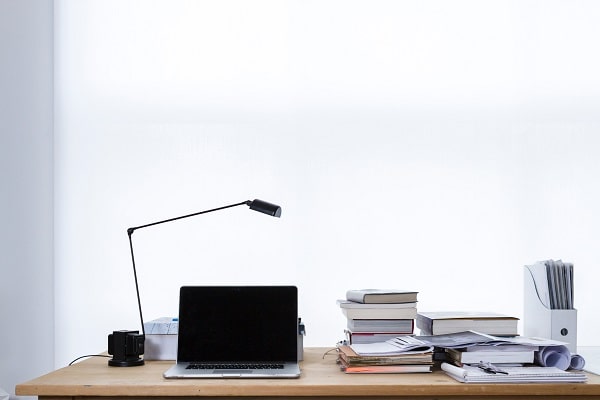
Color temperature is measured in Kelvin (K) and determines whether your light feels warm or cool. For studying, this decision depends entirely on when and how you work. Warm light (2700K–3000K) is relaxing and appropriate for evening reading — it won't suppress melatonin production the way cooler light does, which protects your sleep. Neutral light (3500K–4500K) is the sweet spot for focused daytime work: alert without being harsh. Cool daylight (5000K–6500K) maximizes alertness and is best for high-focus morning sessions.
The best desk lamps for studying in 2026 offer adjustable color temperature — typically 2700K to 5700K — so you're not locked into one mode. If you can only have one setting, 4000K neutral white is the universally practical choice for study work at any hour.
Lumens measure total light output. Lux measures how much of that light actually reaches your desk surface at a given distance. A lamp can be high-lumen but poorly focused, spreading light everywhere except where you're reading. For studying, you want a minimum of 500 lux at desk level — which most quality LED lamps in the 400–700 lumen range achieve at typical arm distances.
CRI (Color Rendering Index) measures how accurately a light source renders color compared to natural sunlight. CRI 80 is acceptable; CRI 90+ is noticeably better for extended use; CRI 97 (OttLite) is near-perfect. Higher CRI means less visual effort, which translates directly into less eye fatigue over long sessions.
A lamp that can't reach your work is useless regardless of its specs. Look for three things: arm reach, head angle, and base stability. Architect-arm lamps (UPLIFTDESK E7) offer the most flexibility. Gooseneck lamps (LEPOWER) are flexible but may drift over time. Fixed-arm lamps with adjustable heads are stable but limited in range.
For standing desk users, a clamp mount is almost mandatory — it keeps the lamp at the right height regardless of desk position. For traditional desk setups, a weighted base is preferable. Stability matters more than most buyers realize: a lamp that wobbles when you brush it or droops after a week of use is a constant low-grade annoyance during study sessions.
In 2026, desk lamps range from simple on/off switches to app-controlled adaptive systems. The right choice depends on how much friction you want in your workflow.
Stepless dimming (ELECTRI) beats fixed brightness steps every time if you're sensitive to light levels. If you find yourself frequently adjusting brightness throughout a session, this feature saves real mental overhead.
For daytime studying, 4000K–5000K neutral to cool white light maximizes alertness and focus. For evening sessions, drop to 2700K–3000K warm white to protect your sleep. The ideal setup is a lamp with adjustable color temperature so you can shift across the day — every lamp on this list except the LEPOWER offers this.
For a single desk with a typical 18–24 inch arm length, 400–650 lumens is sufficient to hit the recommended 500 lux at desk surface. For larger desks or dual-monitor setups, look for lamps with wide-area coverage designs rather than just higher lumen counts — the BenQ's 35.4" spread is more useful than a 1000-lumen spotlight aimed at one spot.
Poor-quality desk lamps can cause eye strain through three mechanisms: flickering (imperceptible but fatiguing), excessive glare, and mismatched color temperature for the time of day. Quality LED lamps with diffused shades, CRI 90+, and flicker-free drivers eliminate all three issues. The OttLite Pivot and BenQ e-Reading are specifically engineered to minimize these factors.
Cool light (4000K–5500K) is better for active study reading during the day — it improves alertness and reduces the likelihood of drowsiness. Warm light (2700K–3000K) is better for leisure reading in the evening, as it doesn't suppress melatonin production. If you do most of your studying after 9 PM, starting in cool light and shifting to warm as you wind down is the evidence-backed approach.
CRI stands for Color Rendering Index — it measures how accurately a light source renders colors compared to natural sunlight, on a scale of 0 to 100. A CRI of 80 is adequate; 90+ is noticeably more natural; 97 (OttLite) is near-perfect. Higher CRI means your eyes work less hard to process what they're seeing, which directly reduces fatigue during long reading sessions. For any task involving color accuracy — design, photography, art — CRI 90+ is essential.
Yes, but choose the right mount. Clamp-mount lamps like the UPLIFTDESK E7 are the best option for standing desks because they attach to the desk edge and move with it. Base-mount lamps on a floor or separate surface don't track your desk height, leaving you either under-lit or over-lit depending on desk position. For standing desk users, the UPLIFTDESK E7 is the clear recommendation on this list.
 |
 |
 |
 |

About Linea Lorenzo
Linea Lorenzo has spent over a decade testing home gadgets, cleaning products, and consumer electronics from his base in Sacramento, California. What started as a personal obsession with keeping his space clean and stocked with the right tools evolved into a full-time writing career covering the home products space. He has hands-on experience with hundreds of cleaning solutions, robotic and cordless vacuums, and everyday household gadgets — evaluating them for performance, value, and real-world usability rather than spec sheet appeal. At Linea, he covers home cleaning guides, general how-to tutorials, and practical product advice for everyday home care.
You can Get FREE Gifts. Furthermore, Free Items here. Disable Ad Blocker to receive them all.
Once done, hit anything below
|
|
|
|