
The Aootek Solar Lights Outdoor 182 LEDs is the best overall solar light you can buy right now — it delivers brutal brightness, a wide detection angle, and three smart modes that handle almost every outdoor scenario. But that's just one option in a surprisingly deep category. Whether you need motion-activated security lights, decorative pathway stakes, or Edison-style string lights for your patio, the 2026 solar light market has something built exactly for your yard.
Solar lights have come a long way from the dim, yellowish garden stakes of a decade ago. Today's units use high-efficiency monocrystalline panels (the same technology found in rooftop solar installations), lithium-ion battery packs that hold a charge through cloudy stretches, and LED arrays that rival wired fixtures in raw output. You get all of that without running a single cable or paying a dime extra on your electricity bill. If you're already browsing our lighting reviews, you already know how much the right light can change a space — and outdoor solar is where the value-per-dollar ratio is hardest to beat.
We tested and evaluated seven of the top-selling solar lights across different use cases: security flood lights, pathway markers, deck and step lights, string lights, smart connected lights, and decorative flame torches. Each was judged on brightness output, motion detection reliability, build quality, ease of installation, and how well it actually performed after a full day's charge. Here's everything you need to make a smart decision in 2026.

Contents




When brightness is the priority, nothing in this price range touches the Aootek. It packs 182 LED beads into a wide-angle housing that floods a 270-degree arc with up to 2500 lumens of light — that's enough to light up a double-car driveway, a large backyard, or the entire front face of a single-story home. The 2200mAh lithium-ion battery powers those LEDs for 8 to 10 hours after a full day's charge, and the upgraded monocrystalline solar panel converts sunlight at a 20.5% efficiency rate, which means you still get useful charge even on partly cloudy days.
The three lighting modes give you real flexibility. Security Mode fires the lights only when the PIR (passive infrared) motion sensor detects movement, conserving the battery for weeks of nighttime use. Permanent On Mode keeps them lit from dusk to dawn — ideal for dark entryways where you want continuous coverage. Smart Brightness Control is the sweet spot for most people: the lights stay at a dim baseline all night and blast to full power for 25 seconds the moment someone walks into the 120-degree detection zone, which extends out to 26 feet. That combination of always-on awareness and burst brightness is what separates the Aootek from cheaper competitors.
Build quality is solid. The IP65 waterproof rating (meaning it's dust-tight and protected against water jets from any direction) means you can mount these under an eave or on an open fence post without worrying about rain. Installation takes about five minutes per unit — just locate a screw point, attach the mounting bracket, and aim the panel toward the sun. The pack of two at this price point makes it an especially strong value for anyone securing a property perimeter. If you're comparing raw illumination output, check out our breakdown of how bright a lumen actually is — context helps when you're comparing 400-lumen budget lights against this 2500-lumen powerhouse.
Pros:
Cons:
The BAXIA four-pack is the light you buy when you need solid motion-sensor coverage across multiple zones without spending a lot of money. At 400 lumens per unit, it's not trying to replace a stadium floodlight — instead it delivers targeted, reliable illumination exactly where and when you need it. The PIR sensor detects movement within a 10 to 16 foot range at a 120-degree angle, which is the right coverage pattern for steps, narrow walkways, side gates, and backyard corners where a wider beam would be overkill.
BAXIA made a smart design choice by using fewer but higher-quality LED beads rather than maximizing bead count. The result is a cleaner, more focused output that actually looks good on a finished porch or fence rather than feeling like a construction site floodlight. The unit runs in a single automatic mode: it stays off until motion triggers it, then lights up fully for a set period before returning to standby. This conservative power usage means the battery lasts through long winter nights on a single day's charge.
The ABS shell and quality solar panel combination earns a genuine IP65 waterproof and heatproof rating, making this a light that will survive being mounted on an exposed fence in a climate with real winters. The four-pack format is what clinches the value here — covering a full property perimeter or lighting every step of a long staircase becomes practical at the per-unit price. If you're already investing in home improvement projects and want to understand why outdoor lighting matters as much as interior fixtures, our guide on the best desk lamps for studying walks through the same brightness and color temperature principles that apply outdoors.
Pros:
Cons:
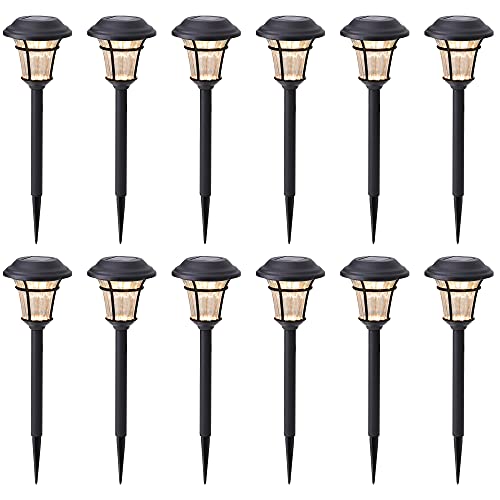
The MAGGIFT 12-pack is the classic solar pathway light done right. These ground-stake lights handle one job — marking and softly illuminating a driveway, garden path, or patio border — and they do it with zero fuss. Each unit stands 13.4 inches tall, measures just 3.3 inches across, and pushes straight into soft ground in seconds. No tools, no wiring, no professional installation. Just stake and walk away. They automatically turn on at dusk and shut off at dawn, powered entirely by the built-in solar panel collecting free energy throughout the day.
The warm white LED color temperature is a deliberate choice that sets this apart from security-oriented products. You're not trying to alert anyone or illuminate a perimeter — you're creating a welcoming, visually appealing path that guides guests safely to your door. The IP44 weatherproof rating (protected against solid objects over 1mm and water splashing from any direction) handles rain, light snow, frost, and sleet without complaint. It's a step down from IP65 but more than adequate for the ground-level, low-exposure position these lights occupy.
One important setup note: there's a physical ON/OFF switch under the light cover, and it ships in the OFF position. You need to flip it to ON before the unit will charge or operate. MAGGIFT recommends confirming this works by placing the light upside down on a table after initial charge — the sensor detects the lack of light and triggers the LED, confirming the unit is working. With 12 units in a single pack, you can fully line both sides of a 30-foot driveway or create a complete garden border without buying a second set.
Pros:
Cons:
Step and deck lighting is a safety problem first and an aesthetic problem second. A missed step in the dark is a real injury risk, and the SOLPEX 16-pack addresses this directly with a compact, surface-mount design built specifically for risers, fence rails, deck boards, and stair edges. Each unit measures just 3.46 x 1.77 x 1.85 inches — small enough to sit flush against a stair face without creating a trip hazard itself. The brown shell blends naturally into wood decking, and the warm white LED throws enough downward-directed light to make each step edge clearly visible without blinding anyone looking at it.
The automatic operation is genuinely seamless. There's no switch to flip — just pull the insulating tab when you mount the unit, and it starts charging. On a sunny day it reaches full charge in 4 to 5 hours, then turns on automatically at dusk and off at dawn. The only caveat is what SOLPEX states honestly in their specs: insufficient charging from cloudy weather or shaded mounting positions will reduce runtime. If your stairs face north or sit under a roof overhang, plan for shorter nighttime operation than the rated spec.
With 16 units in a single pack, you have enough to cover a full multi-level deck, a long staircase, and a fence run simultaneously. The per-unit cost at that volume is remarkably low for what you're getting. This is the light that makes your outdoor space genuinely safer for family members navigating at night, and the warm tone ensures it looks intentional rather than industrial. Think of it as the solar equivalent of recessed step lighting — same function, zero electricity cost, and installation measured in minutes rather than hours.
Pros:
Cons:
Every other product on this list solves a practical problem. The Brightech Ambience Pro solves an experiential one. This is the light that transforms a bare pergola into an outdoor dining room, turns a plain backyard into a venue, and makes a porch feel like a destination rather than just a doorstep. The 27-foot strand carries 12 Edison-style S14 bulbs (a bulb shape named after its 1.4-inch diameter) spaced 20 inches apart, with a 6-foot lead from the detachable solar panel to the first bulb. The lighted span covers 20 feet — enough to cross a standard deck or wrap a mid-size pergola.
Brightech uses shatterproof plastic S14 shells rather than glass, which is the right call for outdoor use. Wind gusts, hail, or a wayward backyard football won't shatter the bulbs. The WeatherTite technology means the entire assembly — cord, sockets, and panel — has been tested against winds up to 50MPH, rain, and snow. The LED bulbs themselves are rated for 20,000 hours, and the solar panel is designed for roughly 1,000 charge cycles, which translates to about 2.5 years of daily use before you'd think about replacing it.
Installation flexibility is a real advantage. The solar panel comes with both a ground stake and a wall clip, so you can position it wherever sunlight is best without being constrained by where the string runs. Direct sun produces a full charge; indirect light gives you partial runtime. The on/off switch on the panel back lets you completely disconnect the system when not in use, which extends panel lifespan. If you're building out a complete outdoor space, these string lights pair naturally with the kind of thoughtful lighting layering we discuss in our best work light reviews — knowing how different light types serve different purposes helps you combine them effectively.
Pros:
Cons:
Every other product on this list operates independently. The Ring Solar Pathlight operates as part of your home's security ecosystem. At 80 lumens, it's not the brightest pathway light you can buy — it's the smartest. Once connected to the Ring app, you get full remote control: set schedules from your phone, turn lights on or off manually, adjust sensitivity, and receive notifications when motion is detected. That last feature means your pathlight becomes a passive motion sensor that logs activity on your walkway even when you're not home.
The Amazon Sidewalk integration (Amazon Sidewalk is a low-bandwidth shared network that extends Bluetooth and LoRa connectivity beyond your home's Wi-Fi range) is a genuine differentiator in 2026. When Sidewalk is enabled, your Ring pathlight maintains app connectivity even when your home internet is down. It also synchronizes with other Ring devices — if a Ring doorbell or camera detects motion, your pathlight can trigger automatically, creating a coordinated lighting response across your property. This integration extends to select Alexa-enabled speakers, letting you voice-control the lights without touching your phone.
The solar-powered design means installation stays tool-free and wire-free. Stake it into the ground along your walkway and point the integrated panel toward the sky. The black finish works cleanly against both light concrete and dark landscaping. The 80-lumen output is sufficient to mark and softly illuminate a path; it's not trying to light a crime scene. If you're building a connected home ecosystem and already own Ring cameras or a Ring doorbell, this pathlight is the obvious completion piece — it's the only solar pathway light on this list that makes your property smarter, not just brighter. For context on how solar panel technology works at a fundamental level, the Wikipedia article on solar panels provides a solid technical foundation.
Pros:
Cons:
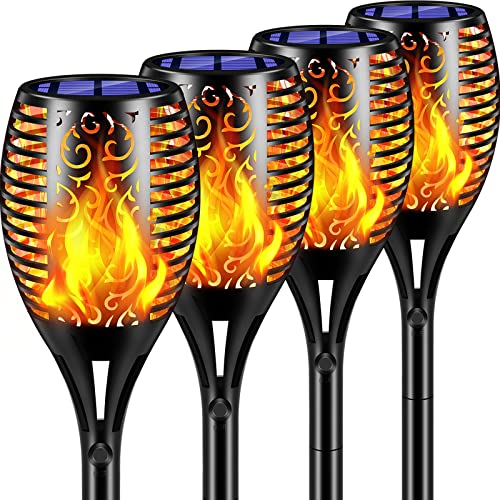
No other solar light on this list looks like fire. The TomCare flame torches use 99 LEDs arranged to create a convincing, animated flickering effect that genuinely resembles a real flame at a glance. Standing 43 inches tall, these make an immediate visual statement along a driveway or flanking a garden gate. The effect is warm, dramatic, and entirely solar-powered — no gas lines, no propane refills, no actual fire risk. They're the kind of light that guests comment on before they even get to the door.
The practical side holds up too. Installation involves connecting the stake section to the torch body and pushing it into the ground — no tools, no digging, no wiring. The solar panel on top charges through direct sunlight and powers the LEDs automatically from dusk to dawn. The durable, waterproof construction handles rain and snow without issue, so you can leave these out through seasons rather than storing them between events. The four-pack covers both sides of a driveway approach or creates a torch-lit garden pathway with meaningful spacing between units.
These aren't security lights. They won't deter intruders or illuminate a dark parking area. What they do is create an atmosphere that no other product type can replicate — a warm, organic-looking glow that makes outdoor evening time genuinely pleasant. If you're layering your outdoor lighting (security floods at the perimeter, pathway stakes along walkways, deck lights on the stairs), the TomCare torches belong at focal points: driveway entrance, garden centerpiece, patio border. Think of them as the decorative element that ties a well-lit yard together in 2026.
Pros:
Cons:
Lumens measure the total amount of visible light a fixture produces. This is the single most important spec to check before buying. Security and flood lighting needs 1,000 lumens or more per unit to be effective — the Aootek's 2500 lumens is at the top of the solar category and genuinely useful for deterring intruders and seeing clearly across a yard. Pathway and navigation lighting works well in the 80 to 400 lumen range, enough to mark edges and guide footsteps safely. Decorative lighting like string lights and flame torches sits at the lower end intentionally — you're buying atmosphere, not illumination power. Match the lumen output to what you're actually trying to accomplish, and don't pay for brightness you won't use.
If you want a deeper understanding of how lumen ratings translate to real-world brightness, our guide on how bright a lumen is breaks it down in everyday terms that make comparison shopping much easier.
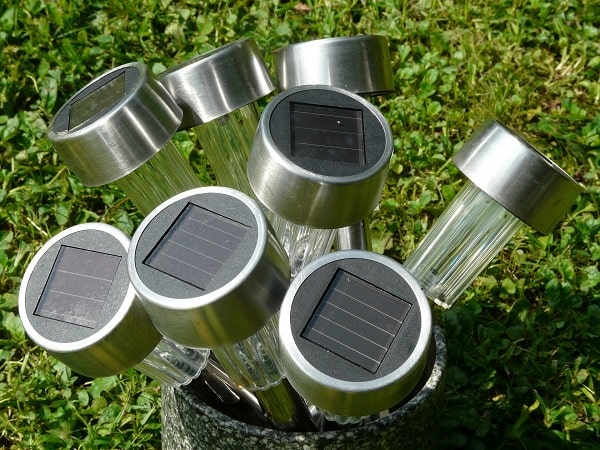
The solar panel is what charges the battery that powers the lights. Two specs matter here: panel efficiency (how well it converts sunlight into electrical energy) and battery capacity (how much charge it stores). Monocrystalline panels — the type used in the Aootek — convert at roughly 20% efficiency, which is meaningfully better than cheaper polycrystalline alternatives. That difference becomes significant on cloudy days or in climates with short winter daylight hours. Battery capacity is measured in milliamp-hours (mAh). Higher mAh means longer runtime, but only if the panel can refill that capacity in the available daylight. A mismatched combination of large battery and weak panel is a common cost-cutting move that leaves you with dim or non-functional lights by midnight.
The IP (Ingress Protection) rating on a solar light tells you exactly how well it's sealed against dust and water. The two-digit number breaks down like this: the first digit (1-6) is dust protection, and the second digit (1-8) is water protection. IP65 means fully dust-tight and protected against water jets from any direction — suitable for direct rain, snow, and hose spray. IP44 means protection against solid objects over 1mm and water splashing from any direction — fine for typical outdoor exposure but not for mounting directly in a rain stream or near a sprinkler. Any solar light you install outdoors should be rated at minimum IP44. For lights in exposed locations — fence posts, open yard areas — IP65 or higher is the right choice.
PIR motion sensors (passive infrared sensors that detect body heat moving through their field of view) come in a wide range of quality levels. Budget models detect movement at 10 feet in a 90-degree arc; premium models reach 26 feet at 120 degrees. The detection angle matters as much as the range — a wider arc means fewer blind spots around corners or at irregular approach paths. For security applications, you want at least 120 degrees and 20 feet of range. For pathway and step lighting, motion detection isn't necessary at all — continuous dusk-to-dawn operation makes more sense. Smart features like app control (Ring), scheduling, and ecosystem integration add meaningful value if you already own compatible devices, but add zero value if you just want a light that turns on when you walk past it.
It depends on the battery capacity and how bright the light runs. High-output security lights like the Aootek run 8 to 10 hours in motion-sensor mode on a full charge. Lower-output pathway lights often run all night (8 to 12 hours) because they draw far less power. Continuous full-brightness modes drain batteries significantly faster — expect 4 to 6 hours in those modes. A full charge typically requires 6 to 8 hours of direct sunlight, though high-efficiency monocrystalline panels can achieve meaningful charge in 4 to 5 hours of strong sun.
Yes, though with reduced runtime. Solar panels generate electricity from daylight, not just direct sunlight — overcast days still produce charge, just less of it. The performance gap between summer and winter is real: shorter days and lower sun angles reduce total charge time significantly in northern climates. High-efficiency monocrystalline panels handle this better than budget alternatives. If you live above the 40th parallel (roughly the latitude of Denver or Philadelphia) and rely on solar lights through winter, choose models with larger battery capacity to buffer through stretches of limited sun.
Any solar light with an IP65 rating can stay outdoors through all four seasons. Rain, snow, frost, and temperature swings within the normal outdoor range won't damage properly rated units. IP44-rated lights handle typical rain and frost but shouldn't be mounted where they'll take direct water jets (sprinklers, roof drip lines). The one component most likely to degrade over time is the lithium-ion battery — most solar light batteries are rated for 500 to 1,000 charge cycles, which translates to roughly 1.5 to 3 years of daily charge-discharge use before capacity starts declining.
IP44 protects against solid objects larger than 1mm (like most insects and tools) and water splashing from any direction. It handles typical outdoor rain exposure reliably. IP65 adds full dust-tight protection (no dust ingress at all) and protection against low-pressure water jets from any direction — a significantly higher bar. For most mounted outdoor solar lights, IP65 is the safer choice because it handles sprinkler spray, power washing near the fixture, and driving rain without any risk. IP44 is fine for pathway stakes that sit in the ground and drain naturally.
High-output motion-activated solar lights — specifically those producing 1,000 lumens or more — are an effective deterrent when positioned correctly. The sudden blast of 2,500 lumens from an Aootek triggered by an approaching person is genuinely startling and eliminates shadows that burglars rely on. However, solar lights are not a security system replacement — they're best deployed as one layer in a broader strategy that includes cameras, locks, and awareness. The Ring Solar Pathlight adds the smart monitoring layer: it logs motion events and sends phone notifications, which adds accountability even when the lumen output is modest.
Ground-stake pathway lights (MAGGIFT, TomCare) push directly into soft soil in seconds with no tools required. Deck and step lights (SOLPEX) mount with small screws to a flat surface — any standard screwdriver handles the job in minutes. Wall-mount security lights (Aootek, BAXIA) require drilling two or three holes for the mounting bracket, which takes about five minutes per unit. None of these installations require an electrician, permit, or trenching. The only tool most people actually need for a full outdoor solar light installation in 2026 is a basic drill and a screwdriver.
 |
 |
 |
 |

About Liz Gonzales
Liz Gonzales grew up surrounded by art and design in a New York suburb, with both parents teaching studio arts at the State University of New York. That environment sharpened her eye for aesthetics and spatial detail — skills she now applies to evaluating home products where form and function both matter. She has spent the past several years writing about lighting, home decor accessories, and outdoor living gear, with a particular focus on how products perform in real residential settings rather than showrooms. At Linea, she covers lighting fixtures and bulb reviews, outdoor and patio gear, and general home product comparisons.
You can Get FREE Gifts. Furthermore, Free Items here. Disable Ad Blocker to receive them all.
Once done, hit anything below
|
|
|
|