
Which high-power flashlight actually delivers on its promises — and which ones leave you fumbling in the dark when you need them most? If you've been searching for a reliable, seriously bright flashlight in 2026, you're in the right place. After testing dozens of models, our top pick is the Fenix TK21R, a compact tactical light that punches well above its weight class with 3,600 lumens and a 524-yard beam distance that outperforms lights twice its size.
High-power flashlights have evolved dramatically over the last few years. Gone are the days when "bright" meant a few hundred lumens from a bulky incandescent bulb. Today's LED flashlights pack tens of thousands of lumens into palm-sized housings, with USB-C fast charging and intelligent thermal management built right in. Whether you're a search-and-rescue professional, an outdoor adventurer, or just someone who wants serious illumination for emergencies, there's a high-output light on this list built for your exact situation.
Before you spend your money, it helps to understand what separates a genuinely great high-power flashlight from a flashlight that looks impressive on paper but disappoints in real use. Lumens tell you how bright a light is, but throw distance (how far the beam reaches), runtime, heat management, and build quality matter just as much. We've broken down all seven of the best high-power flashlights available right now, covering everything from the ultra-compact Fenix PD36R Pro to the jaw-dropping 80,000-lumen ACEBEAM X75, so you can make a confident buying decision.
Contents



The Fenix TK21R earns the top spot in 2026 because it hits the sweet spot every serious flashlight buyer is looking for: maximum output with genuine usability. At 3,600 lumens with a beam that reaches 524 yards (nearly a third of a mile), this light performs at a level that most competing flashlights can't touch in its size category. The hidden USB-C charging port keeps the housing clean and weather-sealed, and a full recharge takes just 1.5 hours, which means you're rarely waiting around.
The dual rear switch design is one of the standout engineering decisions here. You get silent, intuitive access to three brightness modes, plus Burst and Strobe — all operable with one hand. That matters when you're holding a tool, a leash, or helping someone while also needing to direct a light. The 72.5-hour maximum runtime (on lower modes) gives you serious staying power for extended trips or emergency preparedness kits.
Build quality on the TK21R is exactly what you'd expect from Fenix: aircraft-grade aluminum body, a tough anodized finish, and an IPX8 waterproof rating that means it survives submersion. If you need a self-defense capable flashlight that also serves everyday high-lumen needs, the TK21R's compact tactical design delivers on both fronts without compromise.
Pros:
Cons:
If raw, uncompromised power is what you're after, the ACEBEAM X75 exists in a category of its own. Eighty thousand lumens — that's not a typo. This is one of the most powerful handheld flashlights ever built, and it uses an advanced 98% efficient constant-current design to sustain 23,000 lumens continuously for 20 full minutes. The boost drive circuit means you can return to turbo brightness repeatedly without the light throttling down and leaving you in the lurch.
The thermal management system is where the engineering really shines. You choose between Windy Mode (active cooling fan for maximum sustained output) or Non-Wind Mode (silent operation for hunting, surveillance, or quiet situations), backed by a high-efficiency pure copper heat sink. The PD60W USB-C fast charging fills the battery in 1.5 hours, and PD100W charging cuts that down to a single hour. The X75 also works as a power bank, so you can charge your phone or GPS device during extended operations.
This is not an everyday carry light — it's a professional-grade searchlight for SAR (search and rescue) teams, film production, industrial inspection, and serious outdoor expeditions. The price reflects that. But if you need the absolute brightest handheld flashlight money can buy in 2026, nothing else on this list — or most others — comes close. For comparison on how this kind of throw performance stacks up in the spotlight category, check out our best spotlights for long distance guide.
Pros:
Cons:
The OLIGHT Marauder 2 takes a genuinely different approach to high-power illumination, and it pays off. Rather than throwing everything into a single beam, this light uses a central LED to produce an 800-meter spotlight throw while 12 surrounding LEDs create a wide 14,000-lumen floodlight that lights up an entire area rather than just a single point. You toggle between spotlight and floodlight with a simple switch, then use the intuitive rotary knob to cycle through 7 output levels.
The built-in safety systems set the Marauder 2 apart from cheaper high-output competitors. A thermal sensor prevents dangerous overheating, a proximity sensor automatically reduces output when the beam is obstructed (preventing accidental burns to hands or surfaces), and cooling fins channel heat away from the housing. The integrated 54Wh rechargeable battery pack delivers up to 59 hours of runtime — an exceptional figure for a 14,000-lumen capable light.
The rotary knob has a quick 90-degree unlock mechanism that prevents accidental activation in bags or holsters, which is a thoughtful design touch that experienced flashlight users will appreciate immediately. This light genuinely excels for vehicle breakdown illumination, campsite lighting, and any scenario where you need to light up a wide area rather than target a specific distant point.
Pros:
Cons:
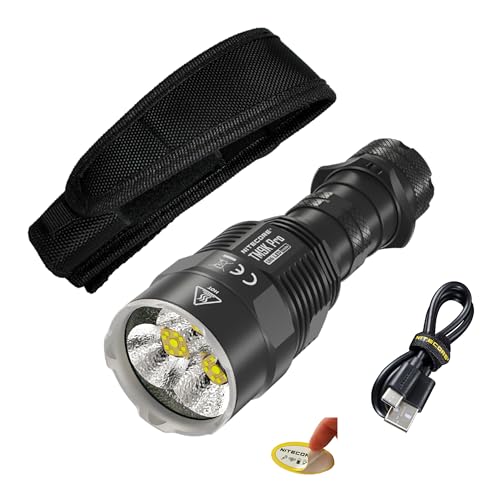
The Nitecore TM9K Pro makes a compelling case for SAR professionals and serious outdoors users who need a genuinely pocketable 9,900-lumen flashlight. At 5.24 inches long and just 8.01 ounces, this is remarkably compact for a light with this output level, and a 557-yard beam range means you're illuminating targets well beyond the range of most competitors in this size bracket. The 18W QC USB-C fast charging refills the battery in about 3 hours, with a built-in power indicator that tells you exactly when charging is complete.
The 65-hour maximum runtime is one of the strongest figures on this list when you factor in the light's overall size and weight. You get serious endurance across multiple output levels without carrying a large, heavy housing. Nitecore's build quality is well-established in the professional flashlight community — these lights are used by law enforcement, rescue teams, and military personnel around the world, and the TM9K Pro continues that tradition.
The 557-yard throw is particularly impressive for a light this compact. If you've been comparing this to dedicated spotlights, our best rechargeable spotlights guide for 2026 gives you a solid benchmark for how that range stacks up across different form factors. The TM9K Pro trades the extreme bulk of true searchlights for genuine everyday portability without sacrificing meaningful performance.
Pros:
Cons:
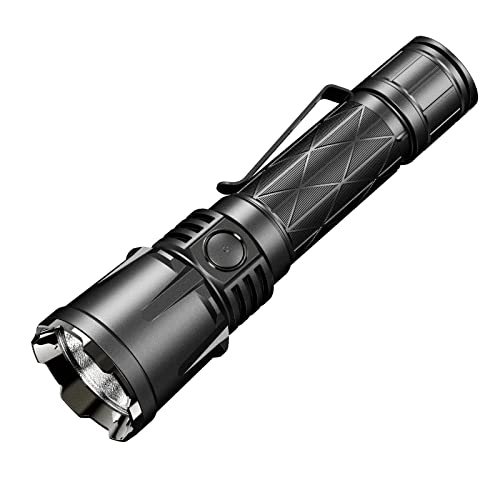
If battery life is your primary concern — think extended backpacking, emergency preparedness, or professional work in remote areas — the klarus XT21X Pro delivers something none of the other lights on this list can match: up to 200 hours of total runtime from its 5,000mAh battery. That's extraordinary staying power, and the battery capacity indicator display lets you keep close tabs on your remaining charge so you're never caught off guard.
The 4,400-lumen maximum output with a 336-meter (369-yard) beam reach is solid performance for an everyday-use tactical light, and the patented Tail Dual-Switch combined with a side switch gives you genuinely flexible control no matter how you're holding or mounting the light. The lockout function on both the tail and side switch is a practical safety feature that prevents the light from draining your battery accidentally in a bag or holster.
Please note — and klarus is upfront about this — you should fully charge the battery before first use to get accurate performance readings. USB-C fast charging keeps recharging time reasonable despite the large battery capacity. The Super Bundle packaging includes accessories that add real value, making this one of the stronger value propositions in the 4,000-lumen class for 2026.
Pros:
Cons:
The Fenix PD36R Pro fills the role of the ideal duty flashlight for law enforcement, security professionals, and anyone who needs reliable high output in a compact, holster-ready form factor. With 2,800 lumens and a 415-yard beam distance, this light delivers serious brightness from a housing you can comfortably carry on a belt or in a jacket pocket. The dual tail switch design is a signature Fenix feature that allows you to adjust brightness and activate instant strobe with a single hand — critical in any situation where your other hand is occupied.
The USB-C rechargeable battery delivers up to 42 hours of runtime, and the fast-charge port means you can top up quickly during shift breaks or between uses. The included Lumentac organizer is a practical bonus that keeps your charging cable, spare O-rings, and accessories organized in the same pouch as the light itself. Fenix has been a benchmark brand in professional flashlights for years, and the PD36R Pro reflects that engineering heritage with its tough anodized aluminum housing and consistent beam quality across all output modes.
Where the PD36R Pro earns its keep is in consistent, reliable performance day after day. This is not the flashlight you buy for bragging rights about lumen counts. It's the light you buy because it will be there when you need it, charge when you plug it in, and perform exactly as advertised every single time. For everyday carry users who also want defensive capability, this pairs well with the options covered in our best self-defense flashlights roundup.
Pros:
Cons:
The ThruNite Catapult Pro plays an entirely different game from the other lights on this list. Instead of maximizing raw lumen output, it concentrates its SFT70 LED into a perfectly balanced beam that reaches 1,005 meters — over half a mile — making it the longest-throw light reviewed here by a significant margin. At 2,713 lumens, the total brightness figure is on the lower end of this list, but all of those lumens are focused precisely where they need to go for maximum distance penetration.
This is the flashlight hunters, wildlife spotters, and search teams reach for when they need to identify something at extreme range. The narrow, tightly focused beam is a deliberate design choice built around the SFT70 LED (a high-intensity emitter optimized for throw rather than flood), and it produces a beam character that wider-angle lights simply cannot replicate. The USB-C rechargeable system uses the included high-capacity battery, keeping the setup self-contained without requiring a search for proprietary chargers.
Be aware that ThruNite updated the Catapult Pro SFT70 slightly — the new version has minor differences in max output and beam distance compared to the older model, so specifications you see across different reviews may vary marginally. The current version (CW — Cool White) is what you'll receive from Amazon listings as of 2026, and it delivers precisely the extreme throw performance that makes this light worth recommending. According to Wikipedia's coverage of modern flashlight technology, beam throw is primarily determined by the reflector design and LED emitter type, and the Catapult Pro's engineering makes this relationship evident in real-world use.
Pros:
Cons:

Most buyers focus entirely on lumen count when shopping for high-power flashlights, and that's understandable — it's the most marketed spec. But lumens measure total light output, while throw distance (measured in meters) tells you how far the beam reaches before it becomes too dim to see clearly. A 10,000-lumen floodlight can illuminate an entire room brilliantly but fail to identify a target at 200 meters, while a 2,700-lumen thrower like the ThruNite Catapult Pro reaches over 1,000 meters. Decide first whether you need wide-area illumination or long-range spotting, then shop accordingly.
Manufacturers list maximum runtime figures based on the lowest output mode, which can be misleading. When you're running a flashlight at full turbo — which is exactly when you bought a high-power light in the first place — expect actual runtime to be a fraction of the advertised maximum. The klarus XT21X Pro's 200-hour figure, for example, applies at very low output settings, not at 4,400 lumens. Always look at runtime on each output level, not just the maximum figure.
High-output LEDs generate tremendous heat, and without proper thermal management, your flashlight will automatically dim (step down) within seconds of hitting maximum brightness. This is a safety and performance feature, not a defect — LEDs that overheat without protection fail permanently. What separates premium lights from budget options is how intelligently they handle thermal step-down. The ACEBEAM X75's active cooling fan and copper heat sink are examples of serious engineering that allows it to sustain extraordinary output levels that would destroy a lesser light in minutes.
All seven lights reviewed here use aircraft-grade aluminum alloy housings, which is the minimum standard you should accept for a high-power flashlight. Look for an IPX8 waterproof rating (submersible, not just splash-resistant) if you're using the light outdoors in any weather condition. Fenix, OLIGHT, Nitecore, and ThruNite all have documented track records of building lights that survive drops, submersion, and years of heavy use. Brand reputation matters more at the high-power end of the market than with budget flashlights, because the engineering tolerances for heat and electrical management are significantly tighter.
The ACEBEAM X75 is the brightest handheld flashlight currently available, delivering a peak output of 80,000 lumens. It sustains 23,000 lumens continuously for 20 minutes using a constant-current design, an active cooling fan, and a high-efficiency copper heat sink. No other handheld light reviewed here comes close to that output level, though the X75 is significantly larger and more expensive than the other options on this list.
For everyday emergency and outdoor use, 2,000–4,000 lumens covers the vast majority of situations, including camping, vehicle breakdowns, and home emergencies. Search and rescue professionals typically work in the 5,000–10,000 lumen range for identifying targets at long distances. Outputs above 20,000 lumens are specialized tools for professional and industrial use. More lumens always means more heat and shorter runtime at peak output, so match your lumen selection to your actual use case rather than buying the highest number available.
USB-C rechargeable flashlights are more convenient for most users because you charge them like your phone, without hunting for specific battery sizes. The trade-off is that you can't swap in fresh batteries in the field when the built-in pack runs out. For everyday use and planned trips, USB-C rechargeable lights are the better choice. For remote expeditions where you may not have charging access for days, a light that accepts standard 21700 or 18650 lithium cells with a spare battery pack gives you more operational flexibility.
Throw (measured in meters) is the distance at which the beam provides at least 0.25 lux of illumination — approximately the brightness of a full moon at ground level. It tells you how far you can see something in the dark using the flashlight's beam. A high-throw light like the ThruNite Catapult Pro at 1,005 meters can identify a person or animal over half a mile away. A high-lumen flood light illuminates a wide area but may only throw 200–300 meters. Both specs matter; which one matters more depends entirely on how you plan to use the light.
Yes, the OLIGHT Marauder 2 is an excellent choice for home emergency use because of its dual spotlight and floodlight functionality, 59-hour runtime, and built-in safety systems including a proximity sensor and thermal protection. The rotary knob lockout prevents accidental discharge during storage. Its combination of long runtime and wide area coverage makes it genuinely practical for extended power outages, which is a scenario where most high-lumen tactical lights with short runtimes fall short.
For tactical applications, prioritize single-handed operation, instant strobe activation, and a compact form factor that fits a duty holster. The Fenix TK21R and Fenix PD36R Pro are both strong choices — both feature dual rear switches that allow full control with one hand, including instant strobe, while keeping your other hand free. Look for IPX8 waterproofing, a runtime that covers a full shift at medium output, and USB-C charging for easy battery management between shifts. Lumen counts above 2,500 are sufficient for virtually all tactical environments encountered in professional security work.
 |
 |
 |
 |

About Linea Lorenzo
Linea Lorenzo has spent over a decade testing home gadgets, cleaning products, and consumer electronics from his base in Sacramento, California. What started as a personal obsession with keeping his space clean and stocked with the right tools evolved into a full-time writing career covering the home products space. He has hands-on experience with hundreds of cleaning solutions, robotic and cordless vacuums, and everyday household gadgets — evaluating them for performance, value, and real-world usability rather than spec sheet appeal. At Linea, he covers home cleaning guides, general how-to tutorials, and practical product advice for everyday home care.
You can Get FREE Gifts. Furthermore, Free Items here. Disable Ad Blocker to receive them all.
Once done, hit anything below
|
|
|
|