
Which fountain pen ink actually delivers — smooth flow, vivid color, and no clogging? That's the question every pen enthusiast wrestles with in 2026. The answer depends on your pen, your paper, and what you want your writing to look like. But if you want our top pick right now, it's the Pilot Iroshizuku Kon-peki — a deep azure blue that flows like water and looks stunning on the page.
Finding the right ink isn't just about color. It's about consistency, pen compatibility, and how the ink behaves over time. A cheap ink can gum up your pen and cost you more in cleaning than you saved at checkout. The good news? The market in 2026 has some genuinely excellent options across every price point. Whether you're new to calligraphy and fine writing instruments or a seasoned collector, this guide covers the best fountain pen inks you can buy right now.
We've tested and researched seven top-rated inks — from budget blues to premium iron gall formulas. Each one has been evaluated for flow, color, dry time, water resistance, and pen compatibility. You'll also find a buying guide and answers to the most common questions. Let's get into it.

Contents




The Pilot Iroshizuku Kon-peki is the ink that converts skeptics into believers. "Kon-peki" translates to "deep azure blue" in Japanese, and it delivers exactly that — a rich, saturated blue with just a hint of teal that catches the light beautifully on white paper. This is a premium ink made in Japan, and the quality shows in every drop. The 50ml glass bottle is elegantly designed, with a built-in reservoir that makes filling your pen easy and clean, even when the bottle is nearly empty.
Flow is this ink's superpower. It moves through fine nibs, medium nibs, and broad nibs with equal ease. There's no skipping, no railroading, and no hard starts after your pen sits capped for a few days. Dry time is moderate — around 15 to 20 seconds on standard copy paper — which is perfectly acceptable for a non-waterproof ink. It's well-behaved on most fountain pen-friendly papers and performs beautifully on premium options like Rhodia and Leuchtturm. This is the ink we recommend to students, teens, and everyday writers who want something that simply works, looks great, and won't punish their pen.
Water resistance is its only real weakness. A splash of water will feather the ink noticeably, so it's not ideal for documents that need to last. But for journaling, note-taking, and correspondence, Kon-peki is nearly perfect. At around $28 for 50ml, it's not the cheapest option on this list — but it earns every cent. If you want one ink that does everything well and looks spectacular doing it, this is your pick.
Pros:
Cons:
Diamine is a British ink brand with over 150 years of history, and Oxford Blue is one of their most beloved colors. It's a classic, deep navy-leaning blue — think old-school British correspondence ink, the kind that looks serious and professional on any paper. The 30ml bottle is smaller than most on this list, but the price reflects that. Diamine Oxford Blue is one of the most affordable quality inks on the market in 2026, making it an easy recommendation for anyone building their first ink collection.
Performance is solid across the board. Flow is smooth and consistent. The ink is well-lubricated without being oversaturated, which means it works in both fine and medium nibs without skipping or flooding. Dry time runs around 10 to 15 seconds on coated paper — faster than many premium inks. Shading is subtle but present, giving your writing a bit of dimension without being dramatic. It's not the most exciting ink on this list, but it is one of the most reliable. Oxford Blue is the ink you reach for when reliability matters more than flash.
The 30ml bottle may feel small if you write every day, but it keeps the entry cost low and lets you try the ink without committing to a large supply. If you fall in love with it — and many writers do — Diamine also offers a 80ml bottle. There's very little to criticize here. For the price, Oxford Blue is an outstanding value and a great daily writer.
Pros:
Cons:
Waterman has been making fountain pens and inks since 1884, and Serenity Blue is their flagship color. It's a medium blue — lighter and softer than Oxford Blue or Kon-peki — with a calm, almost pastel quality. The name fits perfectly. Writing with this ink feels unhurried and smooth. It's exactly the kind of ink you'd use to fill pages in a journal or write a long letter without fatigue. The 50ml bottle gives you plenty of ink to work through, and the price is very reasonable for the Waterman brand.
For beginners, Waterman Serenity Blue is the safest possible starting point. It's formulated to be gentle on pens, with no iron gall acids, no shimmer particles, and no heavy dye loads that could clog fine nibs. Flow is on the wetter side, which makes it forgiving in pens that might otherwise run dry. Dry time is moderate. The color is vibrant — crisp and legible — without being aggressive. It won't impress ink connoisseurs, but that's not the point. This ink is designed to be easy, reliable, and widely compatible.
Shading is minimal and water resistance is low, but neither matters much if you're using this for everyday writing rather than archival documents. One notable point: Waterman Serenity Blue is also widely available in retail stores, which makes replacement easy if you run out mid-project. If you're buying your first fountain pen ink or gifting one to someone who's just starting out, Waterman Serenity Blue is the right call.
Pros:
Cons:
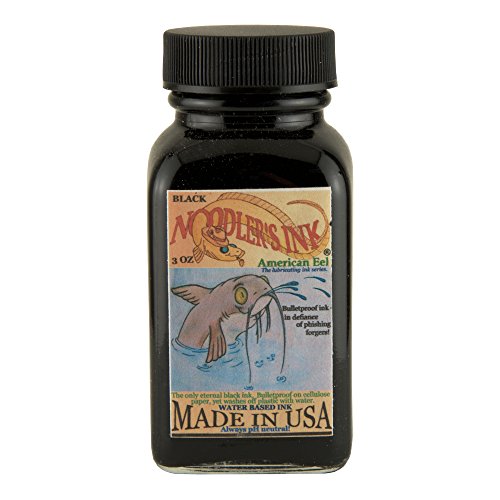
Noodler's is an American ink brand known for making inks that push the limits. Polar Bulletproof Eel Black is their cold-weather formula — designed to stay liquid and flow reliably even in freezing temperatures. The "Bulletproof" designation means the ink bonds permanently to cellulose (the fiber in paper), making it genuinely waterproof and fade-resistant once dry. The "Eel" component adds lubricating qualities to the formula, which helps the ink glide through the pen and protects the nib and feed from excessive wear. This is the ink for anyone who needs a black that truly lasts.
Flow is surprisingly smooth for such a durable ink. The Eel formula compensates for the thickness that iron-based permanent inks can sometimes introduce. You get a reliable, non-skipping write even in fine nibs. Dry time is slightly longer than standard inks — budget 20 to 30 seconds on regular paper — but once it's dry, it will not move. Water, highlighters, alcohol-based markers — none of them lift this ink off the page. That makes it ideal for documents, contracts, or any writing you need to preserve for years.
The cold-weather resistance is a genuine bonus if you write outdoors or live somewhere with harsh winters. Standard fountain pen inks can thicken and clog in cold conditions; Polar Bulletproof Eel stays fluid down to near-freezing temperatures. The ink comes in a generous bottle and is priced very competitively for what it delivers. If you want a black ink that performs like a professional archival tool, this is it. Just make sure to flush your pen more regularly, as all permanent inks benefit from occasional cleaning.
Pros:
Cons:
Pelikan's Edelstein line is the gold standard of premium fountain pen inks. The name means "gemstone" in German, and Onyx lives up to it — a deep, jewel-toned black with exceptional depth and consistency. The formula includes a special ingredient that actually conditions the rubber seals and internal components of your pen as you write, which means less maintenance and longer pen life. That's not marketing language; pen collectors have reported noticeably cleaner pens after switching to Edelstein inks. If you own an expensive fountain pen, Pelikan Edelstein Onyx is the ink you put in it.
Flow is exceptional. Edelstein inks are engineered for smooth, consistent delivery across all nib sizes, and Onyx is no exception. The ink is moderately wet without flooding. It responds beautifully to pressure variations in flex nibs, producing noticeable line variation. On premium paper like Tomoe River or Clairefontaine, it shines — literally. The black has a subtle sheen under raking light that makes it look richer than most inks in the same color family.
The 50ml bottle is elegant and practical. The wide mouth makes dipping and filling easy. At its price point, Pelikan Edelstein Onyx is clearly a treat rather than an everyday workhorse — but for special projects, your best pen, or gift-giving, it's unmatched. Pair it with a quality writing surface and a pen you love, and every writing session becomes something you look forward to. Check out our guide to more product reviews if you're outfitting a full writing setup.
Pros:
Cons:
Shimmer inks are a category all their own, and Diamine Shimmering Blue Pearl is one of the best in the game. The base color is a cool, medium blue. But what makes it special are the flecks of gold and silver suspended in the formula — once the ink dries on paper, those particles catch the light and create a pearlescent, glittering effect that no standard ink can replicate. Writing with this ink feels genuinely special. Open a notebook under a lamp and watch the page come alive with light.
Diamine has formulated the shimmer to be water-based, non-toxic, and pH neutral, which keeps it safe for most fountain pens. The ink is fast-drying for a shimmer formula and flows smoothly despite the particle load. That said, shimmer inks require more pen maintenance than standard formulas. The particles can settle and accumulate in the feed (the plastic piece that carries ink to the nib). You should flush your pen with water every one to two weeks to prevent buildup. Use this ink in a pen you can easily clean — not in a hard-to-disassemble vintage pen with a delicate feed.
The 50ml glass bottle is beautifully packaged and looks great on a desk. Swirl the bottle before filling to distribute the shimmer particles evenly — this is standard practice for all shimmer inks. Blue Pearl pairs exceptionally well with broad or stub nibs that lay down a wet line and really show off the sparkle. If you're looking to add some drama to your writing — for art journaling, creative projects, or just because you deserve a little joy in your notebook — this is the ink for that.
Pros:
Cons:
Iron gall ink (an ancient formula made from fermented oak galls and iron salts) has been used for over a thousand years. Rohrer & Klingner's Salix is a modern iron gall formula that preserves the best qualities of this historical ink while making it safe for use in modern fountain pens. You can read more about the history of iron gall ink on Wikipedia — it's a fascinating subject. The name "Salix" refers to the willow tree, and the ink has a beautiful blue-black color that darkens and oxidizes on paper over time, becoming richer and more dramatic as the days pass.
The oxidation process is what makes iron gall ink special. When it first hits the page, Salix appears as a medium grayish-blue. Within minutes, it darkens. Within hours, it deepens into a rich, authoritative blue-black. This color shift is visually striking and beloved by calligraphers and document writers alike. The oxidized result is also highly water-resistant — not fully waterproof, but far more resistant than standard dye-based inks. For legal documents, important letters, or archival use, iron gall is a legitimate upgrade.
Flow is well-balanced for an iron gall formula. Rohrer & Klingner have done a careful job managing the acid content to keep it pen-friendly. The ink is suitable for quills, dip pens, and modern fountain pens, though you should flush your pen more regularly than with standard inks — every week or two is good practice with any iron gall. If you're interested in the craft of writing and want an ink with genuine historical roots, Salix is a remarkable choice. It's also excellent for those exploring the calligraphy world alongside their calligraphy set.
Pros:
Cons:
This is the single most important spec if your writing needs to last. Standard dye-based inks — like Waterman Serenity Blue or Diamine Oxford Blue — will smear or run if they get wet. That's fine for journaling. It's not fine for important documents. If you need permanence, look for inks labeled "bulletproof," "permanent," or "iron gall." Noodler's Bulletproof and Rohrer & Klingner Salix are the picks in this guide for water-resistant writing. Know what your writing will face before you choose your ink.
Not every ink works in every pen. Modern fountain pens are generally tolerant of most standard inks. Vintage pens are pickier — acidic inks like iron gall can damage rubber sacs and internal components over time. Shimmer inks can clog narrow feeds. As a rule, the more delicate or expensive your pen, the more conservative your ink choice should be. Waterman Serenity Blue and Pilot Iroshizuku are universally safe. Iron gall and shimmer inks require more care. Always check the manufacturer's ink recommendations for your specific pen before filling it with something new.
Color is obvious — blue, black, or something else. But shading is a subtler quality that separates interesting inks from flat ones. Shading refers to how an ink varies in intensity across a single stroke — darker where ink pools at the start and end of a letter, lighter in the middle. Inks with strong shading add visual life to your handwriting. Pilot Iroshizuku Kon-peki and Pelikan Edelstein Onyx both shade beautifully on quality paper. If you write on cheap copier paper, you'll see less shading regardless of which ink you choose.
Fountain pen inks come in bottles ranging from 15ml to 90ml or more. If you write daily, a 30ml bottle will last a few weeks. A 50ml bottle lasts most writers several months. Price-per-milliliter matters if you're on a budget — Diamine Oxford Blue in 30ml looks cheaper than Pilot Iroshizuku at 50ml, but work out the per-ml cost before assuming you're saving money. Also consider dry time: slower-drying inks frustrate left-handed writers who smear wet lines. If you write left-handed, lean toward inks known for fast dry times. The best value depends entirely on how you write and how often.
The Pilot Iroshizuku Kon-peki is our top pick for everyday use. It flows reliably in virtually any fountain pen, looks stunning on paper, and is gentle enough for daily writing without requiring frequent cleaning. If you want something more affordable for daily use, Diamine Oxford Blue is an excellent alternative that costs less without sacrificing quality.
Not quite. Most standard water-based fountain pen inks work in most modern fountain pens. However, iron gall inks can damage vintage pens with rubber sacs or bladders due to their mild acidity. Shimmer inks can clog fine nibs and narrow feeds. Always check your pen manufacturer's ink recommendations, and flush your pen regularly regardless of which ink you use.
Regular flushing is the key. For standard inks, flush your pen with cool water every few weeks or whenever you change ink colors. For shimmer inks and iron gall formulas, flush weekly. Never let ink dry in your pen — if you won't be writing for more than a week, empty and rinse the pen before storing it. A clean pen flows better and lasts longer.
Yes, with some precautions. Modern iron gall inks like Rohrer & Klingner Salix are formulated to be pen-safe at their current acid levels. The risk comes from leaving iron gall ink sitting in a pen for extended periods — the acid can corrode metal parts over time. Flush your pen every week or two when using iron gall ink, and you'll have no problems with modern stainless steel or gold-tipped fountain pens.
Standard fountain pen inks use dye molecules that sit on top of the paper fibers. Water can lift them. Permanent inks — like Noodler's Bulletproof formulas — use molecules that bond chemically to the cellulose in paper. Once dry, they resist water, highlighting, and fading for years. The trade-off is that permanent inks are slightly harder to clean from your pen and may require more frequent maintenance.
They're easy to write with, but require more pen care than standard inks. The metallic particles in shimmer inks can settle in the feed and accumulate over time. To prevent clogs, swirl the bottle before filling, use a pen with a wide feed channel (broad or medium nibs work best), and flush the pen with water every one to two weeks. Avoid shimmer inks in fine nibs or vintage pens with complex internal mechanisms.
 |
 |
 |
 |

About Linea Lorenzo
Linea Lorenzo has spent over a decade testing home gadgets, cleaning products, and consumer electronics from his base in Sacramento, California. What started as a personal obsession with keeping his space clean and stocked with the right tools evolved into a full-time writing career covering the home products space. He has hands-on experience with hundreds of cleaning solutions, robotic and cordless vacuums, and everyday household gadgets — evaluating them for performance, value, and real-world usability rather than spec sheet appeal. At Linea, he covers home cleaning guides, general how-to tutorials, and practical product advice for everyday home care.
You can Get FREE Gifts. Furthermore, Free Items here. Disable Ad Blocker to receive them all.
Once done, hit anything below
|
|
|
|