
You're sitting at your desk, watching your internet connection drop every time someone picks up the landline, and you've finally had enough. It's a frustratingly common problem for anyone still running DSL broadband over a standard telephone line, and the fix is almost embarrassingly simple: a DSL filter. These small inline adapters separate the high-frequency data signal from the low-frequency voice signal, eliminating crosstalk, line noise, and those maddening disconnections that cost you time and productivity.
DSL filters have been around for decades, but the market in 2026 still includes a wide range of quality levels — from budget packs that barely do the job to reliable inline units that genuinely restore both call clarity and connection stability. According to the Wikipedia overview of DSL filters, these devices work by acting as a low-pass filter on the voice side and a high-pass filter on the data side, keeping the two signals cleanly separated. Understanding that basic principle helps you shop smarter, because not every filter on the market achieves that separation equally well.
This guide covers the five best DSL filters available right now, with honest breakdowns of what each one actually delivers. Whether you need a single splitter for one room or a multi-pack to cover your entire home, you'll find the right pick here. You can also browse our full product reviews section for other home tech and networking accessories.

Contents
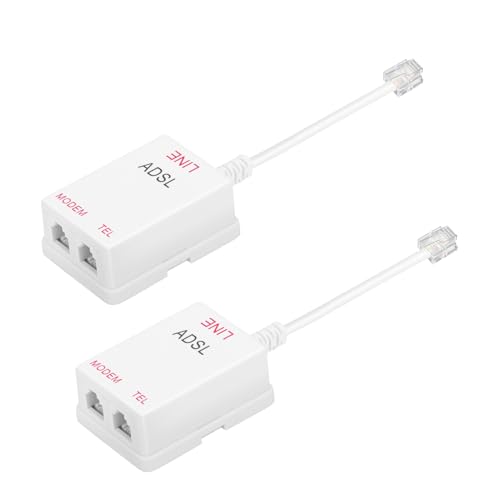




The Uvital in-Line DSL Filter Splitter earns the top spot in 2026 for one straightforward reason: it solves the most common DSL interference problem in a single plug-and-play package, and it comes in a two-piece set so you can cover two devices right out of the box. The RJ11 6P2C male-to-two-female design splits your incoming phone line into one filtered voice output and one unfiltered data output, which is exactly the configuration your setup needs when your modem and landline phone share the same wall jack. You don't need to rewire anything, call your ISP, or buy additional hardware — just plug it in and the separation happens automatically.
The ADSL signal separation itself is clean and reliable. The low-frequency audio band stays on the phone side, while the high-frequency DSL data passes through to your modem without degradation. Users who have struggled with crackling phone calls or unstable DSL speeds caused by unfiltered phones consistently report that the Uvital filter resolves both issues immediately after installation. The white housing is compact enough to avoid blocking adjacent outlets, and the build quality feels solid for the price point — the RJ11 connector seats firmly in the wall jack without wobbling, which matters more than it sounds when you're relying on continuous signal integrity for your internet connection.
What makes this pack particularly appealing is the value equation: two filters at one price means you can tackle both your home office and living room in the same order. If you're troubleshooting your home network and also want to identify where signals are running through your walls before installation, tools like a wire locator can help you map your phone line routing before you start adding filters at each endpoint. The Uvital pair handles the filtering job confidently once you know where your jacks are.
Pros:
Cons:
Most DSL filters on the market are engineered for single-line residential phone systems, which means that anyone running a two-line phone setup — common in home offices and small businesses — is left scrambling for a compatible solution. The LFT4-2-GB addresses that gap directly. This filter is designed specifically for two-line phones and handles both lines simultaneously through a single inline unit, so you don't need to stack two single-line filters or resort to awkward adapter chains that introduce their own signal problems. If your phone system uses both Line 1 and Line 2 over a single physical cable, this is the filter that actually works without compromise.
The build follows the standard inline form factor — it sits between your wall jack and your phone — but the internal filtering circuitry is configured to handle the two-wire two-line signal correctly. In practice, that means both lines of your phone retain clear audio while your DSL data signal passes through cleanly on its separate path. Installation is just as simple as any other inline filter, with no tools required and no driver software to install. The model designation LFT4-2-GB points to a product that has been a reliable staple for two-line installations for several years, and it continues to hold up well in 2026 for exactly the purpose it was built for.
The one honest caveat here is that the product listing is minimal in technical detail, so if you have a specialized proprietary two-line phone system with non-standard wiring, you should confirm compatibility before ordering. For the vast majority of standard two-line RJ11 setups, though, the LFT4-2-GB does exactly what it promises with no surprises.
Pros:
Cons:
When you have multiple phone jacks throughout your home — a kitchen phone, a bedroom extension, a fax machine, and an answering machine — buying filters one or two at a time adds up fast and leaves your coverage incomplete in the meantime. The ScreenBeam FLTR4DSL02 four-pack solves that problem in one purchase, giving you enough inline filters to cover every voice device in a typical home without breaking the budget or making multiple orders. ScreenBeam backs these filters with compatibility testing against their own networking products, which gives you confidence that the filtering performance meets a verified technical standard rather than being purely untested commodity hardware.
Each filter in the pack follows the standard inline configuration — it connects between the wall jack and your phone, fax, or answering machine, filtering out the DSL frequencies before they reach the voice device. The universal compatibility claim holds up well in practice, with these filters working reliably across AT&T, CenturyLink, Frontier, and other major DSL providers who use standard ADSL and ADSL2+ protocols. The compact white housing keeps things visually clean, and the connectors seat securely in both the wall jack and the device cord without any looseness that might cause intermittent signal issues.
One thing worth noting is that these are phone-side filters only — they are not splitters with a separate data port, so you place them on every voice device except your modem, which connects directly to the wall jack without filtering. That's actually the technically correct approach for whole-home filtering rather than using a single splitter at the modem, because it ensures every source of interference in your home gets its own filter. If you've been dealing with DSL instability and haven't been able to pinpoint the source, going whole-home with a four-pack like this one is the most thorough solution available.
Pros:
Cons:
The RocketBus DSL Phone Line Filter Adapter takes a slightly different angle from the other filters in this list by explicitly naming compatibility with a wide range of modem and router brands — AT&T, Westell, Actiontec, TP-Link, Netgear, ASUS — as well as both ADSL and VDSL/VDSL2 standards. That broader protocol coverage matters if your ISP has upgraded your line to VDSL or VDSL2 speeds, because not every inline filter on the market handles the higher-frequency VDSL signal correctly. The RocketBus adapter is rated for both ADSL and VDSL, making it one of the more future-compatible options on this list for users whose service has already been upgraded or who expect an upgrade in the near term.
The noise shielding performance is solid, addressing the two most common DSL interference problems: the crackling and static on voice calls caused by DSL high-frequency bleed-through, and the packet loss and speed instability caused by unfiltered phone equipment loading the DSL line. The adapter eliminates excess noise from the line, which translates to clearer phone calls and more consistent data throughput on your modem. The build quality is standard for the category, with a compact inline form factor that installs in seconds with no tools.
The one-year warranty that RocketBus includes is a meaningful differentiator at this price point, giving you a formal recourse if the unit fails rather than the zero-warranty situation you get with the most budget-oriented options on the market. For anyone who has had a filter fail after a few months and lost time troubleshooting why their DSL suddenly degraded again, that warranty represents real value. The VDSL compatibility combined with the warranty makes this the most sensible choice for users on upgraded or soon-to-be-upgraded DSL service.
Pros:
Cons:
The yan DSL In-Line Filter takes a dual-jack approach that gives it a functional advantage over single-output inline filters: it provides both an unfiltered DSL output and a filtered voice output in the same compact unit, which means you can connect both your modem and your phone or fax machine through a single wall jack without needing a separate splitter. The adapter sits between the wall jack and your voice device while simultaneously offering the unfiltered DSL pass-through that your modem needs, effectively acting as both a filter and a splitter in one unit. That dual functionality simplifies installation in rooms where you want to run both devices from the same jack.
The primary selling point — eliminating erratic impedance from telephone equipment — addresses a specific failure mode that many users encounter but can't identify: the phone equipment itself introduces variable electrical loading onto the DSL line, causing the modem to constantly renegotiate its connection speed or drop synchronization entirely. The yan filter removes that erratic impedance on the voice side, giving your modem a stable, consistent electrical environment to work in. Users on Verizon and AT&T DSL service (the two largest remaining DSL providers in 2026) report noticeably more stable connections after installing this filter, particularly in homes with older phone wiring that tends to accumulate interference sources over time.
For anyone dealing with intermittent DSL drops that seem random and unrelated to weather or service outages, unfiltered phone equipment is one of the most common culprits, and the yan filter addresses it directly. It's worth pairing this filter with a general audit of your home phone wiring — older or corroded connectors can compound the interference problem even after filtering. If you're doing a thorough home infrastructure review, checking out resources on home electrical and signal tools like a quality underground wire locator can help you assess the full picture of what's running through your walls.
Pros:
Cons:
Before you buy, you need to understand that DSL filters come in two fundamentally different configurations, and choosing the wrong one for your setup creates problems rather than solving them. The first configuration is the phone-side inline filter, which installs between a wall jack and a voice device (phone, fax, or answering machine) and simply blocks DSL frequencies from reaching that device. Your modem connects directly to the wall jack without any filter on its line. The second configuration is the splitter design, which takes one wall jack connection and splits it into a filtered voice output and an unfiltered data output, allowing both your phone and modem to connect through a single physical jack. The Uvital and yan filters in this guide use the splitter approach, while the ScreenBeam four-pack uses the phone-side-only approach. Neither is universally superior — the right choice depends on how many jacks you have and how many devices you're connecting.
If you have separate wall jacks for your modem and your phone devices, the phone-side inline approach (one filter per voice device) is technically cleaner and easier to troubleshoot. If you're working with a single jack that needs to serve both your modem and a phone, a splitter-style filter is the practical solution. Many people with older home wiring fall into the single-jack scenario more often than they'd like, which is why splitter-style filters remain popular even though the industry technically recommends whole-home inline filtering at each voice device.
Not every DSL filter handles every DSL protocol equally well, and this is a distinction that matters more in 2026 than it did five years ago as more ISPs have upgraded legacy ADSL lines to VDSL or VDSL2. Standard ADSL filters are designed around the frequency range used by ADSL and ADSL2+ — typically up to 2.2 MHz for the data signal. VDSL2 can use frequencies up to 35 MHz in some profiles, and a filter designed only for ADSL may attenuate or distort the VDSL signal in ways that degrade your connection speed. If your ISP provides VDSL or VDSL2 service, specifically verify that the filter you're buying is rated for VDSL. The RocketBus adapter reviewed above is one of the few inline filters in this price category that explicitly covers both ADSL and VDSL protocols.
If you're not sure which protocol your line uses, check your modem's status page — it will typically display the line type and sync rate. DSL connections delivering speeds above 15–20 Mbps down are almost certainly VDSL, while slower connections are more likely standard ADSL. Getting the protocol match right is one of the most commonly overlooked steps in DSL filter selection, and it's the difference between a filter that solves your problem and one that subtly makes things worse.
The number of phone jacks in your home determines how many filters you need, and buying in multi-packs is almost always more economical than buying individual units. A typical three-bedroom home with a kitchen phone, a living room extension, a bedroom extension, and a fax machine in the office needs four filters — which is exactly why the ScreenBeam four-pack exists as a product category. Single-unit filters make sense when you have one specific problem jack to address or when you need a replacement for a failed unit. For initial whole-home installation, calculate your total voice device count before ordering so you don't end up with an under-filtered setup that still causes interference from the unfiltered devices you missed.
It's also worth accounting for devices that aren't obviously phones: answering machines, fax machines, Caller ID boxes, and security alarm systems that use a phone line all need to be filtered, because every unfiltered device connected to your phone line contributes to the interference load on your DSL connection. A thorough audit of every RJ11-connected device in your home before you buy ensures you order the right quantity the first time.
This is a compatibility issue that trips up a significant number of buyers: if your phone is a two-line model — the kind with Line 1 and Line 2 buttons, commonly used in home offices and small businesses — a standard single-line DSL filter will not work correctly with it. The two-line signal uses both wire pairs in the RJ11 cable, and a single-line filter only addresses one pair, leaving the second line unfiltered and potentially causing signal degradation on one or both lines. The LFT4-2-GB reviewed in this guide is specifically designed for two-line configurations and handles both lines through a single inline unit without requiring any additional adapters. If you're shopping for a home office where two-line service is part of the setup, confirm your filter supports two lines before purchasing rather than discovering the mismatch after installation.
Some modern DSL modems include an integrated POTS splitter that handles the line separation internally, meaning you only need to filter the individual voice devices rather than dealing with the modem connection separately. However, even with a modem-side splitter, every phone, fax machine, and answering machine in your home still needs its own inline filter on the voice side to prevent their unfiltered signals from loading the line and degrading your DSL performance. Check your modem's documentation to confirm whether it includes an integrated splitter, and if it does, focus your filter purchases on the voice device side only.
A properly rated DSL filter placed on voice devices will not slow down your internet connection — in fact, it typically improves stability and effective throughput by removing interference that causes your modem to renegotiate sync speeds or drop connections. The only way a filter degrades internet performance is if it's incorrectly placed on the data line (between the wall jack and the modem), which is why you should never install a standard phone-side filter on your modem's connection. The data signal should always pass through unfiltered, while the voice devices receive the filtered signal.
The clearest indicators that unfiltered phone equipment is causing your DSL problems are: internet connection drops or slows noticeably when someone picks up a phone in your home, you hear crackling or static on your landline calls, or your modem's sync rate fluctuates throughout the day in ways that don't correlate with external service outages. If you have any of these symptoms and you have phones, fax machines, or other RJ11 devices connected anywhere in your home without inline filters, installing filters on those devices is the first troubleshooting step — it costs very little and resolves the problem immediately in the majority of cases.
Standard DSL filters are designed for traditional POTS (Plain Old Telephone Service) analog phone signals, not for VoIP adapters or ATAs (Analog Telephone Adapters) that convert digital VoIP service to an analog phone output. Installing a DSL filter between a wall jack and a VoIP adapter is unnecessary and potentially problematic, because the VoIP adapter connects to your home network (via Ethernet or Wi-Fi) rather than to the telephone line — it doesn't need DSL filtering. DSL filters belong on traditional telephone line connections only, not on any device that gets its phone service through your internet connection.
The correct answer is one filter for every voice device connected to your telephone line, which includes every phone handset (not each extension of a multi-handset cordless system, just the base unit), every fax machine, every answering machine, every Caller ID box, and every telephone-line-connected security alarm. The base station of a cordless phone system needs one filter even if it serves multiple handsets, because the handsets communicate wirelessly rather than through separate telephone line connections. A typical home in 2026 needs between two and five filters depending on how many voice devices remain in use alongside the DSL service.
A DSL filter is a one-input, one-output device that passes voice frequencies and blocks DSL frequencies — it's designed to install on voice devices to prevent them from loading the DSL signal. A DSL splitter takes one telephone line input and produces two separate outputs: one filtered voice output and one unfiltered data output, allowing both a phone and a modem to share a single wall jack. In practice, many products marketed as filters are actually splitters (like the Uvital and yan units in this guide), which creates some category confusion when shopping. The key distinction is whether the product has a separate unfiltered data port — if it does, it's functioning as a splitter regardless of what the marketing calls it.
Choosing the right DSL filter in 2026 comes down to knowing your setup: how many voice devices you have, whether you're running a one-line or two-line phone system, and whether your ISP has upgraded your service to VDSL. Start with the Uvital two-pack if you need a reliable splitter-style solution for a standard single-line setup, go with the ScreenBeam four-pack for whole-home inline coverage, or choose the LFT4-2-GB if two-line compatibility is your priority — and whichever you pick, you'll likely notice the improvement in both call clarity and connection stability within minutes of installation.
 |
 |
 |
 |

About Linea Lorenzo
Linea Lorenzo has spent over a decade testing home gadgets, cleaning products, and consumer electronics from his base in Sacramento, California. What started as a personal obsession with keeping his space clean and stocked with the right tools evolved into a full-time writing career covering the home products space. He has hands-on experience with hundreds of cleaning solutions, robotic and cordless vacuums, and everyday household gadgets — evaluating them for performance, value, and real-world usability rather than spec sheet appeal. At Linea, he covers home cleaning guides, general how-to tutorials, and practical product advice for everyday home care.
You can Get FREE Gifts. Furthermore, Free Items here. Disable Ad Blocker to receive them all.
Once done, hit anything below
|
|
|
|