
You're standing in the vacuum aisle — or scrolling through pages of options at midnight — trying to figure out which bagged vacuum is actually worth your money in 2026. The choices are overwhelming, the specs blur together, and you just want a machine that picks up dog hair without clogging every five minutes. We've done the research so you don't have to.
Bagged vacuums have made a serious comeback, and for good reason. Bagged models trap dust, allergens, and fine debris more effectively than bagless designs, because you never have to open a dusty canister and breathe in what you just cleaned up. According to the U.S. Environmental Protection Agency, indoor particulate matter is a leading cause of respiratory irritation — and a quality bagged vacuum with HEPA filtration (a filter that traps 99.97% of particles as small as 0.3 microns) goes a long way toward cleaner air. If you're shopping in the cleaning space and want the most hygienic option, bagged is the right starting point.
In this guide, we review the two best bagged vacuums available right now, walk you through exactly what to look for before you buy, and answer the questions shoppers ask most. Whether you have hardwood floors, thick carpet, or a house full of pet hair, there's a model below that fits your situation. Let's get into it.

Contents
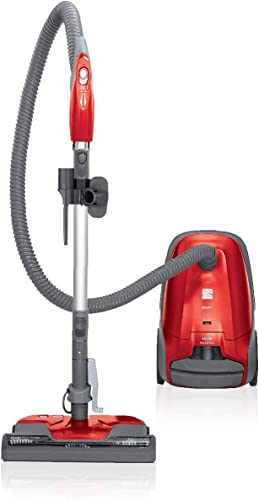


The Kenmore 81414 is the kind of bagged canister vacuum that earns its place in your cleaning closet and stays there for years. At 12 amps, it delivers serious suction across every surface type in your home — hardwood floors, low-pile carpet, area rugs, upholstery, and even your car interior. The canister design gives you the freedom to pull the powerhead anywhere without dragging a heavy upright across the room, and the red finish looks sharp without trying too hard. This is a full whole-home cleaning system, not just a floor vacuum.
The aluminum telescoping wand is one of the most practical features on this machine. It extends your reach up to 9 feet, so you're cleaning ceiling corners, crown molding, and behind radiators without a step stool or a second tool. The wand is lightweight enough that extended cleaning sessions don't fatigue your arm, and the handle detaches cleanly for furniture edges, couch cushions, and tight spaces between appliances. The cleaning path comes in at 14 inches wide, which balances coverage per pass with the agility you need to navigate chair legs and room corners.
What really separates the Kenmore 81414 from cheaper bagged competitors is the triple HEPA filtration system. Triple-layer filtration means particles, dander, pollen, and fine dust are captured inside the bag and filter stack rather than recirculated through the exhaust. If someone in your home has allergies or asthma, this feature alone justifies the purchase. Running at 120 watts of efficient power consumption, it's also gentler on your electricity bill than older high-wattage canister designs. The 400 Series attachment set rounds out the package — you get the tools to cover every cleaning scenario without buying extra accessories on day one. If you want to compare how a corded bagged machine stacks up against a cordless option, check out our roundup of the best cordless vacuums to see the trade-offs firsthand.
Pros:
Cons:
The Bissell Zing bundle is the smartest value entry in the bagged vacuum category for 2026, especially if you're outfitting an apartment, a smaller home, or a second property where you need reliable daily performance without spending more than necessary. Bissell packages the Zing canister together with replacement bags and filters, which means you're not hunting down compatible supplies after your first bag fills up — everything you need for months of cleaning comes in the box. That alone sets this bundle apart from buying the vacuum and supplies separately.
The variable suction control is one of the most useful everyday features on this machine. You dial the suction up for thick rugs and deep carpet, then dial it back for bare hardwood or delicate area rugs where full power would send lightweight items skittering across the floor. The floor-type selector switch lets you flip from carpet mode to hard-floor mode without bending down or changing attachments, so your cleaning routine stays fluid from room to room. The automatic cord rewind saves you the minute of wrestling a tangled cord back into a wrap — you press a button and the cord snaps back cleanly every time.
Above-floor cleaning performance is genuinely impressive for a machine in this price bracket. The included hose and accessories reach shelving, upholstery, stair risers, and window blinds with enough suction to pull dust and debris rather than just nudge it around. The Bissell Zing is compact and light enough to carry between floors without strain, which makes it a practical daily driver for multi-story homes where you don't want to lug a heavy canister up a staircase. If you're also dealing with pet hair on upholstery or car seats, our guide to the best vacuums for human hair covers companion tools that pair well with a compact canister like this. The Zing won't deep-clean a heavily soiled plush carpet the way a 12-amp powerhouse will, but for regular maintenance cleaning across mixed surfaces, it delivers well above its price point.
Pros:
Cons:
| Product | Price | Rating |
|---|---|---|
| Kenmore 81414 Bagged Canister Vacuum Cleaning Tools, 400 Ser | Check Amazon | |
| Bissell Zing + Replacement Bags & Filters | Check Amazon | |
Before you add a bagged vacuum to your cart, it's worth spending five minutes on the factors that actually determine whether a machine works for your home. The specs that matter most aren't always the ones listed largest on the box. Here's what to evaluate carefully before you buy in 2026.
Amperage (amps) measures how much electrical current the motor draws, and it's the closest number you have to a real-world suction indicator. A 12-amp motor like the one in the Kenmore 81414 delivers the kind of deep-cleaning pull that lifts embedded dirt from carpet fibers and handles heavy debris on hard floors. Lower-amp models, like the Bissell Zing, still perform well for regular maintenance cleaning but won't give you the same extraction depth on thick pile carpet or heavily soiled areas. If you have carpeting in most of your home and pets or kids, prioritize higher amps. If you're mostly cleaning hardwood and tile with light daily traffic, a moderate-amp machine handles the job efficiently without the extra weight or cost.
Wattage is a related spec that sometimes appears in place of amps on international or imported models. The Kenmore 81414 lists 120 watts for its motor efficiency rating — lower wattage in combination with high amps means the motor converts energy efficiently rather than burning power wastefully. When comparing two vacuums, look at both specs together rather than treating either one as a standalone quality signal.
If anyone in your household has allergies, asthma, or a sensitivity to pet dander, HEPA filtration is the single most important feature on your list. HEPA filters (High Efficiency Particulate Air filters) are certified to trap 99.97% of particles that are 0.3 microns or larger — that includes dust mite debris, pollen, mold spores, and pet dander. A standard filter won't catch particles that fine, and you end up recirculating allergens through your exhaust while you clean. The triple HEPA system on the Kenmore 81414 sets a high bar for air quality in this category.
Even on budget models, check whether the filter is washable or replaceable. Washable filters save money over time but require a drying period before reinstallation. Replaceable filters are more convenient but add an ongoing supply cost. Either option works well — just factor it into your total cost of ownership when comparing price points. For households dealing with very fine particles like construction dust, a sealed HEPA system (where the entire vacuum body is sealed around the filtration path, not just the filter cartridge) gives you the most complete protection.
Both canister and upright bagged vacuums use bags, but they behave very differently in your home. Canister vacuums separate the motor and bag unit from the cleaning head, giving you a lightweight wand that maneuvers easily under furniture, around chair legs, and along baseboards. The trade-off is that you're pulling the canister body behind you, which takes a moment to get used to. Canister designs excel at above-floor cleaning — upholstery, stairs, curtains, and car interiors — because the hose and wand system is purpose-built for that kind of flexibility.
Upright bagged vacuums keep everything in a single body and stand up on their own when you stop pushing. They're often faster for large open carpeted areas because you're driving the powerhead in straight lines across the floor. If your home is mostly carpeted and you don't do a lot of above-floor cleaning, an upright can be a more ergonomic choice. If you have mixed floors, a lot of furniture to navigate, stairs, and spaces that need above-floor attention, a canister like the Kenmore or Bissell Zing is the better tool. Consider pairing either style with the best carpet extractors for deep seasonal cleaning that goes beyond what a standard vacuum can achieve.
The bag is the consumable that defines your long-term experience with a bagged vacuum. A larger bag capacity means less frequent changes — useful in high-traffic households or when you're cleaning a large home in one session. Check that replacement bags for your chosen model are easy to find and reasonably priced before you buy. Some premium or older models use proprietary bags that are hard to source and expensive when you do find them. The Bissell Zing bundle solves this problem upfront by including replacement bags and filters in the purchase, so you're not scrambling for supplies after your first full bag.
Plan on roughly four to six bag changes per year in an average household, more if you have pets or high foot traffic. Factor the annual bag and filter cost into your budget comparison — a vacuum that costs less upfront but uses expensive proprietary bags can end up costing more over three years than a pricier model with standard, widely available supplies. Also look for bags with a self-sealing closure, which locks the opening shut when you remove the bag, so you're not showering yourself in fine dust during disposal.
Yes, bagged vacuums are the better choice for allergy sufferers in most situations. When you remove a full bag, the sealed closure keeps the collected debris and allergens locked inside rather than releasing a cloud of fine particles back into the air. Bagless vacuums require you to open the dustbin and tap it clean, which releases whatever you collected — pollen, dander, dust mite debris — directly into your breathing space. A bagged vacuum with triple HEPA filtration, like the Kenmore 81414, gives you the most hygienic dust disposal available in a residential vacuum.
Change the bag when it reaches about two-thirds to three-quarters full, not when it's completely packed. A full bag restricts airflow through the motor, which reduces suction power and puts extra strain on the motor over time. In a typical household with average foot traffic, you'll change the bag every one to three months. If you have pets, children, or a larger home, expect to change it monthly. Always check the bag after each major cleaning session — a bag that looks light may still be restricting airflow if fine dust has compacted near the intake port.
Absolutely. Both vacuums reviewed here handle mixed floor types well. For hard floors like hardwood, tile, and laminate, set the vacuum to hard-floor mode (or reduce suction if variable control is available) to avoid scattering debris instead of picking it up. The Bissell Zing's one-switch floor-type transition makes this especially convenient. For hardwood-specific cleaning, our guide to the best microfiber spray mops covers complementary tools that pair well with a canister vacuum for a complete hard-floor care routine in 2026.
A HEPA filter (High Efficiency Particulate Air filter) is certified to capture 99.97% of airborne particles at 0.3 microns in size, including dust mite allergens, pet dander, pollen, and some mold spores. A standard or foam filter captures larger debris but lets fine particles pass through the exhaust back into your room. For households with allergy or asthma sufferers, a HEPA-rated filter is essential. The Kenmore 81414's triple HEPA system layers multiple filtration stages, providing certified air quality improvement rather than just basic debris capture.
Canister vacuums typically take up more floor space than uprights because the canister body and the wand store as separate components. However, many canister designs let you wrap the hose around the body and store the wand alongside it in a closet corner. Upright vacuums stand on their own and fit neatly against a wall. If storage space is your primary concern, measure your closet before buying and check the vacuum's folded or stored footprint in the product dimensions. The Bissell Zing's compact canister body is one of the smallest in its class and stores easily in tighter spaces.
All bagged vacuums experience some reduction in airflow as the bag fills, because a fuller bag restricts the path air takes through the system. The key is to change the bag before it reaches capacity — at around 65 to 75 percent full — so airflow stays strong throughout your cleaning session. Some premium bagged models include a bag-full indicator light that signals when airflow has dropped below a set threshold, taking the guesswork out of timing. Maintaining fresh bags on a regular schedule is the single most effective way to keep peak suction performance over the life of your vacuum.
 |
 |
 |
 |

About Liz Gonzales
Liz Gonzales grew up surrounded by art and design in a New York suburb, with both parents teaching studio arts at the State University of New York. That environment sharpened her eye for aesthetics and spatial detail — skills she now applies to evaluating home products where form and function both matter. She has spent the past several years writing about lighting, home decor accessories, and outdoor living gear, with a particular focus on how products perform in real residential settings rather than showrooms. At Linea, she covers lighting fixtures and bulb reviews, outdoor and patio gear, and general home product comparisons.
You can Get FREE Gifts. Furthermore, Free Items here. Disable Ad Blocker to receive them all.
Once done, hit anything below
|
|
|
|