
Switching from incandescent to LED lighting can cut your electricity bill by up to 75 percent — and if you haven't made the jump yet, or you're upgrading to higher-output bulbs, 2026 is the year to do it right. High-lumen LED bulbs have come a long way from the harsh, buzzy lights of a decade ago. Today's top options deliver 2,600 lumens of crisp, clean light using just 23 watts of power — the kind of output that used to require a 150-watt incandescent burning hot enough to fry an egg.
Whether you're lighting a garage workshop, brightening up a dim living room, or replacing a floodlight on the back porch, the right high-lumen LED bulb makes a real difference in how a space looks and feels. The problem is that the market is flooded with options, and not all of them live up to their packaging claims. Some flicker. Some dim poorly. Some are marketed as "150W equivalent" but fall embarrassingly short of actual brightness. We've done the research so you don't have to — and we're going to be direct about which bulbs are actually worth your money. If you want to understand the science behind lumen output before diving in, check out this useful primer on how bright a lumen actually is — it'll help you make sense of the specs below.
In this guide, we've reviewed seven of the top high-lumen LED bulbs available in 2026, covering everything from Philips and GE to Sylvania and newer budget players. We'll walk you through each one honestly, break down what to look for when buying, and give you a clear winner for every use case. Let's get into it.
Contents
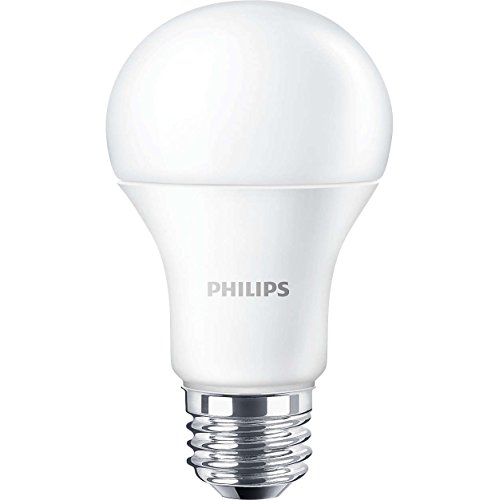




If you need a reliable workhorse bulb that delivers bright, crisp daylight color without drama, this four-pack from Philips is hard to beat. At 14 watts, each bulb pumps out 1,500 lumens at 5000K — that's pure daylight white, the kind of light that makes colors look true and detail pop. It's the color temperature used in offices, art studios, and professional kitchens for a reason. If you're replacing bulbs in a laundry room, workshop, or kitchen, this is your pick.
Philips has been making bulbs for over a century, and the quality control here shows. These A19 bulbs are rated for 10,000 hours of life — or about 10 years at three hours per day — and they use roughly 87 percent less energy than the 100-watt incandescents they replace. The frosted finish diffuses the light beautifully so you won't see harsh hotspots. The E26 medium screw base is universal, so they'll fit virtually any standard fixture. They don't dim, which is a real limitation if you want flexibility, but if you just need consistent bright light, that's not a trade-off you'll feel.
The four-pack pricing makes these a smart bulk buy for a whole room refresh. Compared to single-pack options in this lumen range, Philips consistently delivers better color accuracy (high CRI) and longer rated lifespan. You're paying for reliability. For task-heavy environments where color fidelity matters — matching paint swatches, reading fine print, food prep — the 5000K daylight output is genuinely superior to warm-white alternatives.
Pros:
Cons:
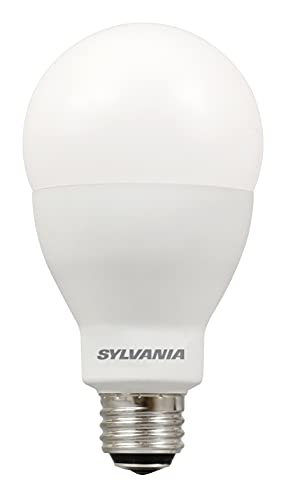
This is the power hitter of the standard bulb category. The Sylvania A21 at 23 watts delivers a staggering 2,600 lumens — that's the brightness of a traditional 150-watt incandescent, squeezed into a standard A21 bulb that fits most medium-base fixtures. And it's dimmable, which puts it in a different league from a lot of high-output competitors. If you have one bulb in a large room's central fixture and you need it to do all the heavy lifting, this Sylvania is the answer.
The 5000K daylight color temperature produces a neutral, energizing white that's ideal for rooms where you want alertness and visibility — think home offices, garages, and kitchens. Unlike some bulbs that claim daylight but drift slightly yellow under load, Sylvania's color consistency is solid. Instant-on performance with zero warm-up delay is another genuine plus here. You flip the switch and the room is immediately full of light. There's nothing subtle about 2,600 lumens — it transforms a dim space dramatically.
One thing to note: the A21 form factor is slightly larger than a standard A19, so check your fixture's harp and shade clearance before ordering. Lampshades that fit flush to the bulb may need to accommodate the extra size. That said, in open fixtures, pendants, and ceiling cans without shades, this bulb is near-perfect. The dimmability is smooth with most standard dimmers, though as always, pairing with a quality LED-compatible dimmer is recommended for best results. For comparison, if you're looking for similarly powerful directional lighting options outdoors, our guide to best solar lights covers a parallel set of performance considerations.
Pros:
Cons:

GE's Ultra Bright series in the four-pack configuration makes a compelling case for anyone lighting a large living area, open-concept floor plan, or high-ceiling space. The soft white color temperature — warmer than the daylight options above — gives rooms a comfortable, welcoming glow rather than the clinical brightness of 5000K. If your priority is ambience alongside raw output, GE's soft white positioning is a smart call. This is the bulb you want over a dining table or in a floor lamp that anchors your living room.
GE's brand reliability is well established, and these bulbs reflect that. The build quality is solid, the light output is consistent across the four bulbs in a pack, and the A21 form factor delivers that 150W-equivalent brightness without running hot. Large spaces benefit enormously from this kind of distributed high-lumen lighting — replacing four dim 60W equivalent bulbs in a single room with four of these transforms the entire atmosphere. For security lighting outdoors, a similar principle applies, and it's worth thinking about whether you want omnidirectional bulbs like these or a more directional solution.
The one gap in GE's product information here is the lack of published lumen specifications on the Amazon listing. That's frustrating from a buyer's perspective. Based on category norms and user feedback, the output aligns with other 150W-equivalent A21 bulbs in the 2,000–2,600 lumen range, but GE should be more transparent about this. For environments where you're comparing exact lumen output between competitors, that opacity is a minor annoyance. Still, the combination of GE's reputation, four-pack value, and soft white color makes this an excellent choice for living spaces.
Pros:
Cons:
Energetic Smarter Lighting doesn't have the name recognition of Philips or GE, but their 150W equivalent A21 bulb is a genuine contender — especially if you want a dimmable high-lumen option at a lower price point. At 20 watts producing 2,600 lumens in 5000K daylight, the core specs match the Sylvania A21 almost exactly. The differentiator is value: the two-pack format comes in at a competitive price, and the dimming range — from 10% to 100% — is impressive for this price bracket.
UL Listed and Damp Rated are two specs that matter more than many buyers realize. UL certification means the bulb has passed third-party safety testing, not just manufacturer claims. Damp rated means you can safely use these in bathrooms, covered porches, laundry rooms, or anywhere moisture may be present without voiding safety standards. That combination of dimmability, high output, and damp rating makes this one of the most versatile bulbs on this list. The E26 standard base fits virtually any household fixture.
The main caveat is compatibility: these are not compatible with smart dimmers or 3-way touch lamps. If you're using a standard leading-edge or trailing-edge dimmer, you'll be fine. But if your home runs smart lighting controls like Lutron Caseta or Leviton Decora Smart, do your homework before ordering. At the rated 15,000-hour lifespan, you're looking at roughly 13.7 years of daily use — genuinely impressive longevity that offsets the cost of the two-pack format. For the price, you'd be hard-pressed to find a dimmable 2,600-lumen bulb from a more established brand.
Pros:
Cons:
Maelsrlg is a newer name in the LED space, but their 4-pack of 150W-equivalent A21 bulbs earns a spot on this list for one clear reason: value. At 21 watts and 2,500 lumens per bulb in a warm 3000K color temperature, you're getting near-class-leading brightness in a tone that works beautifully in living rooms, bedrooms, and dining areas. The four-pack format means you can light an entire room for a surprisingly low per-bulb cost, and the 25,000-hour rated lifespan — the longest on this list — gives real confidence in the long-term proposition.
The flicker-free technology is worth calling out specifically. Flicker is one of the most under-discussed quality issues in cheaper LED bulbs. You may not consciously see it at standard frequencies, but studies have linked high-frequency flicker to eye strain and headaches during extended exposure. Maelsrlg claims rigorous zero-flicker testing, and the mercury-free, instant-on design rounds out a solid spec sheet. For a household with multiple rooms to light, the math on a 4-pack at this lumen output is genuinely compelling.
The trade-off is dimmability — or the lack of it. These are non-dimmable, which rules them out for fixtures on dimmer circuits. The 3000K warm white tone also won't satisfy anyone looking for that crisp daylight look for task-oriented spaces. But if your goal is to flood a living room, bedroom, or home office with comfortable, flicker-free, high-output warm light at a per-bulb cost that won't sting, Maelsrlg delivers. This is the pick for budget-conscious buyers who want to do a whole-home upgrade without breaking the bank. Browse the full lighting category for more options across different fixture types and use cases.
Pros:
Cons:
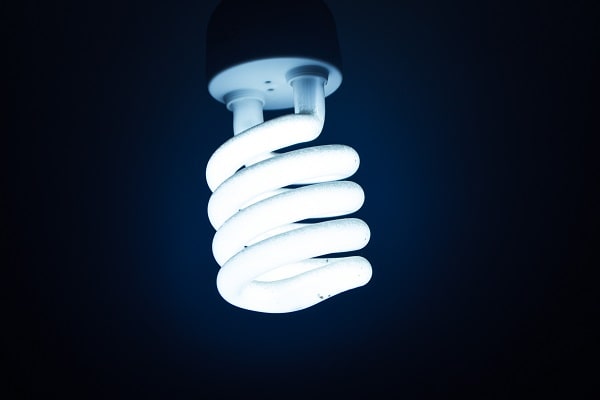
Every other bulb on this list is an omnidirectional A21 or A19 — the Night Chaser PAR38 is an entirely different animal. This is a directional flood bulb designed for outdoor security fixtures, recessed can lights, and landscape spotlights. At 25 watts producing 2,650 lumens in a 3000K neutral white beam, it replaces a 250-watt halogen floodlight and does it with 87% less energy. If you've been living with yellowed, hot-running halogens in your outdoor fixtures, upgrading to this Sylvania is one of the most satisfying lighting improvements you can make.
The spec that matters most for outdoor use is the wet rating — and the Night Chaser delivers. Wet-rated and Energy Star certified, it's built to handle direct rain exposure without failing. The 25,000-hour rated lifespan translates to roughly 22 years in typical outdoor use, meaning once you install it, you're very likely done climbing that ladder for a long time. The dimmability adds flexibility if you're running it on a smart home system or a manual dimmer on your outdoor porch circuit.
The 3000K neutral white is warmer than pure daylight but brighter and crisper than the soft warm bulbs you'd put in a living room — it hits the sweet spot for outdoor security and accent lighting. If you're also looking for work-site or heavy-duty area lighting options, our roundup of the best work lights covers similar high-output scenarios with purpose-built fixtures. For straight residential floodlight replacement, the Night Chaser is the clear winner on this list. Nothing else here is designed for this application.
Pros:
Cons:
Not everything on this list needs to maximize raw lumen output. Sometimes what you need is a beautifully dimmable bulb with excellent color quality that creates the right mood in a bedroom, dining room, or reading nook. Philips' Ultra Definition series in 2700K soft white does exactly that. At 13.5 watts producing 1,600 lumens — the equivalent of a 100-watt incandescent — these bulbs strike a balance between meaningful brightness and warm, comfortable light that modern LEDs often struggle to get right.
The dimming performance on these Philips bulbs is exceptional. Smooth dimming down to 10% of full light levels means you can go from bright working light to a soft atmospheric glow in the same fixture. The flicker-free design is particularly important for dimmed use, where cheap LEDs often strobe visibly at lower power levels. The 15,000-hour lifespan and indoor/outdoor wet location rating make these one of the most versatile bulbs on the list despite their moderate lumen output.
The two-pack format hits a reasonable price point for a premium Philips product. For bedside lamps, sconces, pendant fixtures over a dining table, or any application where you'll be running a dimmer regularly, these are our recommendation. The 2700K color temperature is also the warmest on this list — closer to the amber glow of old incandescents — so if you're one of the many people who miss the way a room felt under traditional bulbs, this is your answer. According to the U.S. Department of Energy, LED lighting uses at least 75% less energy and lasts 25 times longer than traditional incandescent lighting — and Philips' Ultra Definition bulbs are a prime example of that technology done right. Also see our guide to the best desk lamps for studying if you're pairing a high-quality bulb with a purpose-built fixture for focused work.
Pros:
Cons:
If you're still shopping for light bulbs by wattage, you're using outdated logic. Watts measure power consumption, not brightness. Lumens measure actual light output — and that's the number that matters. A modern 20W LED produces the same 2,600 lumens as a 150W incandescent. Once you make this mental shift, comparing bulbs becomes much simpler. As a rough guide: 800 lumens replaces a 60W incandescent, 1,100 lumens replaces 75W, and 1,600+ lumens gets you into 100W territory. Anything above 2,000 lumens is genuinely high output for a single standard-base bulb. Always shop by lumens, not watts — it's the only number that tells you how bright your room will actually be.
Color temperature is measured in Kelvin (K) and determines whether a bulb feels warm and cozy or cool and clinical. Lower numbers (2700K–3000K) produce a warm amber-tinged white similar to old incandescents — great for bedrooms, dining rooms, and living spaces where comfort and ambience matter. Higher numbers (4000K–5000K) produce a crisp, neutral-to-blue-white that's energizing and ideal for task-focused environments: kitchens, garages, workshops, and offices. Most of the bulbs on this list come in either 5000K daylight or 2700K–3000K soft white. Match the color temperature to the room's purpose, not just personal preference.
Not all LED bulbs are dimmable, and not all dimmable LED bulbs work with all dimmers. This is one of the most common sources of buyer frustration in 2026. If you have dimmer switches — or plan to install them — only consider bulbs explicitly labeled as dimmable. Then check the dimmer compatibility. Older incandescent-style leading-edge dimmers often work poorly with LEDs. Modern LED-compatible dimmers from brands like Lutron or Leviton are strongly preferred. If you're using smart home dimmers, double-check compatibility before buying, as some LED bulbs explicitly call out incompatibility with smart controls. A flickering or buzzing dimmable bulb is almost always a dimmer mismatch, not a defective bulb.
The shape of the bulb matters practically. A19 is the classic standard bulb shape — slightly smaller, fits almost every residential fixture. A21 is larger in diameter and length, used for high-output bulbs that need more space to dissipate heat. Most fixtures accommodate A21, but enclosed fixtures and tight lampshades may not — always check clearance. PAR38 is a directional flood bulb for recessed cans and outdoor security fixtures — it's not interchangeable with A19/A21. Beyond shape, pay attention to wetness ratings: if you're installing a bulb anywhere near moisture (outdoor fixtures, bathrooms, laundry rooms), look for damp-rated or wet-rated certification. UL Listing is a meaningful safety credential that signals third-party testing.
In practical terms, a high-lumen LED bulb produces 1,500 lumens or more — equivalent to a 100-watt incandescent or higher. The bulbs on this list range from 1,500 to 2,650 lumens. The higher the lumen count, the brighter the light output. For reference, a typical living room needs roughly 1,500–3,000 lumens total, depending on size and ceiling height.
Yes, as long as you match the bulb's wattage to your fixture's maximum wattage rating. Because these LEDs use 14–23 watts to produce what used to require 100–150 watts, they run far cooler than the incandescents they replace. A 23W LED in a fixture rated for 100W incandescent is perfectly safe — you're dramatically under the thermal threshold. Just check the label inside your fixture's socket and make sure the bulb's wattage is at or below that number.
This is where people get confused. Your lamp's wattage rating refers to actual power draw, not equivalent brightness. A 150W equivalent LED bulb only draws 20–23 watts of actual power. If your lamp is rated for 60W, a 23W LED bulb is well within that limit and completely safe to use. You'll get dramatically more brightness without any risk to your fixture.
For focused work, 4000K to 5000K (neutral to daylight white) is the most effective range. These cooler color temperatures promote alertness and reduce eye fatigue during extended screen time. The Philips A19 (5000K) and Sylvania A21 (5000K) on this list are both excellent home office choices. If you want flexibility, a dimmable 5000K bulb gives you the ability to drop brightness and color intensity in the evenings to support a natural sleep cycle.
Rated lifespans on this list range from 10,000 to 25,000 hours. At 3 hours of use per day, that translates to roughly 9 to 22 years. Real-world lifespan depends on heat management (enclosed fixtures shorten LED life), power quality, and dimmer compatibility. Brand-name bulbs from Philips, GE, and Sylvania tend to meet their rated lifespans more reliably than unbranded competitors. The Maelsrlg bulbs on this list carry the longest rated lifespan at 25,000 hours — impressive if it holds up over time.
Generally, no. The 5000K daylight spectrum is stimulating and cool — it suppresses melatonin production and can make it harder to wind down before sleep. For bedrooms, 2700K to 3000K warm white is the better choice. The Philips Ultra Definition (2700K) and the Maelsrlg 4-pack (3000K) on this list are designed specifically for warm, relaxing residential light. Save the 5000K bulbs for kitchens, workshops, bathrooms, and home offices.
 |
 |
 |
 |

About Liz Gonzales
Liz Gonzales grew up surrounded by art and design in a New York suburb, with both parents teaching studio arts at the State University of New York. That environment sharpened her eye for aesthetics and spatial detail — skills she now applies to evaluating home products where form and function both matter. She has spent the past several years writing about lighting, home decor accessories, and outdoor living gear, with a particular focus on how products perform in real residential settings rather than showrooms. At Linea, she covers lighting fixtures and bulb reviews, outdoor and patio gear, and general home product comparisons.
You can Get FREE Gifts. Furthermore, Free Items here. Disable Ad Blocker to receive them all.
Once done, hit anything below
|
|
|
|